Bone Flute
Source: Edit: Time:
2006.06.20 08:00:00
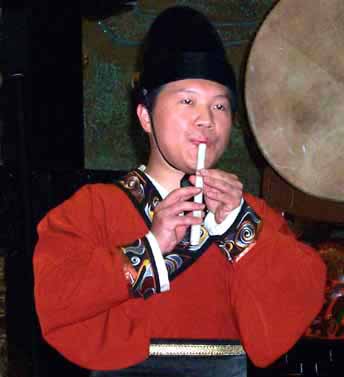
Bone Flute: The Neolithic Age, unearthed with the Relics of Jiahu, Wuyang.
“Whose jade flute is secretly playing the melody, which is dispersed into the spring breeze of Luoyang?
Willows are implied in the night, so nobody can pass by without missing his hometown.”
The Bone Flute, produced some 8,000 years ago, is made from the limb bone of a crane. The flute is commonly 20cm in length, and some 1cm in caliber. Its form is fixed, and the craftsmanship is standard. At one side are 7 perforated sound holes with almost identical intervals. Another smaller, attuning hole is between hole 6 and hole 7 and is closer to hole 7, indicating the complex of sound production was known to the flute maker.
According to the measurement, the Bone Flute is able to perform the
Chinese Cabbage, folk song of Hebei Province. Research shows that the structure of the Bone Flute, found at Jiahu, is at least able to sound a hexachord, and may be the ancient “Xia Zhi” scale of seven notes. There is also possibility: The flute was part of an ensemble performance. Unearthing the Bone Flute has furthered the historical knowledge of music from the Xian Qin period to the flute’s emergence; the history of ancient Chinese music deserves further attention and assessment. Without a doubt, the Bone Flute, at Jiahu, is the earliest instrument ever discovered.
The Bone Flute, fabricated some 8,700 years ago, is made from the limb bone of a crane, and is perforated with seven holes. According to the measurement, it is already provided with the heptatonic scale and able to perform today’s melodies.