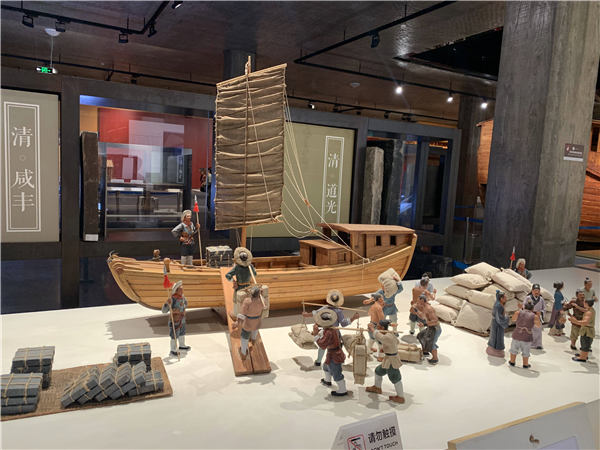
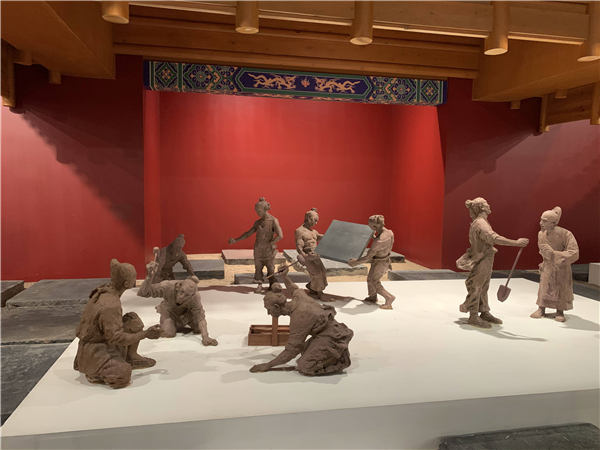
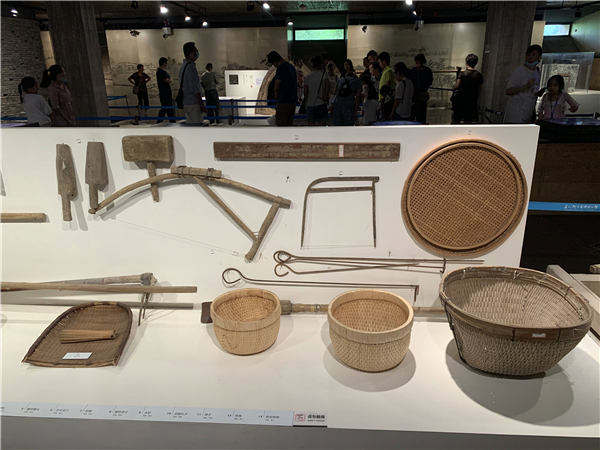
The exhibits on display at the Suzhou Museum of Imperial Kiln Brick offer a vivid and panoramic view of the age-old craft of brickmaking. Highlights include imperial bricks dating to the Qing Dynasty (1644-1911), replicas of tools, a miniature model of a kiln, and pottery figurines that demonstrate the production and transportation processes. [Photo provided to China Daily]
An ongoing exhibition shines a light on the historical significance of imperial kilns in China, Wang Hao and Zhang Lei report in Suzhou, Jiangsu.
By Wang Hao and Zhang Lei | China Daily | Updated: 2020-09-18 07:40
The courtyard of the Suzhou Museum of Imperial Kiln Brick has many old kilns shaded by tall trees, with the ground covered by thick grass. The museum opened in Suzhou's Xiangcheng district in 2016.
Few know that bricks were transported from the city in today's Jiangsu province along the Grand Canal during the Ming Dynasty (1368-1644) to lay the foundations of the Forbidden City and Temple of Heaven in Beijing.
The tiles on the floor of the Forbidden City were made with bricks from Suzhou's imperial kilns-a high-standard paving material used only for the royal families of the Ming and Qing (1644-1911) dynasties-and each brick is about 67 cm by 67 cm and weighs about 20 kilograms.
The bricks are smooth because of exquisite craftsmanship. A popular saying goes, "bright as a mirror, and sounding like a chime".
This type of brick is known as jin zhuan (golden brick). One theory ascribes its name to the fine grains and dense texture that reflect a golden color under the sun.
But according to many scholars, the name originated from jing zhuan (capital brick) for its exclusive use in the imperial palace and then gradually evolved to jin zhuan, as jin and jing are homophonic.
One such imperial brick is currently on show at Everlasting Splendor: Six Centuries at the Forbidden City, an exhibition being held at the Palace Museum in Beijing, the site of the former Forbidden City, to celebrate the 600th anniversary of the completion of its construction.
Four experts from the Palace Museum and two professionals in charge of brick-packing visited the Suzhou museum for the handover ceremony in late August.
Shen Quannan, director of the Suzhou museum's research department, says the exhibition will "raise public awareness about the bricks' significance".
The 59 kg, 420-year-old "fine-material square brick" from the reign of emperor Wanli is the most complete piece of all Ming imperial bricks preserved at the Suzhou museum, with inscriptions recording names of the potters, construction officials and supervisors still visible on its sides.
The Suzhou museum boasts a collection of 1,458 imperial bricks from the Yongle period of the Ming Dynasty to the Xuantong period of the Qing Dynasty. It covers an area of 38,875 square meters, including the building area of 15,087 square meters.
Designed by architect Liu Jiakun, the museum aims to protect cultural relics through architectural organization and showcases the historical and cultural connotations of its exhibits.
The lobby on its second floor displays the process of imperial brickmaking, from firing to transportation.
Visitors can touch the exhibits and learn more about the brick culture. There is also an imitation kiln patio on this floor with a narrow crack in an exhibited wall at the entrance that one can squeeze through.
The third floor presents the restoration models of some palaces and buildings that have been made with the bricks since the Ming and Qing dynasties. The names of hundreds of craftsmen are written on an illuminated wall.
In July 2019, the Suzhou museum donated some imperial bricks to the French Architectural Heritage Museum at Place du Tertre in Paris to mark the 55th anniversary of the establishment of diplomatic relations between China and France.
The museum is located on the west bank of Yangcheng Lake, where the mild soil has given the bricks a texture "different from other places in the country", Shen says. The area has since been the only source of bricks used in the interior works of the Forbidden City until the end of the Qing Dynasty.
"For the imperial brick, its noble status is not only an honor but also a burden. After the end of China's feudal monarchy in 1912, the bricks were no longer needed, and the craftsmanship dissipated among the people," Shen says.
In the 1980s, Jin Meiquan, a bricklayer whose family made imperial bricks for generations, restored the old method of making imperial bricks and brought them back to life.
His team worked on the porch of Kunning Gong (Palace of Earthly Tranquility) at the Forbidden City in the early 1990s. They haven't sustained major wear and tear, even though millions of visitors have walked on them.
"It has been difficult for ordinary people to gain access (to the imperial kiln), except to see the bricks used at the Forbidden City as building materials, and a small number of private collections and furnishings," says Shen, the Suzhou museum official.
He says ordinary people should feel a connection with the culture.
In recent years, the museum has recruited young people to form a creative development team with the aim of inheriting and innovating upon brick pottery crafts and culture.
For example, brick boards are made into tea tables and desktops that help to highlight the practical value of the imperial bricks in a modern social context.
The museum plans to cooperate with some universities to jointly cultivate talent for the inheritance of brickmaking techniques, and at the same time, "to develop more derivatives" that meet the needs of ordinary people.