A few records exist about timepieces like bronze clepsydras of the Han Dynasty: the clepsydra in the official residence of the Han Prime Minister, which is recorded in Kao Gu Tu by Lü Dalin of the Northern Song Dynasty; the Han bronze clepsydra with silver-inlaid pattern of a horse-drawn carriage, which is recorded in Rong Geng's Song Zhai Ji Jin Tu Lu; four pieces founded during archaeological excavation.
The clepsydra in the Prime Minister's official residence, which belonged to Su from Danyang, recorded in Kao Gu Tu by Lü Dalin of the Song Dynasty (Fig. 8)
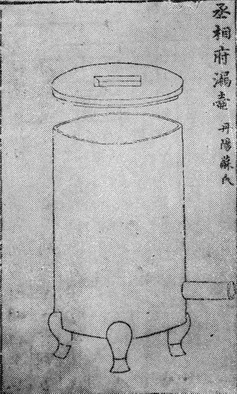
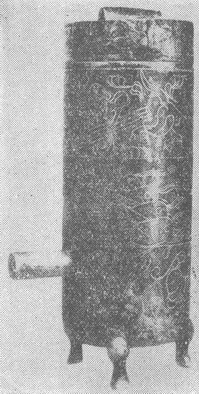
Fig.8 Fig. 9
Fig. 8 The clepsydra in the Prime Minister's official residence
Fig. 9 Han bronze clepsydra with silver-inlaid pattern of a horse-drawn carriage
Han bronze clepsydra with silver-inlaid pattern of a horse-drawn carriage, recorded in Rong Geng's Song Zhai Ji Jin Tu Lu (Fig. 9)
The bronze clepsydra from a Han tomb in Mancheng, unearthed from the tomb of Liu Sheng (Prince Jing of Zhongshan) of the Western Han Dynasty in Mancheng, Hebei Province in 1968; overall height: 22.4 cm (Fig. 10)
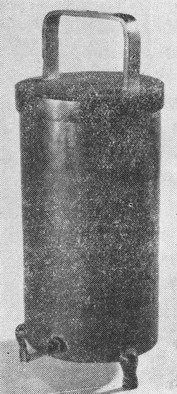
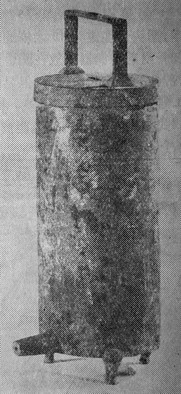
Fig.10 Fig.11
Fig. 10 Bronze clepsydra from a Han tomb in Mancheng Fig. 11 Bronze clepsydra from Xingping
Bronze clepsydra from Xingping, unearthed from a Western Han tomb in Xingping County, Shaanxi in 1958; overall height: 32.3 cm (Fig. 11)
Qianzhang bronze clepsydra, unearthed in Hangjin Banner, Yikezhao League, Inner Mongolia in 1976; overall height: 47.9 cm (Fig. 12, 13, 14)
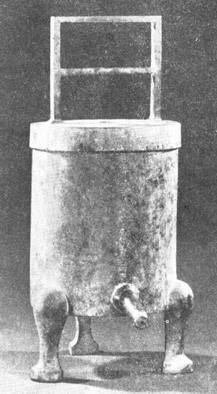
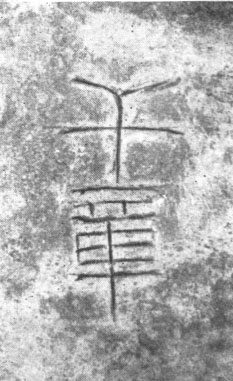
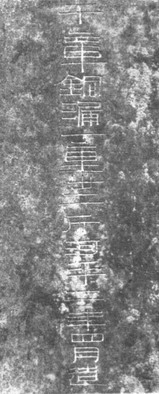
Fig.12 Fig.13 Fig.14
Fig. 12 Qianzhang bronze clepsydra
Fig. 13 The inscription cast on the inner bottom
Fig. 14 The inscription on the exterior
Juye bronze clepsydra, unearthed from a Western Han tomb on Hongtu Hill in Juye County, Shandong Province in 1977; overall height: 79.3 cm (Fig. 15, 16)
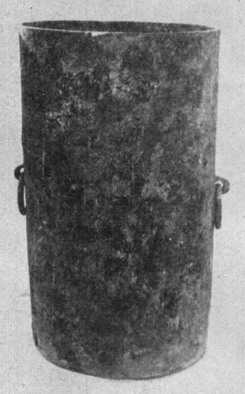
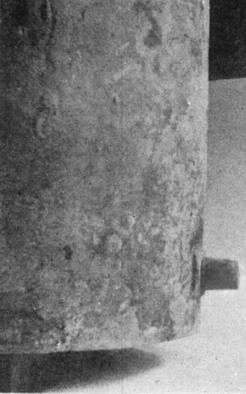
Fig. 15 Juye bronze clepsydra Fig. 16 Juye bronze clepsydra (detail)
The six clepsydras above fall into two categories. The first five are single-stage outflow clepsydras and are similarly designed; Juye clepsydra belongs to a different category and is probably a vessel for supplying water. The clepsydra in Henan Museum differs from the former five clepsydras in the handle, the extra tube for holding the indicator rod, and the position of the hole for putting the rod inside (the hole for each of the former five in the center, while the hole for the one in Henan Museum at one side on the top). However, these differences do not alter the functions of its various parts, so it can serve as a single-stage outflow clepsydra. Yet it should be noted that none of the other five clepsydras has a groove in the handle that is connected to the inside of the main body. The hole in the upper part of the vessel can be used for the inflow of water, which suggests that the vessel could be the middle one of multi-stage water-receiving tanks. The two-stage clepsydra used by Zhang Heng of the Eastern Han Dynasty was the oldest multi-stage clepsydra recorded in the history. Thus, despite the characteristics of Western Han single-stage clepsydras, the bronze clepsydra in Henan Museum may serve as one stage in a clepsydra of two or more stages, indicating that it probably dates from the Eastern Han Dynasty.

Compared with other Han clepsydras, this bronze clepsydra is ingeniously designed, which seems unnecessary so far as its function is concerned. Why, then, was it designed so? Besides, it is the smallest of all the Han clepsydras known so far. That is to say, the time it can measure is the shortest. On what occasions calling for the measurement of a short time would it be used?
Your answer please, if you have any questions or answer, please fell free to send us email, we are waiting for your answer and participation, and your comments or answers will be highly appreciated. We will select and publicize the most appropriate answers and comments in the proper time.
Weekly Selection Email: meizhouyipin@chnmus.net
The clepsydra (or water clock) was an ancient timepiece used in such civilized countries as China, Egypt and Babylon. The Chinese clepsydra, called kelou, jianlou or tonghu dilou, consists of a vessel with a spout (lou) and a graduated arrow (ke). It can be classified into the inflow type and the outflow type, depending on the vessel, which can serve to drain or receive water.
The oldest clepsydra can be traced back to the time of the Yellow Emperor. Most of the records about clepsydras of the Xia, Shang and Zhou Dynasties concern military affairs or funerary rituals, so there is no knowing if they were used by common people at that time. There are relatively abundant records about clepsydras dating from the Qin and Han Dynasties or later ages, which not only describe the materials, weights and sizes of such instruments, but also touch upon the political system and official institutions as well as time-measuring practices and related stories among the common people. This indicates that the clepsydra might have spread from the military or ritual area to the common people during the Qin and Han Dynasties.
The clepsydra measures time with water or sand. Most of the early ones used water, so their precision depended on the evenness of the water flow. They mostly consisted of a single vessel so that the speed of water flow would be affected by the water level. The change in water level would cause a change in pressure, so that the water could not flow out at a constant speed, leading to low precision. During the late Western Han Dynasty or the early Eastern Han Dynasty, the multi-stage inflow clepsydra was invented, in which several tanks were arranged one on top of another, each supplying water to the one beneath it. This could ensure a relatively constant water level in the last tank, from which the water would flow at a relatively even speed. The single-stage outflow clepsydra was soon outdated after the appearance of the multi-stage clepsydra which was made for higher precision.
Historical records indicate that Zhang Heng of the Eastern Han Dynasty started to use the two-stage clepsydra, which consisted of one water-supplying tank and another one for receiving and discharging water (the bottom tank is usually not included in the counting of the stages of a clepsydra). The three-stage clepsydra appeared in the Jin Dynasty, and the four-stage clepsydra was designed by Lü Cai in the Tang Dynasty. In the Northern Song Dynasty, Yan Su invented a new type of multi-stage clepsydra known as the lotus clepsydra, in which a hole was made in a special position in the upper part of the middle tank so that the water from the tank above would automatically discharge if it rose above the hole. Thus the water level in the middle tank would be constant, and the water would flow out at an even speed. The lotus clepsydra was popular across the country in the Northern Song Dynasty. At present, the National Museum of China has a three-stage clepsydra in its collection, which dates from the third year of Yanyou period in the Yuan Dynasty, while the Palace Museum has a four-stage clepsydra in its collection, which dates from the fourth year of Jiaqing’s reign in the Qing Dynasty. Apart from water clocks, there were hourglasses using sand, the incense clock (xiangzhuan zhong) using incense, and wooden clocks using copper balls (this category also includes gundan, xingwanlou, and beilou). With the introduction of Western clocks in the Qing Dynasty, all the traditional timepieces were gradually abandoned.
This ingeniously designed vessel has a special shape and is exquisite in many unexpected ways.
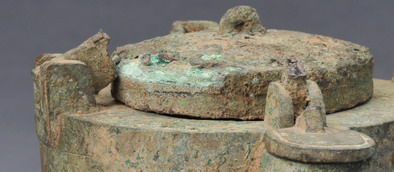
First, whereas the lid was linked to the body with a chain in most of the earlier bronze vessels, the lid of this vessel is connected to the body with an axle. Both the main lid and the ancillary lid of the extra tube attached to the front are connected to the main body in this way. Such connection is much more secure. Moreover, it can effectively prevent the lids and the body from being damaged by knocking against each other (Fig. 1 & 2).
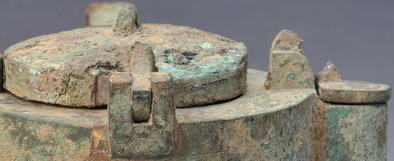
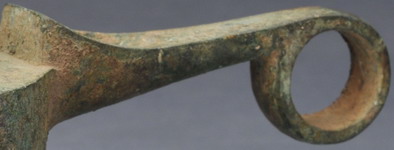
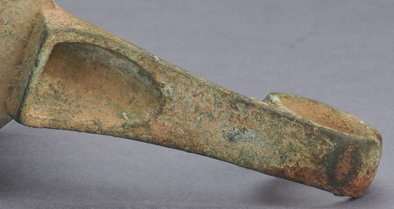
Second, the handle serves multiple purposes. Firstly, the oval ring enables the vessel to be hung when put into storage (Fig. 3). Secondly, the groove near the body makes it easy to hold the vessel steadily. Thirdly, the groove, which leads into the inside of the vessel, can serve as a water channel. This has broadened the use of the vessel, which can serve as either a single outflow clepsydra or a multi-stage inflow clepsydra (Fig. 4).
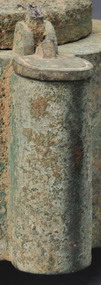
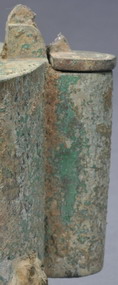
Third, there is an extra tube for accessories. Attached to the front of this vessel is a semi-cylindrical tube topped by a semi-circular lid, which is also fastened by an axle. The bottom is on the same level as the bottom of the main body. The inside of the tube is separate and isolated from the inside of the main body, but both are of the same height. It is assumed that the tube serves to hold accessories such as a graduated indicator rod and a float (Fig. 5 & 6).
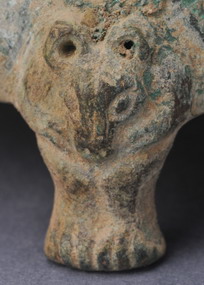
Fourth, there are three vividly shaped feet. The three animal-shaped feet are identical. Each lowers its head slightly and supports it with its two arms, with its legs in a half squat, as if it were thinking or waiting. The overall effect is a charming innocence and great loveliness (Fig. 7).
In a word, principles of mechanics are implied in the way the lids are connected to the body by axles and the design of the groove in the handle; the connection of the groove to the main body apparently serves to hide the inflow hole so that the vessel can be a single outflow clepsydra, yet it also conceals the vessel's function as one stage in a multi-stage clepsydra. The existence of this function not only proves that inflow clepsydras of two or more stages had already appeared at that time, but also indicates that clepsydras like this one played a transitional role during the progress from single stage to multiple stages. Moreover, the vividly shaped feet reflect the superb artistry of its maker.
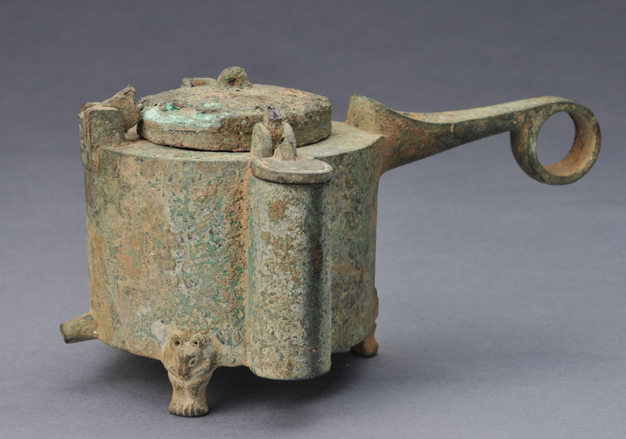
The clepsydra has a cylindrical body and a dome-like lid with a semi-circular knob. The body features a flat top, straight belly, a flat bottom, and three short animal-shaped feet. There is a tubular spout on the lower left near the bottom and a handle on the upper right near the top. At one end of the handle is a groove leading to the inside of the vessel; at the other end is an oval ring. There is an extra tube attached to the front of the vessel and a square hole on the edge of the top at the back. The whole vessel is plain except for the animal-shaped feet.