In the ancient literature there are a limited number of references to Jiao, involving ritual, volume, vessel combination, etc. Based on the accounts of the available literature, Jiao may be concluded as a vessel with a relatively bigger volume, that was used, together with other wine containers such as jue (another type of wine vessel with the same pronunciation) and zhi combined in proportion, in sacrifice or feasts by people in the light of their social status.
An Illustrated Catalogue of Antiquities of the Song dynasty is the first book that identified the real object as Jiao, as recorded in the ancient literature, and so named it. In fact, the denomination of Jiao, which is categorized as bronze ware, is a legacy handed down from our Song ancestors. Although inscriptions may be seen on other unearthed vessels of the same category, these inscriptions are all obscure rather than specific, which makes it hardly possible for the present-day researchers to ascertain whether or not these vessels are the jue referred to in the ancient literature. The physical characteristics of the unearthed objects differ so considerably from what is recorded in the ancient literature that they should not be identified as the same category at all.
As a matter of fact, there are still different opinions upon the form distinction methodology of the vessels that have been denominated as Jiao. In his treatise The Chinese Bronzes, Mr. Ma Chengyuan classifies into Jiao category those spouted, Jiao-shaped vessels of the Xia dynasty that mimicked pottery ones. Another book, A Study on Bronzes of Xia, Shang and Zhou written by Mr. Chen Peifen, refers to vessels of this kind as jue. However, Mr. Zhu Fenghan does not list those vessels in either Jiao or jue category in his book entitled A Comprehensive Study of Chinese Bronzes. In other bronze-related books or catalogs there also exists such phenomenon of similar objects having different names – they all look so much like Jiao or jue in appearance that it’s no easy job to distinguish them. I myself opt to approve of Mr. Ma’s idea concerning the categorization of spouted vessels.
Jiao, as the identifying word by which this type of bronze vessels is called, has the same pronunciation as jue, and functioned as a warming vessel among the wine containers of Shang and Zhou dynasties. Mr. Rong Geng comments, in his A General Study on Bronzes of Yin and Zhou, Jiao‘with three legs on the bottom, and usually with a lid, was convenient to place on fire to warm up wine, hence a wine warming vessel as was the jue.’ What remains unsettled is whether or not Jiao and jue are exactly the same, or slightly varied in functionality.
The earliest Jiao to-date is the spouted Jiao of the late Xia period deposited in the Shanghai Museum. Only seen in the book A Compilation of Bronzes of the Yin & Zhou Dynasties Plundered by American Imperialists from Our Country, Jiao dating to the early Shang dynasty is quite typical of those early Shang vessels, however this vessel has sculpted inscriptions of Fujia on the interior of the side handles, which differs greatly from the contemporary bronzes that used to bear clan emblem as their inscriptions, leaving a lot of room for fact checking concerning the authenticity of this vessel’s inscriptions. Jiao reached its heyday during the period from the late Shang dynasty to the early Western Zhou era, and disappeared thereafter. There exists only a humble number of passed down and excavated Jiao, if compared with that of other type bronzes.
Whilst the number of existing bronze Jiao, be it passed down from the past or excavated, is relatively limited, those that have been handed down or dispersed among private individuals or to overseas as a result of illegal excavations outnumber those that have been discovered through scientific archaeological excavations, adding up to the fact that it is a much more difficult task to conduct comparative study on the Jiao vessels.
Fig. 5: Bronze Guanliu Jiao (Jiao with slanted spout) of the late Xia dynasty excavated in Luoning, Henan 1980; height: 21cm, mouth length 11.5cm.
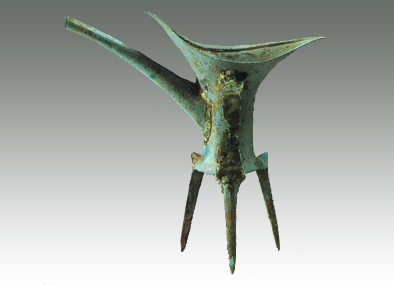
Fig. 6: Bronze Guanliu Jiao (Jiao with slanted spout) of the late Xia dynasty retrieved at a recycling center and now kept in the Shanghai Museum; height 21cm, mouth length 16.3cm.
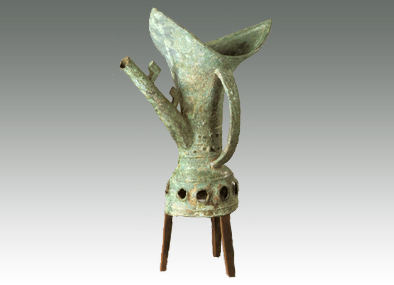
Fig. 7: Bronze Jiao dating to circa upper layer period of Erligang culture as recorded in A Compilation of Bronzes of the Yin & Zhou Dynasties Plundered by American Imperialists from Our Country; height 15cm, width 11.5cm.
Fig. 7
Fig. 8: Bronze Jiao of the late Shang dynasty, said to be unearthed at Anyang and now kept in the Ashmolean Museum of Art and Archaeology, Oxford University, UK; height 195cm.
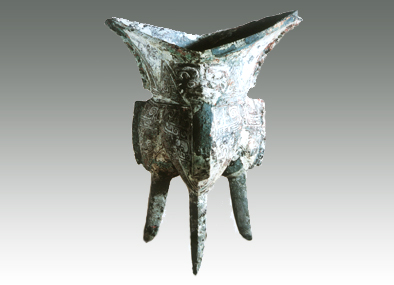
Fig. 9: In 1990, ten specimens of bronze jue of the late Shang dynasty were excavated from Tomb M160 at Guojiazhuang, Anyang, Henan, which are basically alike with respect to structure, ornament, inscription and dimension. Of the examples M160-143: 21.6cm in height with wing width of 16.8cm.
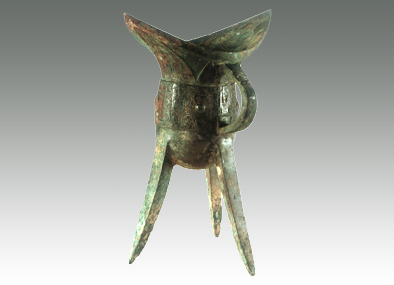
Fig. 10: A bronze Jiao of the late Shang preserved in the National Palace Museum, Taipei; height 23cm, spout width 18.3cm.
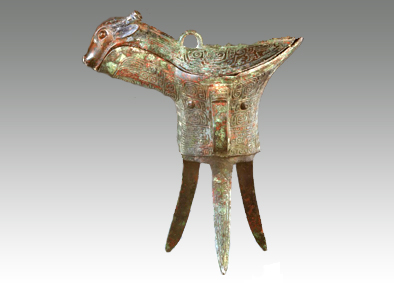 Fig. 10
Fig. 11: Bronze Jiao of the early Western Zhou, discovered at Hejia village, Qishan, Shaanxi in 1966; height 21.5cm, wing width 17cm.
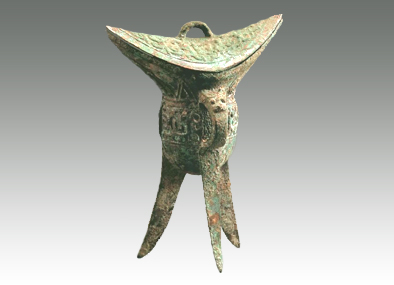 Fig. 11
Fig. 12: Bronze Jiao of the early Western Zhou excavated from tomb no. M1 at Baicaopo, Lingtai county, Gansu in 1967; height 23cm, wing width 8.5cm.
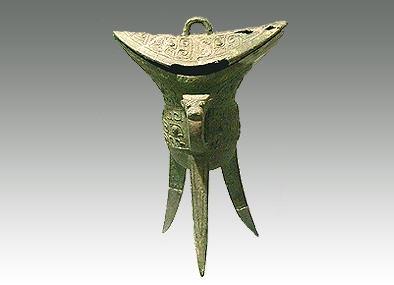 Fig. 13
Based on the foregoing materials of different periods, we may see that the development of Jiao had undergone three periods, namely, late Xia, early Shang and late Shang. There are only two pieces of the late Xia Jiao, both being spouted type, which should have been derived from mimicking the pottery spouted Jiao of the late Xia period. Stylistically, this type of Jiao have neither lid nor wings, but have thickened lip rim, semicircular handle, long spout, dropped waist, flat base, and three triangular splayed legs, being unornamented throughout. Cast with thinner walls, the typical Jiao of this period features a long slanting spout, which is the clear stamp of the age.
As for the Jiao dating to early Shang, there exists only one piece which, not coming from scientific archaeological excavation, corresponds virtually to the structure of the contemporary jue, all cast with flared mouth, contracted waist, semicircular handle, flat base, three triangular splayed legs, and a decorative band around the waist. While Jiao has two wings and no post on the lip, jue has one spout, one wing(or tail), plus posts on the lip. Thin wall and flat base constitute the signature of this period’s Jiao vessels.
It was during the late Shang and the early Western Zhou when the bronze jue reached its peak period of development, hence a much larger number of Jiao vessels originating therefrom, in the form which is close to that of the contemporary jue, with difference existing mainly in spout and post. This period, as shown in the materials available so far, may be further divided into the late Shang stage, when jue vessels flourished, and the early Western Zhou, during which the form was unvarying and the jue industry was dying out. Of the existing Jiao vessels, no small proportion are handed down and excavated ones originating from the late Shang, cast in the form which is close to that of the contemporary jue, some with lid, but most lidless. Other features include thicker wall, sagging mouth with no rim, almost vertical belly, semicircular handle in the shape of animal head, footrim, triangular legs, with wings, belly and tripod legs most likely decorated with motifs. As the principal mark, the Jiao vessels of this period all have vertical or close to vertical bellies.
Moreover, there are also irregular Jiao vessels, such as Three Flaring-legs Jiao, Spouted and flat base Jiao with animal-head lid, and Jiao with a standing bird knob on the lid, and etc. The emergence of irregular Jiao vessels suggests that the shape had not come to a fixed form yet during the late Shang, and that the irregularity in forms is nothing but the embodiment of explorations the craftsmen had made towards the structures during the development period. The number of handed down and excavated Jiao vessels of the early Western Zhou is remarkably small, as compared with that of the late Shang. The bronze Jiao vessels of this period were, as supported by those excavated, cast in forms that became increasingly fixed, with lid on most occasions. Speaking of the shape, the lid is usually seen as a sloping roof type, with a semicircular knob in the middle, whereas the vessel has a rim-concaved mouth without turn-up, wings on both sides, semicircular handle in the shape of animal head, egg-like belly, footrim, and triangular legs, with motifs decorated on lid, wings, belly and legs. The egg-like belly is the characteristic of this period. Although there exists lidless, flat base Jiao vessel among the handed down articles, the case is only occasional.
Compared with Jiao vessels of different periods, Fuyi is the largest one in terms of size, being approximately 10cm taller than most of the others; from the standpoint of decoration, is one of the few jue vessels that were cast using three-layer pattern method, with a projecting leaf edge that is seldom seen on other Jiao vessels; and is among the few Jiao or jue vessels that bear an inscription of over ten characters. On the whole, Fuyi jue has an almost vertical belly, which resembles those of the late Shang; in the same time, however, it has three legs, a phenomenon identical to those of the early Western Zhou (in different stages of development, the legs of jue had presented noticeable characteristics typical to their respective periods, for instances, the cross section minimum angle of the triangular legs was great during the late Xia and early Shang dynasties, but lessened in the late Shang, and further diminished to a very small one during the early Western Zhou), plus the inscription of as many as twelve characters which is a peculiarity to be seen on some of the Jiao -vessels dating to the early Western Zhou.
Therefore, Fuyi Jue ought to be a bronze dating back to the early Western Zhou, and is an outstanding one that is measured the largest in the known jue vessels, with the most beautiful ornament and lengthy inscription on it.
Glossy black from top to toe, and almost free of any rust, Fuyi Jiao stands out as a very rare thing among the Shang and Zhou bronzes. What could be attributable to the shinny outer look of the vessel after being buried underground for nearly three thousand years? Is it the underground condition, or the mix ratio of bronze, tin and lead, or any other reason?
Your answer please, if you have any questions or answer, please fell free to send us email, we are waiting for your answer and participation, and your comments or answers will be highly appreciated. We will select and publicize the most appropriate answers and comments in the proper time.
Weekly Selection Email: meizhouyipin@chnmus.net
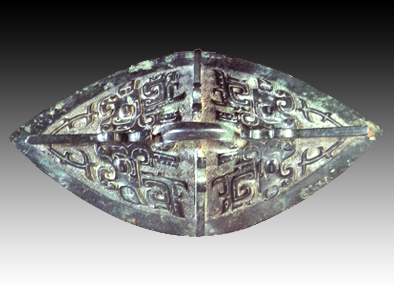
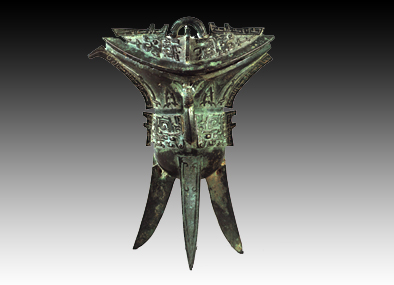
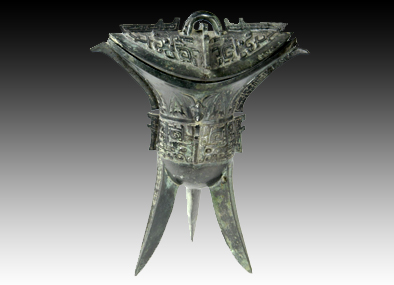
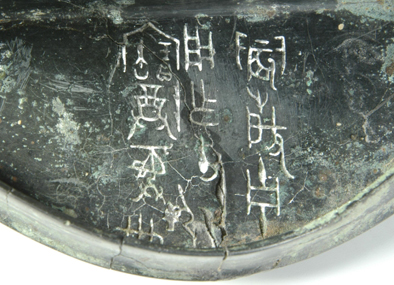
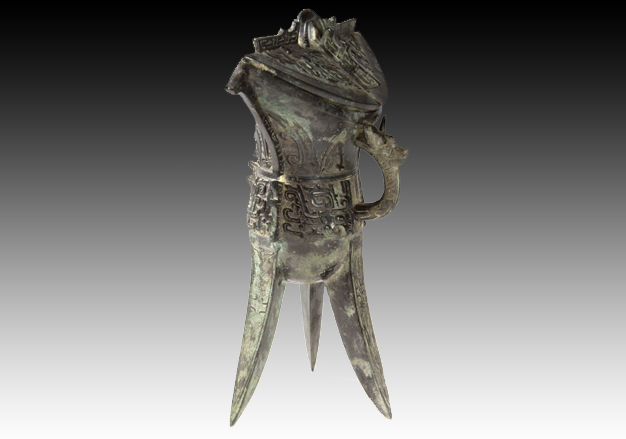
Fuyi Jiao, bronze ware, is a wine vessel of the Western Zhou dynasty, measured 29.00cm in overall height, 20.3cm in mouth length and 9.8cm in mouth width, unearthed at Shi River Harbour, Xinyang county, Henan province in 1986.
Note:Jiao usually is identical with Jue,i.e. has the same pronunciation with Jue, both of them are classified in to the same category in bronze.

Zhang Junru, Graduate of Jilin University, majoring in museology. Researcher of the Collections Administration Department, specialized in the study and authentication of the Bronzewares of Xia and Shang dynasty.