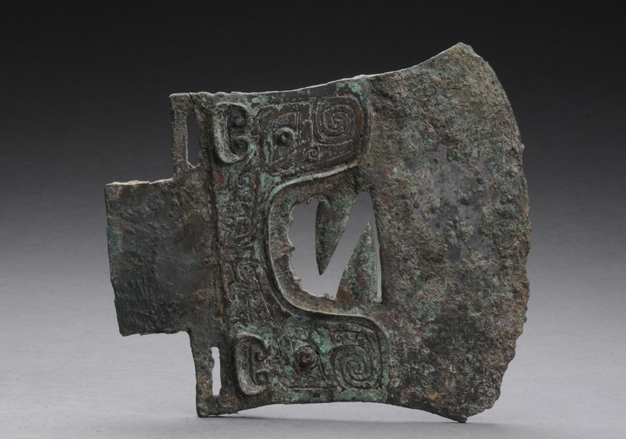
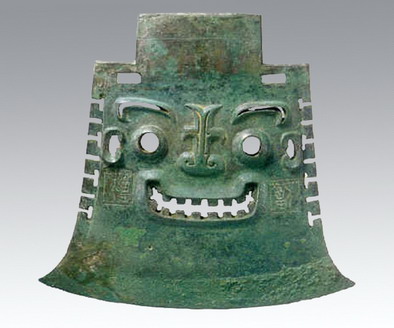
The cultural relics working team of Henan Province discovered a group of graves of the Shang Dynasty around the artificial Lake of Youth in the People’s Park of Zhengzhou in March 1954 when they launched an excavation project there. The graves were densely arranged in a neat order. This bronze battle-axe with animal mask motif was unearthed from tomb C7M15 in Phase I of the Shang graves unearthed in the People’s Park of Zhengzhou, which were for burial sacrifices. [1]

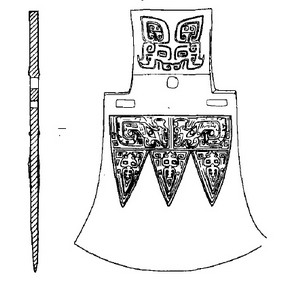
Fig. 1 Different parts of the yue-axe
The bronze yue-axe with animal mask motif (Fig. 1) features a thin and wide body contracting at the waist, two widely flaring corners and a curved blade. On the flat shoulder there is a narrow and short na or rectangular handle holder. Two rectangular pierced holes are opened on the part where the body and the handle holder joined. In the middle part of the body is a group of animal mask pattern, featuring two inward-curling horns, bulging round eyes, five small triangular pointed teeth on the upper lip of the fretwork mouth, and two bigger teeth zigzagging on the lower lip. The ferocious-looking animal mask is decorated with a kui-dragon motif on the forehead.
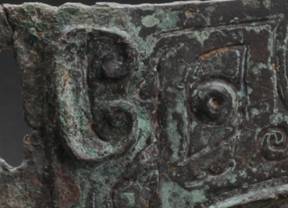
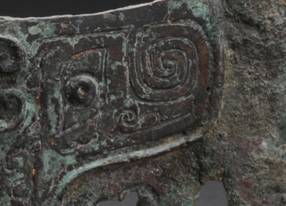
The animal mask motif fits into the principle of symmetry popular with the bronzes of the Shang and Zhou dynasties. Either of the two curved horns is bold-lined and almost forms a round-cornered rectangle, except for the tiny gap on one side. All the horns and the bulging round eyes are cast in relief (Fig. 2). The eye corners, eyebrows, nose and the kui-dragon motif on the forehead are all carved with delicate incised lines. Inside the semicircular mouth at the lower part of the animal mask motif there are teeth with raised motifs in exquisite openwork and relief (Fig. 3). The animal mask opens its mouth wide toward the enemies and looks awesomely ferocious.
The bronze yue-axe unearthed from C7M15 in Project I of the People’s Park of Zhengzhou looks quite similar in shape and motif to those unearthed from the early-period graves of the late era of the Yin Ruins in Anyang, Henan Province. Plus the evidence from the pottery vessels unearthed from the same grave and those from the graves of the late era of the Yin Ruins, the grave was thought to be an early-period one of the late Shang Dynasty. Unearthed with proper methods, the bronze yue-axe remains intact and its location of excavation is unquestioned. It is a piece of material evidence valuable for dating the Shang ruins in Zhengzhou, and has great value for related studies.
Yue axe was an axe-like weapon used in ancient China. Bigger than an axe, the curved-bladed yue could be used to chop. The Chinese character “钺” (battle-axe) was written as in the form in inscriptions on bones and tortoise shells of the mid- and late Shang Dynasty and in the form in the inscriptions on ancient bronze objects of the Shang Dynasty. Both were pictographs of the weapon. Either pictograph of this “weapon of chopping” is composed of a curved blade and a long handle. Book of Documents: Testamentary Charge reads, “A person with a cap holds a yue in his hand”. Zheng Xuan, a renowned scholar of the Chinese classics, explained yue as “a big axe”.
Evolving from stone axes of the early and mid-Neolithic Age, yue was gradually developed into stone and jade ones. Initially used as a tool of production, stone yue soon became a weapon and ritual object. [2] As the civilization and productivity progressed, yue was made of metal, instead of stone or jade.
As shown in excavation projects, fewer stone or jade yue were used as burial objects in the tombs of the late Neolithic Age. [3] Thousands of close-in weapons like ge (dagger-axe) and spear were unearthed from the tombs of the Xia, Shang and Zhou dynasties, but seldom bronze yue. In a tomb of the Shang Dynasty from which a small yue was unearthed, there were mostly other weapons, such as ge and spear, and some bronze ritual vessels in some cases. A tomb of the Shang Dynasty, from which a 30cm-long or larger yue was discovered, must be a large grave, usually with bronze ritual vessels and weapons and even immolated human beings as burial objects. A tomb where small and large yue were unearthed in set, must be a high-ranking one for a prominent person, in terms of the tomb area and the ritual vessels and weapons buried.
In the Shang Dynasty, bronze yue began to be used more as a symbol of sovereign power than a weapon. The Records of the Grand Historian: Annals of Yin and Classic of Poetry • Sacrificial Odes of Shang: Selected by Heaven described the battles fought by the kings of Shang and Zhou who both held yue in their hands, respectively.
In a battle in ancient China, yue not only served as the truncheon and symbol of the military authority, but also an instrument of punishment for the execution of law. A king gave yue to a subordinate duke as a symbol of sovereign power, endowing the duke with the military authority on behalf of the king. Yue served here as the symbol of military power. In addition, yue were also held by guards of honor. As described in Records of the Grand Historian: Annals of Zhou, Ji Dan, or the Duke of Zhou, held a large yue, and Duke of Bi a small one when they were walking on either side of King Wu of Zhou.
In the Shang and Zhou dynasties, yue as a sort of ritual object was an indicator of hierarchy, in terms of the number, material and size of yue adopted. Usually, only a slave owner of the ruling class with military power could have yue buried in his grave. The bronze yue unearthed from Fu Hao’s tomb (M5) in the Yin Ruins in Anyang is of a huge size and extravagantly decorated. The large number of bronze ritual vessels and weapons buried in the tomb well showed the prominent status Fu Hao enjoyed as the wife of Wuding the King of Shang, as well as the power she possessed as the supreme commander.
As an instrument of punishment, yue was only used in a penalty on someone who enjoyed a higher social status. As described in Book of Documents: Speech at [the Battle of] Muye, King Wu of Zhou ordered executions with yue on King Zhou of Shang and the latter’s favorite concubines, indicating that such an execution was only used on the high-ranking ruling class during the Shang and Zhou dynasties.
Bronze yue was widely adopted in the Shang and Zhou dynasties. Those made in the Shang Dynasty were ferocious-looking and impressively awesome. They began to get smaller both in size and number during the Western Zhou Dynasty. Bronze yue was widely used mainly in south China during the Spring and Autumn and the Warring States Periods. They were gradually replaced by iron yue in the Han Dynasty when iron weapons were widely used. [4]
A weapon used during the Shang and Zhou dynasties, only dozens of bronze yue have been unearthed in archeological excavations by now. Compared with other bronze weapons, such as spear, ge (dagger-axe) and arrowhead, the number of bronze yue discovered was simply too small, making a sharp contrast to numerous description of the weapon in historical documents. By now, bronze yue have been unearthed in ten provinces and municipalities, namely, Henan, Hebei, Beijing, Shanxi, Shaanxi, Shandong, Hubei, Hunan, Sichuan and Gansu. [5] The following are some bronze yue selected from the unearthed ones for a comparative study.
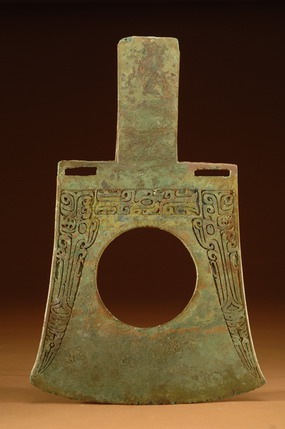
The bronze yue (Fig. 4) unearthed from M2 grave of the Shang Dynasty at Lijiazui, Panlongcheng, Huangpi County, Hubei Province, in September 1974, features a curved blade, a narrow and long rectangular handle holder and two rectangular pierced holes on the shoulder part. In the center of the body there is a large round hole, around which are kui-dragon and cicada motifs. Overall length: 41cm; Width at the blade: 26cm. [6]
Two bronze yue were unearthed from M1 grave for immolated slaves as burial sacrifices in the Subutun Village, Yidu County, Shandong Province, between the autumn of 1956 and the spring of 1966. One bronze yue (Fig. 5) is large and long with a straight rectangular handle holder and two rectangular pierced holes. Both sides of the yue are carved with human face motifs in openwork. The edges are decorated with ornamental ridges (feileng). Either side bears the inscription of , the tribe’s totem. Overall length: 32.7cm; Width at the blade: 34.5cm. [7]
The bronze yue (Fig. 6) unearthed from Laoniupo Site of the Shang Dynasty in the eastern suburb of Xi’an, Shaanxi Province, between March and June 1986, features a curved blade with widely flaring corners, flat shoulder, a rectangular handle holder with a round pierced hole, and two symmetrical rectangular pierced holes at the shoulder. Both sides of the handle holder are decorated with animal mask motifs. Inside the banana leaf design on the body there are cicada and animal mask motifs. Overall length: 23cm; Width at the blade: 17.2cm. [8]
Four bronze yue were unearthed from Lady Fu Hao’s tomb (M5) in the Yin Ruins in the Xiaotun Village in Anyang, Henan Province, in the spring of 1976. The large-sized one with a tigers-eating-human-head motif (Fig. 7) is roughly of an axe shape and features a curved blade, a rectangular handle holder and two symmetrical rectangular pierced holes at the shoulder. On either side of the body there is a motif near the shoulder part, depicting a scene in which two tigers are eating a human head. The ground is carved with thunder motif. In the center of one side of the body there are inscriptions about Lady Fu Hao. Overall length: 39.5cm; Width at the blade: ca. 37.3cm; Shoulder width: 28.9cm. [9]
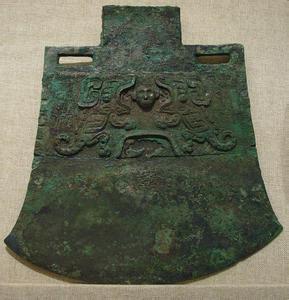
Fig. 7 Bronze yue with a tigers-eating-a-human head motif unearthed from Lady Fu Hao’s tomb in the Yin Ruins in the Xiaotun Village in Anyang, Henan Province
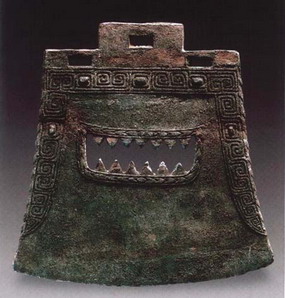
Six bronze yue were unearthed in the Dayangzhou Township, Xin’gan County, Jiangxi Province, in November 1989. A large-sized one (Fig. 8) features a slightly-curved blade wider than the shoulder part. On the rectangular handle holder there is a rectangular pierced hole. At the flat shoulder there are two rectangular pierced holes. The rectangular hole in the upper center of the body is decorated with triangular pointed teeth. The belts with eye-and-thunder motif are applied underneath the shoulder and around the edges. Overall length: 35.2cm; Width at the blade: 34.8cm. [10]
Bronze yue of the Shang Dynasty unearthed in different places vary in shape, size and motif, depending on the owners’ identities and social status, as well as on the regions where those yue were unearthed. A bronze yue of the early Shang Dynasty features a body much longer than the shoulder width. There is a round hole in the center of the body and only one pierced hole. In addition, the motif is usually quite simple. One bronze yue of the mid- and late Shang Dynasty, however, has no round hole in the center of the body. There are usually two or three pierced holes on the body and the rectangular handle holder. The body is decorated with various motifs, including those realistic ones of animals like birds and cicada, as well as the imaginary animal mask and kui-dragon motifs. In addition, one also finds geometric designs, such as clouds-and-thunder motif, on a bronze yue of the time. The motifs are in shallow carving and relief, with the imaginary animal patterns as the core, accompanied by realistic animal designs on the ground carved with geometric patterns. A bronze yue with three layers of motifs on its relatively thin body looks extraordinarily extravagant and awesome. It indicates a high level of motif art and bronze casting technique and skills in the Shang Dynasty.
The Shang City Site in Zhengzhou is located around the old seat of the Zhengxian County and Beiguan in the east of Zhengzhou (Fig. 9). The site was first discovered by an archaeologist named Han Weizhou in the autumn of 1950. An archaeological work team launched a large-scale excavation project around the Erligang area in the spring of 1954. With the archaeological excavation and discoveries in the past 60-plus years, archaeologists have confirmed that the Shang City Site in Zhengzhou mainly dates back to the period of the Erligang Culture, including Projects II and III of the Luodamiao Site that was a bit earlier than the Erligang Culture and the Nanguanwai Site of the Shang Dynasty in Zhengzhou, as well as the Site of the Shang Dynasty in the People’s Park of Zhengzhou, slightly later than the Erligang Culture period. [11]
The ruins of the rammed earth walls of a large city of the Erligang Culture period of the Shang Dynasty were discovered in the Shang City Site in Zhengzhou in 1955. The city is of a rectangular plan. The rammed earth walls measure 6,960 meters in circumference, with 11 gaps, some of which might be city gates. [12]
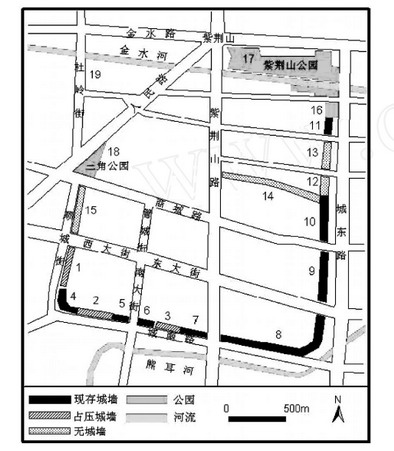
Within the walls of the ruins there were palace and residential areas. Outside the walls there were sites of workshops of bronze casting and bone artifacts and potteries, graves, as well as the site for sacrificial rites and the pit for bronzes. The bronze ritual vessels are material evidence for the lineage of bronze ritual vessels of the late period of the Yin Ruins.
By now, tens of thousands of precious artifacts have been unearthed from the large Shang City Site in Zhengzhou, which is a significant archaeological discovery in China. On March 4, 1963, the Shang City Site in Zhengzhou was listed by the State Council among the first batch of State Priority Protected Sites. [13]
How were the body and wood handle of a bronze yue joined?
Your answer please, if you have any questions or answer, please feel free to send us email, we are waiting for your answers and participation, and your comments, answers and suggestions will be highly appreciated. We will select and publicize the most appropriate answers and comments some time in the future.
Weekly Selection Email: meizhouyipin@chnmus.net