Zaju of the Northern Song Dynasty, by inheriting the comical features of the dramas in Tang Dynasty and absorbing the styles of folk dramas, is usually performed with acrobatics, music and dance. It is composed of three parts, namely Yanduan(the prelude), the Zaju proper(the main play) and Zaban(also Sanduan, the loose part), covering a wide variety of social activities.
With social stability and popularity of entertainments in the Northern Song Dynasty, Zaju was flourishing. Artists often created new dramas and brought them onto the stage, so there appeared a lot of performing groups and places. The fenced performing places are set up in the vacant lot nearby the markets. In the middle of it, a stage in the form of a temple is built. For example, there are many cases in which the scenes at such performance places are depicted in Outlaws of Water Margin, a famous historical novel in the Chinese history.
The performers of Zaju of the Song Dynasty can be divided into two types, one being court artists, and the other folk ones, many of whom became court artists later. The Zaju of the Northern Song Dynasty is aimed at pursuing the effect of satire and humor in that it adopts both social realities and historical events as its contents to play a role of warning to the reality. Therefore, the recreational centre for Zaju and other dramas of the Northern Song Dynasty is located in the capital, present day Kaifeng City, Henan Province.
The traditional Chinese art of carving bricks evolved from the carving on the plain brick. Carving bricks are easy to make and inexpensive in cost, so they are widely used in the tombs of the Northern Song Dynasty as a widely-accepted custom of the time. The contents carved on carving bricks are a miniature of a society, reflecting the social background and people’s taste for living from one perspective. Such archaeological excavations as the drawing of Zaju on the stone coffin of the third year of the Shaosheng period(1096 AD) unearthed at Donghuaixicun village, Xingyang County of Zhengzhou, the carving bricks of Zaju characters of the Song tomb unearthed at Jiuliugou Reservoir in Yanshi City, and the carving bricks of Zaju characters unearthed in Luoning County, Luoyang, have reproduced the drama form of the Zaju of the Song Dynasty and witnessed the development of Chinese drama.
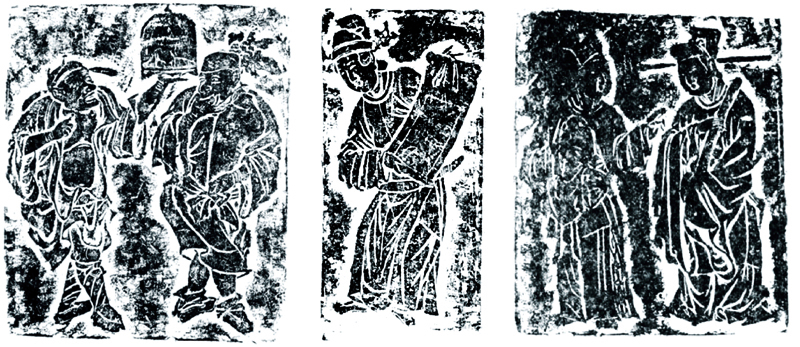
A set of three carving bricks of Zaju characters of the Song Dynasty were unearthed at Jiuliugou Reservoir in Yanshi City of Henan Province in April 1958. There are two characters on the first rubbing from the left. One character is capped with a soft towel decorated by a flower at the back of his head, wearing a short gown and boots, with both legs naked and his right fingers put into his mouth for whistling to tease a bird. The other one is capped by a soft towel with a pair of soft wings, with his left hand holding high a bird cage for recreation. The character on the second rubbing wears a cap with a flower, a gown with round collar and a waist belt, with his both hands holding a Chinese paint for display. And there are two characters on the third rubbing: one wears an official cap and a gown with loose cuffs, with both hands holding a long wood strip with written records; the other one wears a soft-towel cap and a gown with round collar and tight cuffs, with his right hand holding a seal box. They are talking to each other.
Rubbings of the five Zaju characters on the carving bricks unearthed from Yanshi city, Henan province
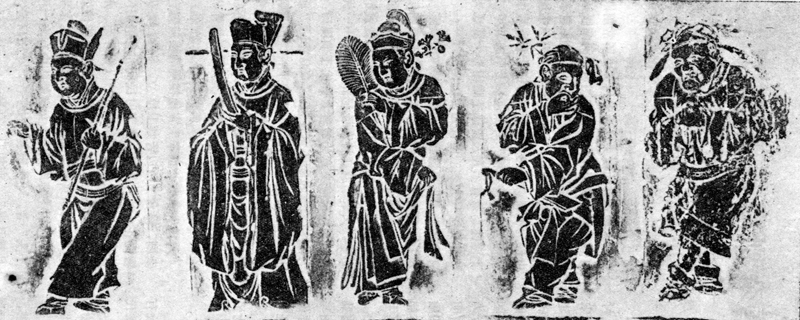
Five carving bricks of Zaju characters of the Northern Song dynasty were unearthed at Qiandongnanwang Village, Wenxian County, Jiaozuo City, Henan Province in April 1982. The first character from the left wears a Dongpo hat with a feather at the left side of his head, and his left hand holding a stick. The second one from the left wears an official cap, a rounded-collar gown, a waist sash, and boots, with his both hands holding a long wood strip with written records. The third from the left wears a cap decorated with a flower and a gown with round collar, with his left hand holding a fan. The fourth from the left wears a soft towel on his head, a green bamboo at the back of his head and a short gown, with his left hand holding a big knife and his right hand put in his mouth for whistling. The fifth from the left wears a soft towel, a gown and boots, with funny expressions on his face.
The Ding-Dusai carving brick of the Song Dynasty, collected by the National Museum of China, is 28cm long, 8cm wide and 3cm thick. The character wears a soft towel and a flower on his head, a gown and short boots. The carved character and this carving brick are the earliest drama image and real physical evidence respectively in Chinese history.
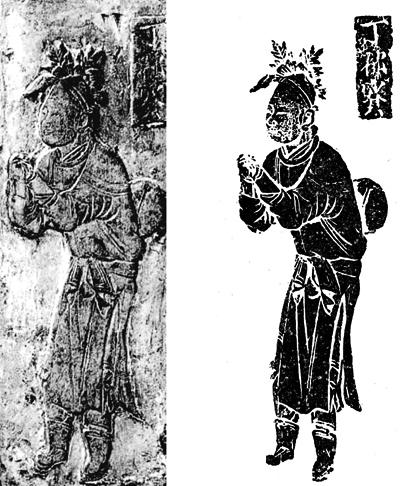
The Ding-Dusai carving brick of the Song Dynasty and its rubbing
Five carving bricks of Zaju characters of the Song and Kin period, unearthed in Luoning County of Henan Province in 1973, are of about 47cm high, 23cm wide and 6cm thick. The first character from the left is the role of Yinxi, the second the role of Fujing, the third the role of Zhuanggu, the fourth the role of Moni, and the fifth the role of Fumo. The characters on the five carving bricks have distinctive features from each other.
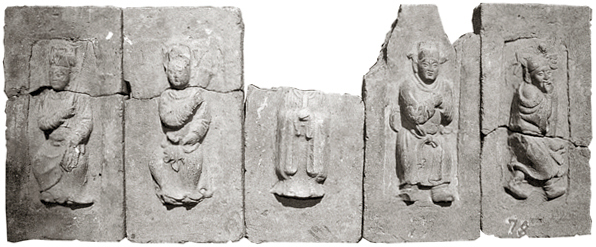
Carving bricks of Zaju characters of the Song and Kin period, unearthed in Luoning County of Henan Province
Four carving bricks of Zaju characters of the Song and Kin period, unearthed in Yima City of Henan Province in December, 1988, are of 31cm high and 26.5cm wide. The first character from the left is the role of Zhuanggu, the second the role of Fujing, the third the role of Fumo, and the fourth the role of Moni. The characters on the four carving bricks are all comic images.
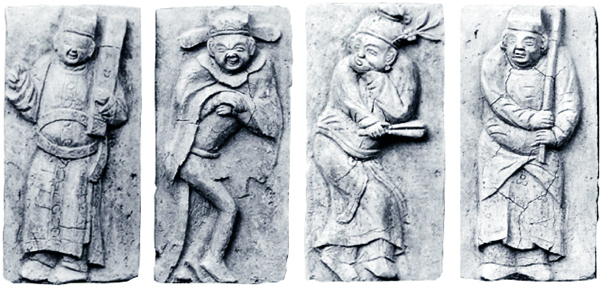
The above-mentioned five sets of carving bricks of characters from different periods, sharing the same style of Zaju performance of the Song Dynasty, vary slightly in terms of carving skills. In comparison, the set of carving bricks of Zaju characters unearthed at Xiguangsanjie, Wenxian County, Jiaozuo City, Henan Province, are best preserved with proportional portrayals and proper postures, so they are rare treasures indeed.
Dear readers, since you have appreciated this set of carving bricks of Zaju characters unearthed at Xiguan, Wenxian County, Henan Province, would you like to guess what the owner of the set of carving bricks did for a living before his death? Why is his tomb chamber decorated with such carving bricks of characters?
Your answer please, if you have any questions or answer, please fell free to send us email, we are waiting for your answers and participation, and your comments, answers and suggestions will be highly appreciated. We will select and publicize the most appropriate answers and comments some time in the future.
Weekly Selection Email: meizhouyipin@chnmus.net
1. A Brief Introduction to the Song Tomb at Xiguan, Wenxian County, Henan Province
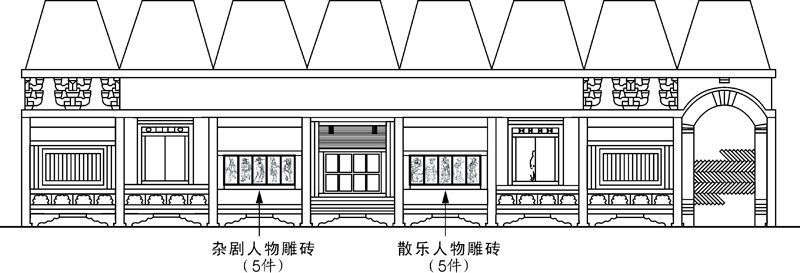
The pit of the Song tomb at Xiguan, Wenxian County of Henan Province, is in a shape of octagon. Both the tomb passage and tomb chamber are two separate sections. The tomb gate is to the north of the tomb passage. The carving bricks of Zaju characters are inlaid on the tomb wall in the northwest, and a set of carving bricks of Sanyue(variety show) characters on the tomb wall in the northeast. The tomb is facing south, composed of tomb passage, tomb gate and tomb chamber.
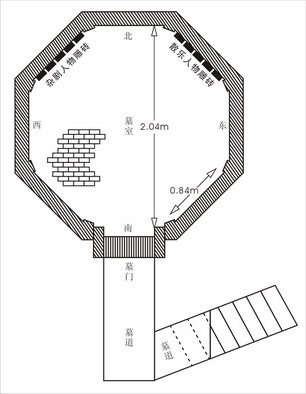
The east wall of the tomb is decorated with a door named “half-closed door by a woman”. The tomb chamber was ever colorfully painted, but the paint has flaked off with traces remained. The tomb walls were applied white on the whole, in which there is a little silt soil and the remains are seriously decayed. The number of the buried and the funeral form still remain unknown.
2.The Methods of Making Carving Bricks
There are three traditional methods of making a carving brick.
1. Carve on the mud brick and fire it.
2. Mold the mud brick with carved pattern and fire it.
3. Put raw materials into the brick mold with carved pattern and press them to be solid, then dump the mud brick out and fire it.
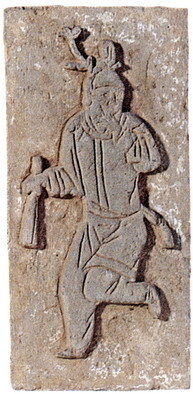
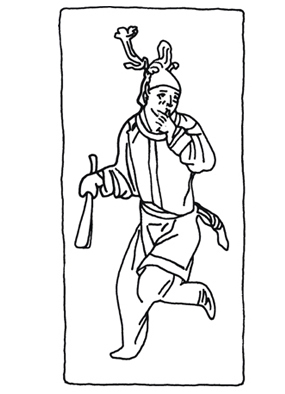
A set of carving bricks of Zaju characters, composed of 5 pieces, were found in the tomb chamber of a tomb of the Northern Song Dynasty at Xiguansanjie, Wenxian County, Henan Province in April 1991. On the surface of these bricks the outlines of characters were carved in low relief , and then,their features, clothes, and props by incision. The characters are very concise and vivid.
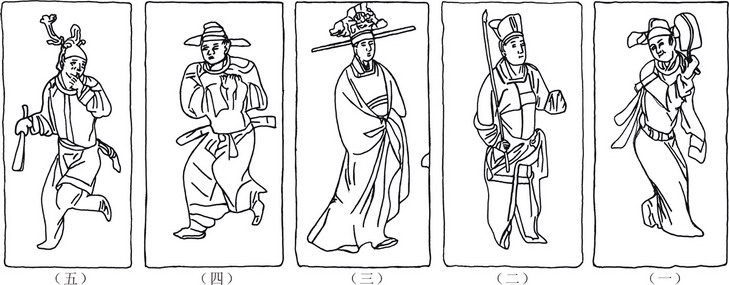
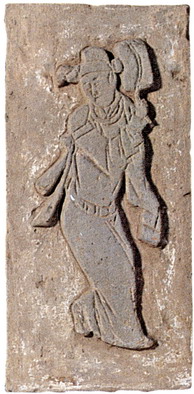
Five Zaju characters on the set of five carving bricks have different images. The first character (from right) wears a soft-towel cap and a gown with round collar and tight cuffs, facing his right side. With a belt around his waist, he takes on a posture of dramatic wriggling. He makes a funny show with his left hand hanging down in the sleeve and his right hand holding a fan high. This role is called Fumo, who is a comic role with a face applied with white paint and powder in Zaju of the Song Dynasty.
|
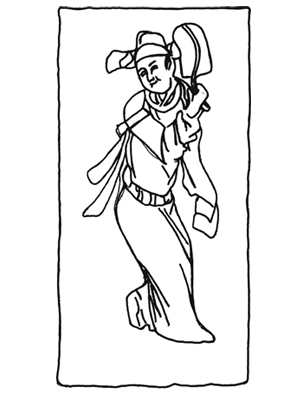 |
The first character(from right) and its rubbing
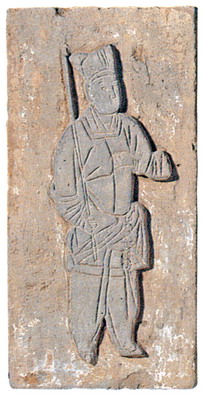
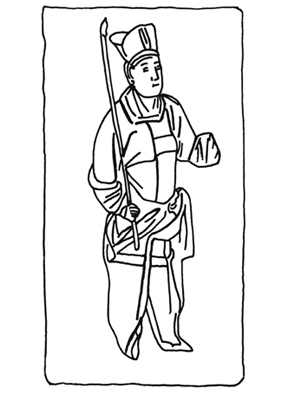
The second character is capped with a Dongpo towel, wearing folded-collar underwear, a square-but-round-collar and tight-cuff gown and tights. It is a woman disguised as a man, holding a stick in the right hand. This role in Zaju is called Yinxi, who dances first on the stage and then is followed by other roles.
|
|
The second character( from right) and its rubbing
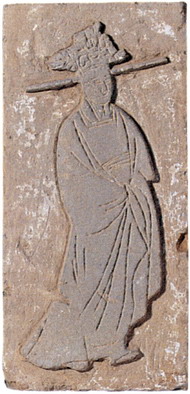
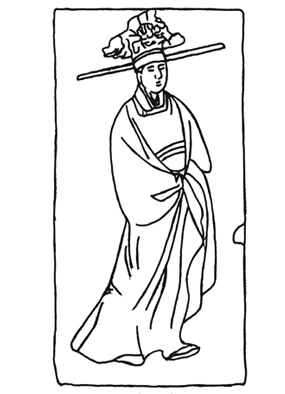
The third character wears a floral-shaped cap, folded-collar underwear, and a square-but-round-collar and loose-cuff gown, putting his hands in front of his belly. This role is called Zhuanggu, who specially plays the role of a government official in Zaju.
 |
|
The third character(from right) and its rubbing
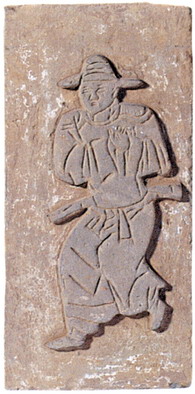
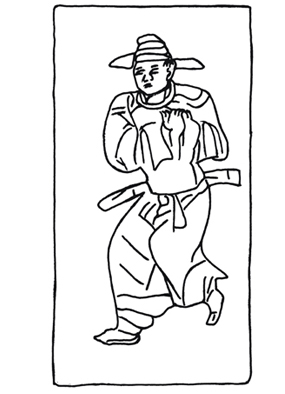
The fourth character wears a soft-towel cap ornamented by a pair of soft wings, a round-collar tight-cuff gown and a prop attached to the back of his waist. He is making a funny show with folded hands in salute and a posture of wriggling. This role is called Fujing, whose face is usually applied with paint and powder.
|
|
The fourth character(from right) and its rubbing
The fifth character is capped with a high soft towel ornamented by a flower on the head, a round-collar, tunic and long-sleeve gown and tights. It is a woman disguised as a man. This role is called Moni in Zaju, who plays the role of an usher and recites poems and songs on the stage as well.
 |
|
The fifth character(from right) and its rubbing
This set of carving bricks of Zaju characters collected by Henan Museum are all separate bricks, on which the five Zaju characters are in complete accordance with the five roles ( namely Yinxi, Moni, Zhuanggu, Fujing and Fumo ) of Zaja recorded in documents of the Song Dynasty. They are of great artistic value because they are a mirror of the Zaju form of the Northern Song Dynasty.
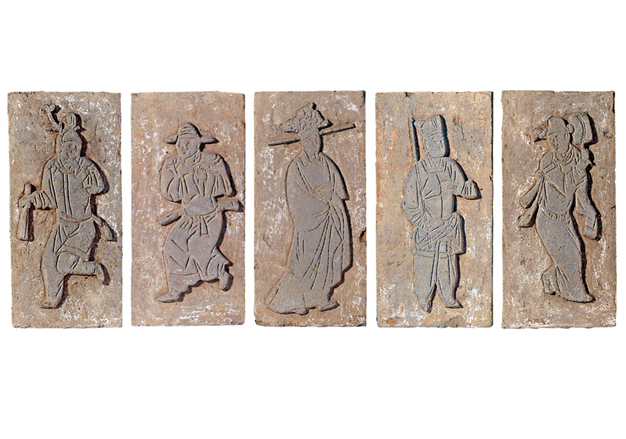
Name: carving bricks of the characters in Zaju Opera
Category: pottery architecture component
Period: Northern Song dynasty (960–1127)
Measurement: a set of 5 items, each with a length of 37cm, a width of 17cm and a thickness of 4.3cm
Provenance: unearthed from a Song tomb at Xiguansanjie, Wenxian County, Jiaozuo City, Henan Province in 1991

Zhao Le: a museologist of the Collections Administration Department of Henan Museum, dedicated to collections design and research.