Song Hua, graduate of Zhengzhou University, majoring at cultural heritage and museology, museologist and executive editor of Henan Heritage Network, devoting herself to the study on museology and collections at Henan Museum.

Cizhou Kiln
Cizhou kiln, the biggest type of civilian kiln in ancient north China, and a famed non-governmental kiln with its locations range the Guantai township in Xixian county, to Pengcheng township in Fengfeng mining district, Handan, Hebei province. Due to Cixian county was under the administration of Cizhou prefecture in Song Dynasty, hence the ware’s name. Cizhou kiln was created in the mid-Song Dynasty and saw its heyday, continued through Southern Song, Yuan, Ming, and Qing Dynasties.
Cizhou ware is noted for its white-glaze-black-decors, pioneering a new way of painted decoration on porcelain in China, and laid the foundation for significant development of white-and-blue and polychrome ceramics of Jindezhen. After the collapse of Northern Song marked by conquering the capital by the Jurchen people, to avoid the war, large quantity of craftsman fled the central plains to south China, i.e. regions south of the Yangtze River to make a living, consequently, the potters of Cizhou kilns emigrated to regions of present-day Jiangxi, Anhui, Zhejiang. In the late Song Dynasty, with the immigrations of artisans of Cizhou kilns, Jizhou kilns that had been producing ceramics since Tang and Wudai (Five-dynasty) period, began to make numerous black-painting-white-ground wares, as a result, Jizhou kilns were categorized into Cizhou kiln series by the experts.
Of the discovered pillows from Cizhou kilns so far, why are they featuring only one child playing Cuju in the paintings?
Your answer please, if you have any questions or answer, please feel free to send us email, we are waiting for your answers and participation, and your comments, answers and suggestions will be highly appreciated. We will select and publicize the most appropriate answers and comments some time in the future.
Weekly Selection Email: meizhouyipin@chnmus.net
Ceramic pillow with child-playing design is the typical work of the Cizhou Kiln, its form and decoration represents the craftsmanship of the folk artisans of the age, played an significant role in studying the prosperity and development of Cizhou Kiln.
In 1954, a ceramic pillow with a boy fishing in pond design of Jurchen Jin Dynasty was discovered at Caoyanzhuang village, Xingtai, Hebei province(Fig.4), it measures 28.8cm in length, 22.1cm in width, 7.7 cm in front height, 13 cm in rear height.
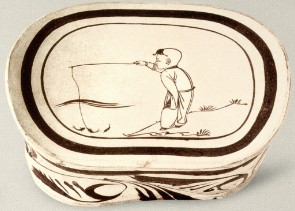
Fig.4 Ceramic pillow with a boy fishing in pond design uncovered in Xingtai city, Hebei
Pillow with boy tending a duck, Jurchen Jin Dynasty, housed by the Artifact Preservation Institute of Cixian County, Hebei Province, measurements: L. 28.5cm, W. 16.7cm, H. 10.8cm in front, 13.3cm in rear side.
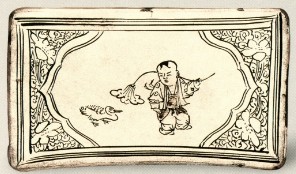
Fig.5 Pillow with boy tending a duck, Jurchen Jin Dynasty, housed by the Artifact Preservation Institute of Cixian County, Hebei Province
Oval-shaped pillow of the Jurchen Jin Dynasty in the collection of the Museum of the Mausoleum of Nanyue King in Guangzhou city(Fig.6), L. 22.8cm, W.17.1cm, H.9.6cm; it is ornamented with floral scrolls on whole side, vertical double frames with lotus leaves in the upper and lotus flowers in lower part, and Kiln Impression “Zhang Jia Zao” are on the bottom.
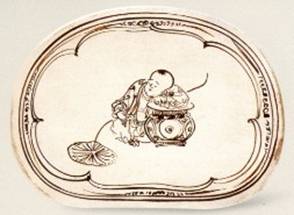
Fig.6 Oval-shaped pillow of the Jurchen Jin Dynasty in the collection of the Museum of the Mausoleum of Nanyue King in Guangzhou city
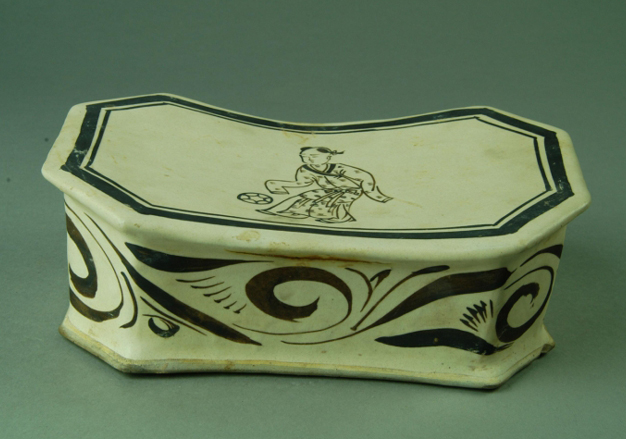
In 1954, an octagonal pillow with a boy playing Cuju design was unearthed from a tomb of Juechen Jin Dynasty at Caozhuang village, Xingtai, Hebei Province(Fig.7), measuring 30cm long, 18.5cm wide, 10.8cm high, with protruding rim on the obverse, two ends perks upward, the central part is concave. The sides are decorated with floral scrolls pattern, a horizontal kiln mark in relief, Zhang Jia Zao ("made by the Zhang family"), has been impressed on the base.
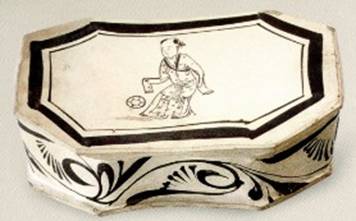
Fig.7 octagonal pillow with a boy playing Cuju design unearthed from a tomb of Juechen Jin Dynasty at Caozhuang village, Xingtai, Hebei Province
Oval-shaped pillow with Cuju design in the collection of the Palace Museum(Fig.8), dated to Song to Yuan period.
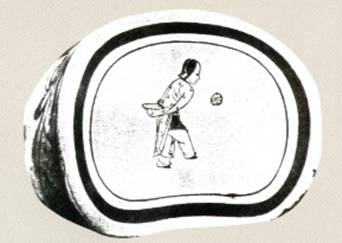
Fig.8 Oval-shaped pillow with Cuju design in the collection of the Palace Museum
Pillow with children bird-fighting design housed by the Palace Museum(Fig.9), dated from Jurchen Jin to Yuan period. Measurements: 29.9cm long, 22.5cm wide, 10.4cm high.
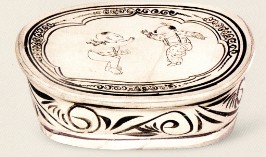
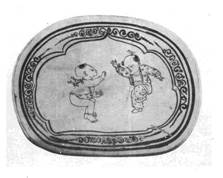
Fig.9 Pillow with children bird-fighting design in the collection of the Palace Museum and its topview
A white glaze pillow with carved child-playing against floral background was unearthed nearby Xi’an city, Shaanxi, in 1956(Fig.10), dated to Juechen Jin Dynasty, measuring 45cm long, 18cm wide, 11.5cm high.
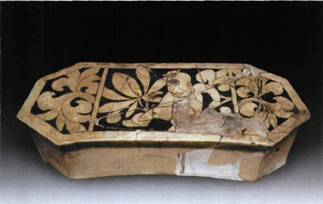
Fig.10 A white glaze pillow with carved child-playing against floral background unearthed nearby Xi’an city, Shaanxi
In 1985, a Sancai(tri-color) pillow with a design of sgraffito child-playing was unearthed at Anjizhai, Hancheng County, Shaanxi province(Fig.11), measuring 24cm long, 10cm wide, 8.5cm high.
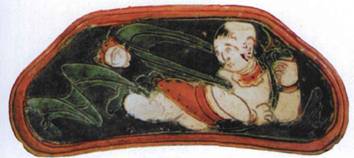
Fig.11 Sancai pillow with a design of sgraffito child-playing unearthed at Anjizhai, Hancheng County, Shaanxi province
In 1979, a Sancai pillow in the form of lotus leaf above a reclining boy was excavated at Yuzhou village, Zhouzhi County, Shaanxi Province, dated back to Northern Song Dynasty, measuring 33cm long, 15cm wide, 16cm high, it is a Cizhou ware.
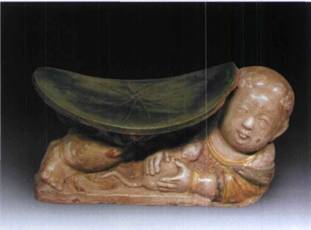
Fig.12 Sancai pillow in the form of lotus leaf above a reclining boy excavated at Yuzhu village, Zhouzhi County, Shaanxi Province
The above comparison revels that there are numerous decorative child-playing patterns on Cizhou wares. As a civilian kiln, Cizhou wares share some similarities in painting skills but vary in techniques of expression, particularly, the child-playing designs are remarkably true to life, with successive innovations of the decorations.
The First, there are a great variety of painting patterns on the Cizhou pillows. The painters express the detailed action and countenance of children by means of close-up technique.
Secondly, the dignified and modesties with restriction in modeling of the porcelain in Song Dynasty was favored, artificialness and excessive ornaments was unpopular, and the trend was manifested on the charm of fineness, delicacy, gentle colors, and gracefulness, displaying the style of mildness, simplicity, and elegance in pursuit by the people of the age. Thanks to the thrived trading, enrichment and prosperity of the folk culture, thus rich folk style was manifested over the designs on the ceramics, which is represented by means of lively reappearance of the recreational and frolic activities of the common children on the pillows.
Thirdly, apart from the black-paint-white-ground ornaments, the artisans of Cizhou kiln, by adopting the artistic characters of the previous dynasties, taking sgraffito, carving, and Sancai of Song as the main decorative techniques, established a set of unique artistic styles of its own. With the techniques, layering is enhanced, the patterns on the ceramics are more diversified. The polychrome child-playing patterns under the glaze are more expressive, and with the realistic painting skills, the naïveté and cuteness of children are displayed on the pillows.
Located at present-day Cixian county, Hebei province, Cizhou Kiln is a well-known ancient civilian kiln in north of China, because it was under the administration of Cizhou prefecture, hence the kiln’s name. The decorations on Cizhou wares have a distinctive characters of northern folk customs, with multiple ornamental varieties, of which the black paintings against the white background is the most remarkable.
White-glaze-black-paint, also known as “black flower on white ground”, “Black paints on the white ground”, is a peculiar decorative skill of the Cizhou wares, and manifests the transition of the decorations from the glaze of the greenware to colored drawings, which provide the technological and material condition for the formation and development of the other types of porcelain as the blue-and-white, polychrome, and Doucai. The technique of the white-glaze-black-paint decoration is borrowed from the traditional Chinese ink and wash painting, the motifs derived from the common themes which are quite familiar with in daily life, and are displayed by means of simple and proficient technique, and sharp contrast between black and white ornaments, truly exemplified the folklife of the age.
The popularity of the white-ground-black-paint decorative art of the time is closely associated with the social and historical reasons. In Tang and Song period, the flourishing economy boosted the development of culture and art. In Song Dynasty, several Emperors were obsessed with calligraphy and painting, Emperor Hui Zong even invented the "Slender Gold" (瘦金体) style of calligraphy. The painters in Song Dynasty could become governmental officials by participating the painting exam, which was virtually attributed to the formation of the strong cultural atmosphere and trend of studying calligraphy and painting. Additionally, a large number of intellectual folk artists enriched the prosperity and development of the social culture. Under such circumstance, the potters of Cizhou Kiln, by borrowing from the previous decorative skills, and inspired by the craftsmanship of the popular traditional Chinese ink painting and calligraphy, created the decorative style of the famed white-ground-black-paint which is characterized by brush painting charm, established a unique style.
Originally, the decorative pattern of child-playing on the ceramics was rare, and it was not prevalent before the Song Dynasty. The diverse child-playing patterns on the Cizhou wares, particularly, the lively, true-to-life children images, mostly in a bid to expressed the expectation and auspicious wish for fertility. The Chinese tradition and wish for fertility and thrived offspring since ancient time, and the preference for boy who is capable of boosting the family production capacity and raising the living standard, as well as the idea of raising children for relying on for a happy life in old age, significantly boosted the creation and prevalence of children patterns. So far, most of the excavated Cizhou wares with child patterns are pillows, a manifestation of the wishes for fertility by painting the child-playing pattern on the surface of pillow.
What’s more, in Song Dynasty, a complete and complex rites and custom had come into being over bearing and raising children. As for the health care, a governmental organ Children’s Beneficiary Bureau was established for nursing the abandoned children, such charity organization for children found and operated by the government is likely the first in Chinese history. Regarding the education, schooling was emphasized from the imperial court to the general public, Neo-confucianists, in particular, attached great importance to elementary schooling, and they even proposed a number of educational suggestions, and had compiled quite a few books for that.
With a octagonal shape, the top of the pillow features a decoration of a child playing Cuju, enclosed by black band, the sides are wholly ornamented with leaf-scroll motif. The boy, with a cute hairstyle that features a bald head with just two paralleled locks of hair left, clad with a collar-crossed right over left robe ornamented with floral patterns, loose pants, a ribbon tied on his waist. He has his arms stretched, hands in sleeves, body bends forward, stands on left foot, uplifts his right foot, being indulged in kicking the ball. The bottom of the pillow was impressed with a mark of three words “Zhang Jia Zao”(Lit. produced by the Zhang family). (Fig. 1,2,3)
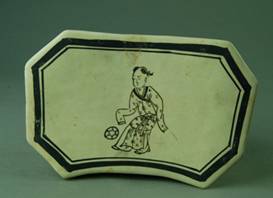
Fig.1 The top view of the pillow
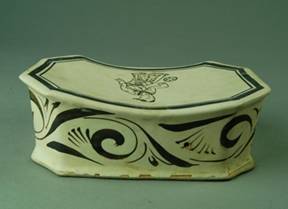
Fig.2 The side view of the pillow
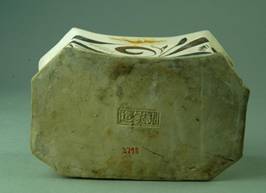
Fig.3 The base of the pillow
Similar to the modern soccer, Cuju, emerged quite early and prevailed in large part of China in Chinese history, thus boasts a history of thousands of years, and it is quite a typical traditional ball game. At first, Cuju was made of leather outside and stuffed tightly with feather inside. In Tang Dynasty, an innovation was made, the ball was sewn with ”eight patches of leather”, and filled with air. Originally, Cuju mainly served for military training purpose, and later the game was popular among the general public, consequently, skilled players arose.
As a representative object of Cizhou Kiln, this white-glazed-black-banded pillow with Cuju design is a precious example for study on the life style, customs, and clothes of the children in Song Dynasty, and serves as important reference example for studying the development of the Cizhou wares at the time.