
Wu Wei, born in 1974. Phd. of archaeology, vice director of the Research Dept. Associate Researcher. Chief editor of Cultural Relics of Central Plains Journal. Research on the archaeology of the Warring States, Qin and Han dynasties.
1.The constructional feature of the 7-storied ceramic manor tower:
The civil constructional technique of Han dynasty made a great progress against the preceding dynasties, esp. Pre-Qin periods. Influenced by the grand imperial constructions, and the pursuit for “Air residence” like “Immortal Dwellings” in the sky by all of the circles of the society, the fashion of residing in high buildings was popular in Han dynasty, thus the constructional system of the varied pavilion-shaped buildings with wood and earth structure took the shape. From pre-Qin period to Western Han dynasty, buildings with high foundation were prevailing. Commonly based on the high and large rammed earthen foundations, the well-proportioned and majestic palace buildings were constructed on. Till the Eastern Han dynasty, the technology of the wooden structure multistoried buildings had been mature, the beam-bracing and Dou-Gong structure had formed and was commonly seen in the later period, and single-towered pavilions and edifices had appeared. Wooden buildings have served as a link between the past and the future in the development of ancient Chinese pavilion-type buildings.
High and large in structure, the ceramic 7-storied granary tower has its first and second floor for grain storage. The first floor is enclosed without any doors or windows, but a stairway leads to the grain entrance on the second floor. Considering compacted enclosure of the granary, air vent were designed at the bottom of the walls for the requirement of ventilation, dehumidification, and rodent prevention.
The upper part from the third floor is pavilion-style construction, which features the structure of cantilever beam, and Dou-Gong which was used for bracing the overhanging eaves on each floor, veranda with handrails for overlooking, recreation and etc.
In one word, the ceramic 7-storied granary tower is a multifunctional ceramic building combining the applications of grain storage, recreation, and dwelling.
The covered corridor on the third floor between the main building and the detached building is the representation of the constructional facility “Fudao”, (the connecting passage between buildings)recorded in Qin and Han books.
2.Henei prefecture and Shanyang city in Han dynasty
The earthenware models of granary towers were mainly excavated from Jiaozuo municipality, Henan province. In ancient times, belonging to Henei prefecture, Jiaozuo was noted since Pre-Qin era, for its advanced agriculture, prosperous commerce. Under it jurisdiction, two wellknown cities, Wen(present day west of Wenxian county, the cradle of the shadow boxing) and Zhi(present day south of Jiyuan city, west of Jiaozuo) were famed for their richness all over the country between pre-Qin and Han period. The archeological sites of the earthen towers in Jiaozuo mainly focus on the Han tombs around the Shanyang ruin in the present day Shanyang district of Jiaozuo city. Shanyang was initially built in the Warring States era, and used to a political center in Han dynasty, belonging to Henei prefecture. After the usurpation by Cao Pi by founding Wei kingdom, Shanyang was the fiefdom of the dethroned Emperor Xian of Han court.
In 2006, the Han tombs around the Shanyang ruin was listed in the Fifth National Protected Key Heritage Units by the State Council. In recent years, a large quantity of earthen towers were unearthed from the Han tombs around Shanyang ruin, some just have the courtyard without detached tower and the bridge(the covered corridor); some are just single-tower building. But all were grey potteries made of clay, with colored paintings and carvings. Anyway, they were all well made, looks grand, tall and straight in appearance.
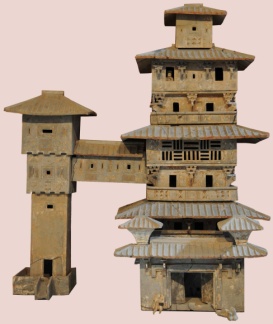
1. The earthenware funerary architecture unearthed from Jiaozuo city is as high as 7-storied, the story height, if we count it in Han measure unit, 1.5 Zhang (equivalent to 3.45meters ), the actual height of the earthenware building will probably be as high as 24 meters. Though the story height of different floor varies a little, even it is only 3 meters high in average, then the total height of the tower will still be more than 20 meters high, thus, did such a high construction really exist in Han dynasty?
2. All of the surviving ancient Chinese wooden constructions were built no earlier than Tang dynasty. The chamber number of the building is mostly odd number, three or five, and it is very convenient for people to get in the room by the passage facing the middle chamber of the building. However, the chamber number of many main building of the constructions in the Han texts available are even numbers, how did the people of that era get in and out of the building?
Your answer please, if you have any questions or answer, please fell free to send us email, we are waiting for your answer and participation, and your comments or answers will be highly appreciated. We will select and publicize the most appropriate answers and comments in the proper time.
Weekly Selection Email: meizhouyipin@chnmus.net
In term of the structure of the ceramic funerary building models unearthed, generally they are at least 2 or 3 storied, some are as high as 4 to 5 storied, the highest is as high as 7 storied. According to the different functions and applications, the ceramic funerary buildings of Han dynasty are categorized by the scholars as watchtower, waterside pavilion, granary building and etc.
1.Earthenware granary building:
Earthenware granary buildings usually have at least 2 floors, with rooftop, rectangular or square in floor plan, firmly molded, and without doors mostly. It is commonly the same with the first and second floor of the multi-storied earthenware buildings. Some have doors, and the door leafs can be locked from outside. Other granary towers have windows on the top for venting moisture. What’s more, some crop hulls, such as that of millet, have been found inside these granary towers when excavated. Some front walls of the earthenware towers were painted with illustrations of collecting rent by the landowners, and the images of horses. In front of some granary towers, grain-shouldering figurines or models of the food processing tools as mortars, millers are placed. All of them are related with the grain storage, transportation, processing and etc.
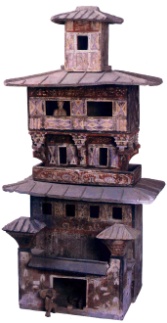
Model of earthenware granary tower of Han period unearthed in Jiaozuo city
2.Earthenware watchtower
With certain height, most of the earthenware towers are 3—5 storied, with several windows on the top floor, apparently for enjoying a panoramic view from a high place. They are multifunctional architecture for overlook, recreation, guarding, defending and so on.
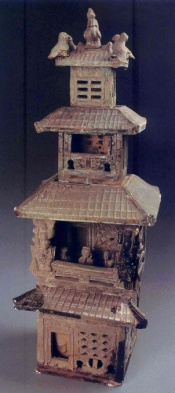
Earthenware watchtower unearthed in Lingbao city
3.Ceramic waterside pavilion
Waterside pavilion is built on waterside or in the pond. In the Spring and Autumn and Warring States periods, waterside pavilions were mainly constructed in the royal courts and the grand residence of the nobles. Most of the models of ceramic waterside pavilions were unearthed from Sanmenxia, Nanyang areas of Henan province. The ponds are round or square in shape, in which some figurines of fish, tortoise, and duck were molded, in the middle of the pond stands a single-tower-typed building, generally 2—5 storied, the see-through structure facilitates ventilation. The waterside pavilion of Han dynasty features recreation, climbing and commanding the panorama.
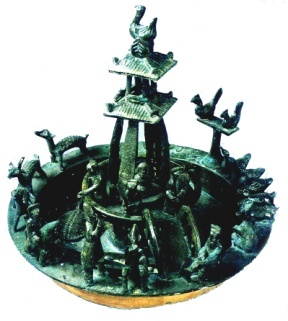
Green-Glazed Pottery Waterside Pavilion found in Xichuan county Henan province
In the Western and Eastern Han period, Agriculture was attached great importance, and state policies were made to highlight agriculture. Thanks to the series of measures for reviving and developing agriculture, agricultural economy progressed rapidly, and grain output increased significantly. Consequently, the storage of grain became more and more important, which led to the construction of numerous large scale official granaries by the central government and local government, and strict administrative rules formed correspondingly. On the other hand, since the mid Western Han, especially in the Eastern Han period, the manor economy of the wealthy and powerful landlords developed rapidly. Due to owning a great amount of grain, they requested to construct large scale barns. Consequently tremendous storage facilities became the symbols of wealth for individuals and the governments economically.
The earliest practice of interring the ceramic burial objects with the deceased was found in the tombs of the Eastern Zhou dynasty in Central Shaanxi Plain. After the founding of the Western Han court, the funerary custom was greatly influenced by the culture of Qin dynasty, thus the ceramic funerary models, named Mingqi, began to prevail in the tombs of the Western and Eastern Han dynasty. The Confucian concept of “View the deceased as the living” greatly influenced Han dynasty, numerous ceramic Mingqi, that is, the funerary objects of the various models, which symbolize the wealth owned by the tomb occupant whilst alive, began to come into being, and they are the objective representation of the tomb occupant’s desire to seize material and power whilst alive, as well as the true reflection of the manor economy of the wealthy and powerful landlords of that period.
The Colored Seven-Storey Joint Pottery Granary Tower comprises of four parts: the main building, the detached granary building, courtyard, roofed corridor(the covered bridge). The whole model is detachable, and all of the components are as many as 31 pieces.
The 7-story main building is made by following the structure of a wooden architecture. The first and the second floor are storehouses, the first floor is enclosed without any doors; on the second floor, four square entrances were cut on the frontal wall for grain, a exterior staircase from the first floor leads to the front balcony of the second floor. The above floors from the second floor are pavilion-shaped structure. The roofs of the second and the fourth floor are tiled with overhanging eaves, underneath the eaves are stretched bracing Dou and Gong. Above the eaves are balconies. Different numbers of doors and windows were cut on the frontal walls of each floor. The bottom of the seventh floor looks like a saddle placed on the ridge of the sixth floor. One window is in the center of the frontal wall.
The rectangular courtyard is in front of the main building, three sides walled. The front double-leaf door is in the center of the front wall, and flanked by two watchtowers. A figurine shouldering a sack of grain is striding inward the courtyard where a guard dog lies on the ground.
The detached building, a 4-story building, 128cm in total, is based on a platform. A slope with two-side handrail leads from the ground to the platform. A door on the front wall faces the slope. And one window is on the front walls of each floor from the second to the fourth storey. .
The connecting roofed corridor between the two buildings, integrates the two buildings into one fortified manor building. It is horizontal rectangular in shape, covered with roof , and a window in the front wall.
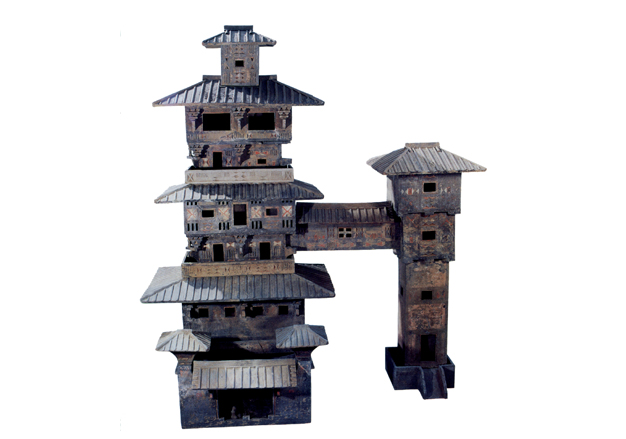
Colored 7-storeyed Earthenware Manor House With Connected Granary Tower
Period: Eastern Han dynasty
Measurement: 192cm high totally, 168cm in frontal width, 78cm long base.
Place: Excavated from No.6 tomb at Baizhuang village, Jiaozuo city, Henan province in 1993, now housed by Henan Museum.
Category: Burial object, Mingqi.