
Li Qin, Director of the Exhibition Dept. of Henan Museum, dedicating to exhibition design, and research on the culture and archaeology of the Pre-Qin Period.
The covered bronze ding with coiled serpent design had a zimukou (a structure with its upper part able to be plugged in the lower part), a deep belly with a pair of square upright handles on both sides. Under the circular bottom were three flared hoofs in the shape of beast head. A circular handle with six dents was attached to the exterior center of the cover that was decorated with whorl pattern, outside of which were three circles of plait pattern and two circles of coiled serpent pattern. The rim of the cover was decorated with cloud-in-triangle pattern, the upright handles with geometric design, and the belly with two circles of coiled serpent design and one circle of plait design. (Fig.1, 2 & 3)
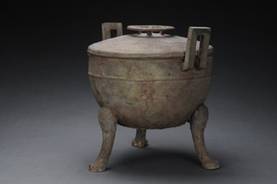
Fig. 1 Side of the covered bronze ding with coiled serpent design
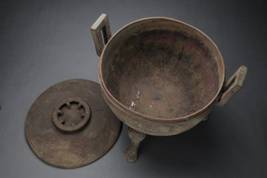
Fig. 2 A top view of the covered bronze ding with coiled serpent design
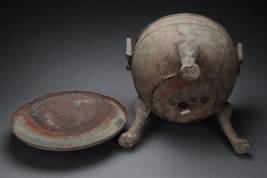
Fig 3 A bottom view of the covered bronze ding with coiled serpent design
The major design on the belly – coiled serpent design, underscored the trend in the design of the bronze wares in the mid Spring and Autumn Period. Also known as shewen in Chinese, the coiled serpent design was in a geometric shape formed by intertwined little snakes. It had, along with the interlaced hydra design (formed by the repetition of designs in the shape of a pair or more intertwined little chi dragons), dominated the bronze design for several-hundred years since they first appeared in the mid Spring and Autumn Period.
The covered bronze ding with coiled serpent design was unearthed in 1966 from the two timber-chambered tombs of the late Spring & Autumn Period in Gaodaochang, northwest of Huangchuan County, Henan Province. A total of 13 bronze artifacts were excavated, including ding, dui, fu, plate, yi, fou, zhou, etc., among them was the covered bronze ding with coiled serpent design served as one of the funerary objects. The Chinese characters “Cai Gong Zi Yi Gong Zhi Si Fu” (meaning “a vessel that belonged to Prince Yi Gong of Cai State for holding glutinous millet, rice and sorghum”) were inscribed on a bronze fu unearthed in Tomb 1. The textual research indicates that these bronze wares were relics of Cai State.
As one of the famous ancient states and one of the twelve important vassal states in the Chinese history, Cai State lasted nearly 700 years from the time it was established in the early Western Zhou Dynasty till it fell in the mid Warring States Period. In its heyday, its territory extended from west Anhui Province in the east to Funiushan region in the west, and from the foothill of Dabie Mountains in the south to the bank of Yingsha in the north, crossing the Ru and Huai rivers.
After Ji Fa, King Wu of Zhou, established the united Western Zhou Dynasty after he overthrew the Shang Dynasty in the 11th century BC, he employed the policy of “giving land to relatives and building vassal states to shield Zhou”. The land was given as enfeoffments to the royal family members or to the influential or meritorious nobles by different family names, setting up vassal states to fortify the new regime. Traditionally, as the former site of the Shang Dynasty in the Central Plains, Henan was the place where important vassal states in the early Zhou Dynasty were. King Wu assigned the land of Cai (now Shangcai County in Henan) to his brother Shu Du who became one of the famous Three Supervisors in the early Zhou Dynasty. Cai State held a unique strategic position to defend against the State of Chu from the south and shield the Central Plains against invasions from the north in the Western Zhou Dynasty. However, it became the first state to submit to the rule of Chu in the mid Spring and Autumn Period, and Cai became a tributary state to Wu in the late Spring and Autumn Period until it was finally annihilated by the State of Chu in 447 BC. With the changing political situations in the Spring and Autumn and Warring States Periods, Cai moved its capital from Shangcai to Xincai and eventually to Xiacai (Fig. 4).
During the 700 years in existence, Cai State had experienced several rises and falls. In the early Zhou Dynasty, it served as the fortress in the south, and later was turned into a gateway to the State of Chu in the north, as well as a strategic central position that linked the defense lines of the States of Wu, Yue and Chu, leaving behind a history full of stories and mysteries.
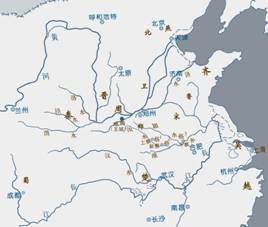
Fig. 4 Shangcai, Xincai, Xiacai – the capital moving route of Cai State
The cultural relics unearthed at the site of Cai State showed that they followed the traditions of the Western Zhou Dynasty in the early Spring and Autumn Period. But the trend prevailing in Chu State became popular in the mid to late Spring and Autumn Period, indicating that Cai was the place where the Central Plains rivaled Chu State. Following the decline of the Zhou Dynasty, Cai dwindled from a state that protected the southeast of the Zhou Dynasty to the prey of the big powers and was finally assimilated into the culture of Chu.
Similar design of the body of the bronze ding from Cai State in the mid to late Spring and Autumn Period excavated in Gaodaochang of Huangchuan County could be found in the same kind of bronze wares of Zheng, Wei, Jin and other states in the Central Plains, including the ding with coiled serpent design unearthed from the Great Tomb of Duke Zheng in Xinzheng of Henan and the bronze ding excavated from the tomb of the nobles of Jin State in Houma, Shanxi Province. (Fig. 5, 6 & 7)
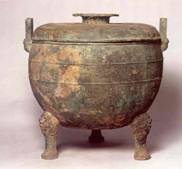
Fig. 5 A covered ding with coiled serpent design unearthed from the Great Tomb of Duke Zheng in Xinzheng, Henan Province
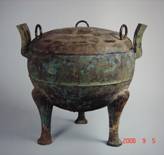
Fig. 6 A covered ding with coiled serpent design unearthed from Tomb A in Liulige, Hui County, Henan Province
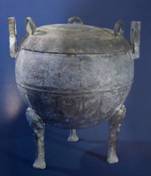
Fig. 7 A bronze ding excavated from the tomb in Shangma Village of Houma, Shanxi Province
In addition, the fine and elegant design on the covered ding was achieved through fine, reticular and wide patterns on the body by the moulding method. It indicated that the technology of moulded pattern was in sync with that of the Central Plains. The decorative pattern was typical in the similar bronze ding from the Central Plains.
The ding with a tightened mouth that featured a protruding zimukou with a deep belly was found among bronze wares of Chu State. According to the materials available now, the word “Po Ding” was inscribed on the ding in the mid Spring and Autumn Period. Examples included “Peng Zhi Si Po” unearthed from M1 and M2 and “Po Ding” unearthed from M3 and M10 at Xiasi, Xichuan county, Henan Province. (Fig. 8, 9)
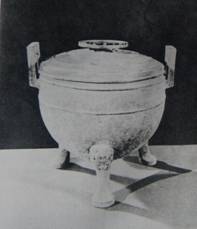
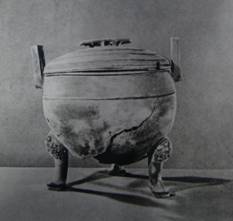
Fig. 8 Po Ding unearthed from M3 Fig. 9 Po Ding unearthed from M1 at
at Xiasi, Xichuan county, Henan Province Xiasi, Xichuan county, Henan Province
The ding of such design from the late Spring and Autumn Period to the late Warring States Period was called “Qiao Ding”, named after the inscription of such characters on the ding. The Deng Ziwu Ding (Fig.10) selected by Gengsheng warehouse in Hubei Province in 1971 had a total height of 27 cm, a mouth diameter of 23.1 cm and a belly depth of 17.1 cm. It featured a zimukou, a circle of protruding ridges under the mouth, a deep belly, a circular bottom, upright handles and flared thin and long hoofs. Each of the three hoofs was decorated with a beast face. Its neck and belly were decorated by interlaced hydra design, separated by convex bow-string patterns. The Chinese characters “Deng Zi Wu Zhi Si Qiao” (meaning “Deng Zizu’s ding for containing food”) were inscribed on the interior wall and the ding was therefore called “Si Qiao” (meaning “food container”). This was the earliest ding that had the inscription of “Qiao”. According to Explaining Simple and Analyzing Compound Characters, “Qiao is similar to ding with longer legs”. This ding indeed had longer legs that were slightly flared outward.
![C:\Documents and Settings\Administrator\桌面\K}%3`~U]6TP__8P3759$~IM.jpg](/images/attachement/jpg/site22/20130930/00248120257713b37beb0a.jpg)
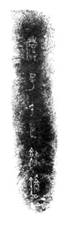
Fig. 10 The Deng Ziwu Ding and its inscription in the collection of the Wuhan Cultural Relic Store
Some scholars believed that the ding with three flared legs found in Chu State from the mid to late Spring and Autumn Period to the Warring States Period was made under the influence of the bronze wares of the States of Wu and Yue in the lower reaches of Yangtze River. The bronze wares of the Wu and Yue States in the Spring and Autumn Period were similar in many aspects and were collectively referred to as Wuyue Bronze Wares. The majority of them were unearthed in southern Jiansu, northern Zhejiang and eastern Anhui. As far as ding vessels were concerned, they differed from those of the Central Plains in that the three legs of them were flared, and they were named Ding in Yue Style. The earliest bronze Ding in Yue Style was excavated from Tomb 1 in Tunxi, Anhui Province (Fig.11) and Tomb of Yihou of the Western Zhou Dynasty in Dantu, Jiangsu Province. According to some scholars, the Ding in Yue Style originated from the pottery ding of the Shang and Zhou Dynasties in the lower reaches of the Yangtze River.
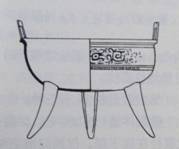
Fig. 11 The bronze ding unearthed from Tomb 1 in Tunxi, Anhui Province
The above analysis clearly showed that the covered bronze ding with coiled serpent design among these bronze wares excavated from Gaodaochang in Huangchuan was influenced by the culture of Chu. Such a design was new in Chu State in the mid Spring and Autumn Period. The character of the flared legs was an indication of the influence of Wu and Yue cultures in their interactions with Chu State.
The influence on the bronze wares of Cai State by those of Chu and in Yue Style could also be seen from the artifacts unearthed from the dukes’ tombs of Cai State from the late Spring and Autumn Period to early Warring States Period in Shou County and Caijiagang of Huainan County in Aihui Province. In addition to the elements of the Central Plains and Chu culture, these wares also displayed the characters of Wu and Yue cultures, which correlates with the account in the ancient literatures on the historic changes in Cai State.
In the mid to late Spring and Autumn Period, Chu was a powerful state that extended to the territory of Han and Huai river basins. However, the food container of Prince Yi Gong of Cai State unearthed in Gaodaochang of Huangchuan County indicates that this was very likely to be a tomb of Cai State. Why was a tomb of Cai State constructed in the territory of the powerful Chu State?
Your answer please, if you have any questions or answer, please feel free to send us email, we are waiting for your answers and participation, and your comments, answers and suggestions will be highly appreciated. We will select and publicize the most appropriate answers and comments some time in the future.
Weekly Selection Email: meizhouyipin@chnmus.net
The Political Marriages that Connected the Vassal States in the Eastern Zhou Dynasty
In the early Spring and Autumn Period, a declining royal court of Zhou prompted wars among the big vassal states that vied for the control of the country. In the fierce annexation warfare, the relationship between the vassal states was characterized by competition as well as cooperation, creating a very complicated situation. This left the smaller states with no choices but to seek protection from the big powers or fight them by uniting with other smaller states. Political marriage was often used as a diplomatic strategy by the vassal states.
In the Spring and Autumn Period, Zheng, Qi, Jin, Chu and other states were strong enough to compete for the dominance over the Central Plains while the only way for Cai State to survive was to rely on Zheng or Chu States sometimes but became tributary to the States of Jin or Qi in other times.
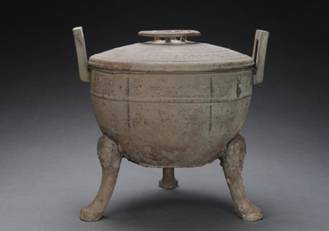
The covered bronze ding with coiled serpent design, bronze ware, dates back to the late Spring and Autumn Period with a total height of 35 cm, a mouth diameter of 31 cm and a weight of 5.6 kg. It was unearthed in Gaodaochang production team of the brigade by the same name, Longgu Commune, Huangchuan County, Henan Province in 1966, and is now collected in HeMuseum.nan Museum.