
Zhao Le: a museologist of the Collections Administration Department of Henan Museum, dedicated to collections design and research.
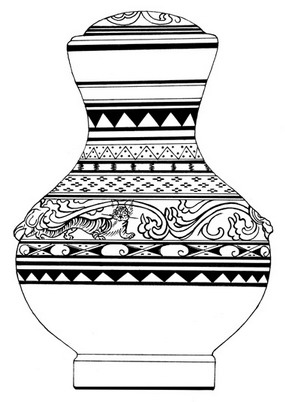
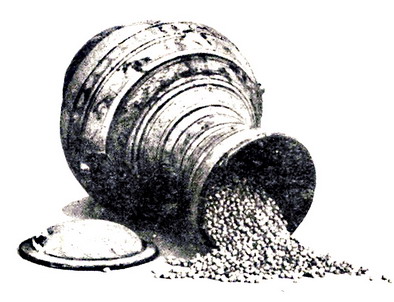
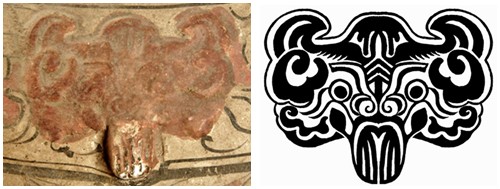
The knob of the pottery pot (Fig.3) features an animal mask with tao-tie (ogre-mask) design in the manner of bronze, which comprises eyes, eyebrows, horns, nose, ears, body, tail, legs and feet. It has two upright ears and round eyes; the eyebrows connect with a stylized nose, under which there is a more realistic presentation of a nose.
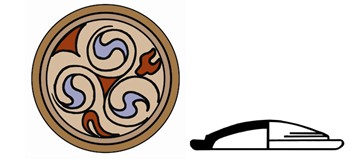
The covered painted pottery pot with four spirits pattern has nine groups of patterns (Fig.4). The main pattern is made up of four parts: the first part, white tiger; the second, cloud; the third, auspicious beast; the fourth, cloud. The cover with a diameter of 18.5 cm is decorated with the design of three pieces of cloud (Fig.5).
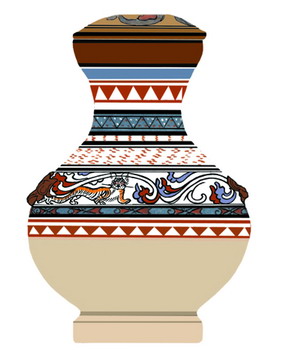
The white tiger and cloud are part of the theme patterns of the covered painted pottery pot with four spirits pattern (Fig.6). On the top and in front of the tiger is a group of cloud images that reflect the meteorological phenomenon and were illustrated in the freehand style popular in the traditional Chinese painting. Patterns of sacred tiger were often seen on objects unearthed from tombs of the Western Han Dynasty, with the tiger ears normally being long and pricked up. As the lower part of the pot is coated in white powder, the tiger is therefore called the auspicious beast white tiger. The clear image of the tiger on this pot makes it extremely valuable.
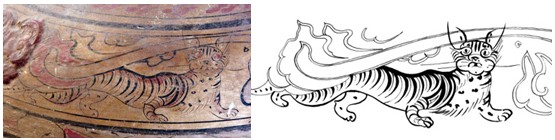
Fig. 6 The detail and drawing of the white tiger pattern on the painted pottery pot with four spirits pattern
The covered painted pottery pot with four spirits pattern was covered with mould stains when it was unearthed. It is the most representative of the kind dating back to the Western Han Dynasty unearthed from the tombs in Shaogou. It derives the name of “white tiger auspicious beast pattern” from the evident tiger pattern on its body. (Fig. 7)
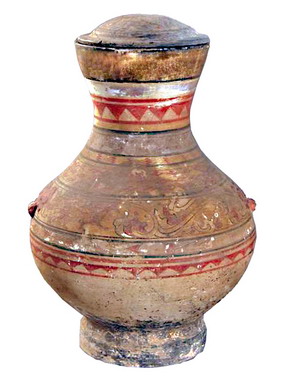
The covered painted pottery pot with four spirits pattern, (Fig.8), was likely to adopt wheel-making, moulding and hand-making techniques as it has the cover and knobs. The knobs were moulded and the cover was wheel-made (the knobs and bosses on the cover of some pottery pots were moulded as well). The ring foot was made on a wheel and then pressed to the bottom by hand. If fired at a high temperature, it would look pure grey on both the interior and exterior with a hard texture. If fired at a lower temperature, it would form a softer texture and both the interior and exterior would turn blackish grey produced by the smoke from a weaker fire due to the lack of oxygen. This ware suffered severe discoloring and peeling-off when excavated.
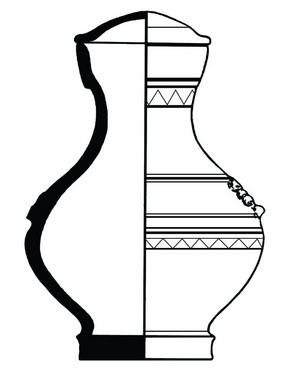
The early painted potteries in China were fired at a temperature of about 900°C. The unearthed kiln sites indicate that they were poorly sealed, which made the clay color of the potteries being fired turn grey due to oxidization.
The techniques of pottery firing had reached a fairly high level in the Han Dynasty and some methods are still being used today. The improvement in the firing technique of grey potteries in the Han Dynasty was demonstrated by the finished potteries in the stone-grey color. The even and high firing temperature of over 1000°C as a result of a perfect control created such a hard texture.
It reveals the information about the spiritual and cultural activities of the Western Han Dynasty. The images on the painted pottery pot with four spirits pattern has clear cultural meanings that represent the meteorological phenomenon, deity and mystery, auspiciousness and warding off evil spirits, making it a rare artifact of the Western Han Dynasty with high reference value in archeological dating and art.
In the Western Han Dynasty, Luoyang had been a well-known flourishing city. The entire Heluo region was located in a strategic place that linked Chang’an in the west and the Qilu culture in the east, making it a commercially booming area. The numerous potteries in various styles unearthed in Luoyang have provided an opportunity to understand the productivity at the moment and taste the profound cultural connotation. They are a reflection of the developmental status in the politics, economy, culture, religion and art in the society at the time.
The four spirits pattern matured preliminarily in the Western and Eastern Han Dynasties (Fig.9). It was used on the burial objects in the ancient tombs as an auspicious sign and included the four images of Azure Dragon of the East (up), the White Tiger of the West (down), the Vermillion Bird (Zhuque) of the South (left) and the Black Tortoise (Xuanwu) of the North (right), symbolizing the four directions of east, west, south and north and four seasons of spring, fall, winter and summer respectively. The Azure Dragon is a symbol of spring, the White Tiger of fall, the Black Tortoise of winter and the Vermilion Bird of summer. Before Xuanwu was created, a monster with a duck’s head, a scale-covered body, a fish’s tail and sometimes in the shape of Yufu (a half-human and half-fish creature) was used to represent the north. The four spirits emerged in the process of astronomical observation by the ancient people. Out of the four spirits, Xuanwu features the most bizarre look that combines the two animals of tortoise and snake and the image has gradually become the symbol of the deity of the north. According to Hong Xingzu of the Song Dynasty, “Xuanwu is a combination of tortoise and snake. It lives in the north and is called Xuan. Its body is covered with scale and therefore is called Wu.” The four spirits are also referred to as the Azure Dragon of the Eastern Palace, the White Tiger of the Western Palace, the Vermilion Bird of the Southern Palace and the Black Tortoise of the Northern Palace. From the Warring States Period to the Qin and Han Dynasties, the four spirits pattern was widely used to name the gates, halls, towers and palaces of the imperial palace, and to decorate architectural components, eaves and tiles and daily life utensils, symbolizing the deities from heaven that marked and guarded the four directions.
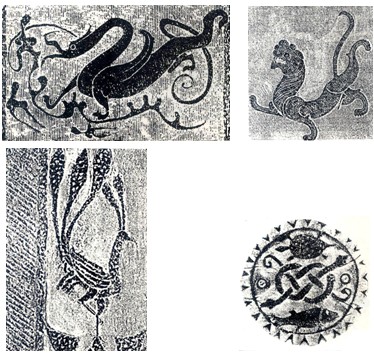
The designs on burial accessories in tombs of the Western Han Dynasty developed towards the secularized style that carried an auspicious meaning and was favored by the common people. As people’s perception of life and death in the Western Han Dynasty underwent a change and people viewed death as a change of living space, they started pursuing longevity and immortalization. Consequently, the concept of longevity and blessing became people’s dream and goal, which was reflected in the burial accessories that carried the wish and desire to make both the living and the dead happy, lucky and lasting safe.
The abundant and different types of painted potteries with decorative patterns have been unearthed in Henan in different periods. Below is a list of them that are representative.
A covered painted pottery pot was (Fig. 10). It is a storage vessel made from a grey pottery body in the Western Han Dynasty that measures 19 cm in mouth diameter, 103.9 cm in belly circumference and 48.7 cm in total height. It features the theme patterns of wide bow-string, saw-tooth, cloud-in-triangle, wave, flaky clouds, etc. The cover is decorated with cirrus pattern in vermilion, black and blue.
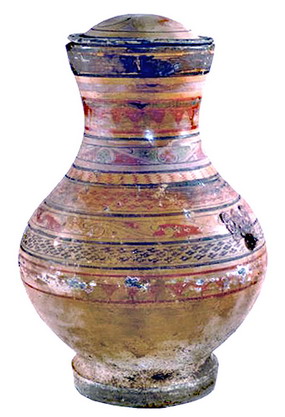
A covered painted pottery pot with four spirits pattern (Fig.11) of the Western Han Dynasty was unearthed in Luoyang Municipal Granary in 1958, with a total height of 49 cm, a belly circumference of 101 cm and a mouth diameter of 18.2 cm. The entire body is covered with red, green, purple and black patterns. The theme pattern is a reflection of the immortals ascending up to the heaven, and shows apparent characteristics of the Han Dynasty.
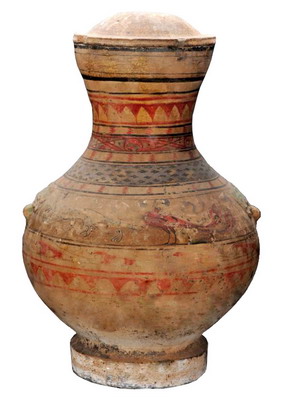
The painted pottery pot with hunting scene (Fig.12) that measures 44 cm in total height, 8.6 cm in mouth diameter, and 32 cm in belly diameter, was unearthed in Xigong District of Luoyang in 1974. The entire body is painted white, decorated with four groups of patterns in red and black. The pot features a theme pattern of hunting scene.
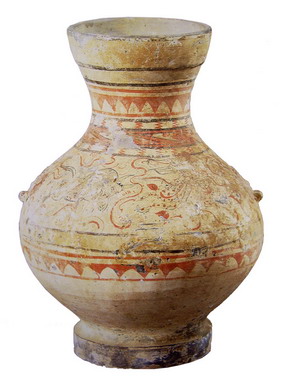
The painted pottery pot with four spirits pattern (Fig.13) that measures 40 cm in total height and 17.4 cm in mouth diameter was unearthed from the tomb of the Han Dynasty at the Wanji Lead Foil Company in the Hi-tech Development Zone of Luoyang in 2004. The entire body is painted white, decorated with five groups of geometric patterns and four spirits patterns in red and black, among which the image of white tiger is the most prominent.
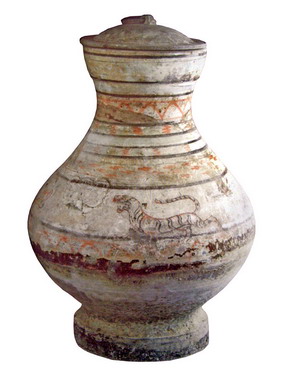
The covered painted pottery pot on a black ground (Fig.14) of the Western Han Dynasty that measures 115.5 cm in belly circumference and 57 cm in total height was unearthed from the tomb of the Han Dynasty in the Bricks and Tiles Factory in Luoyang in January 1960. The cover is raised in the form of a hill and the bottom is a trumpet-shaped ring foot. The pot features theme patterns of the cirrus and the stylized triangular banana leaf, surrounded by patterns of the auspicious cloud in fairyland.
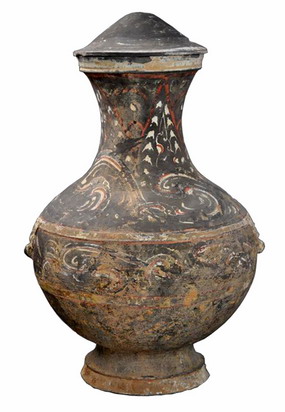
The covered painted pottery pot with triangle pattern (Fig.15) of the Western Han Dynasty that measures 12 cm in mouth diameter, 32 cm in height and 70 cm in belly diameter was unearthed at Shangcunling in Sanmenxia City in May 1975. It was wheel-made with the theme patterns of saw-tooth, triangle, and white pearls on a grey background.
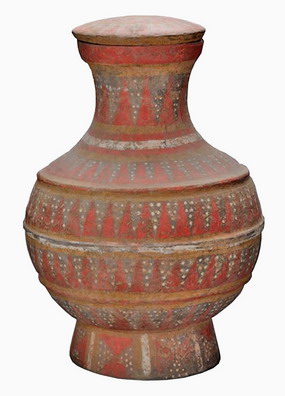
The covered painted pottery pot (Fig.16) of the Han Dynasty that measures 51 cm in total height, 110.5 cm in belly circumference and 18.6 cm in mouth diameter was unearthed at the flood control site in a factory in the western suburb of Luoyang in July 1959. The body of the pot is preserved intact but the paint peels off. It is decorated with fairyland designs without a main figure on a plain ground.
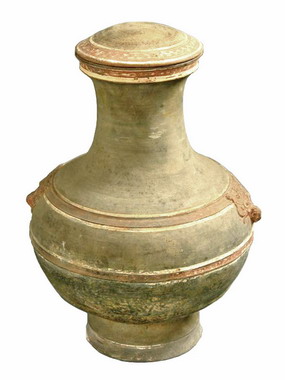
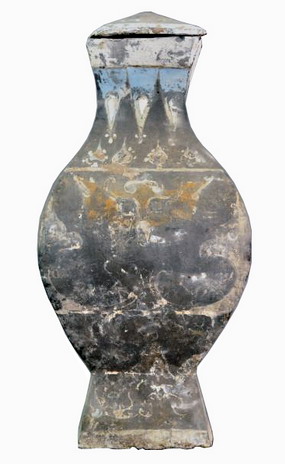
The covered painted square flat pottery ewer with animal mask design (Fig.17) of the Han Dynasty measures 41 cm in total height and 11 cm in mouth rim circumference, and is now in the collection of Zhengzhou Museum. It takes the shape of the bronze prototype fang, and is painted in blue, red and white. The two sides of the belly feature the symmetric design of animal masks with rings and the other two sides are decorated with stylized animal mask design. The other parts are decorated with cirrus pattern.
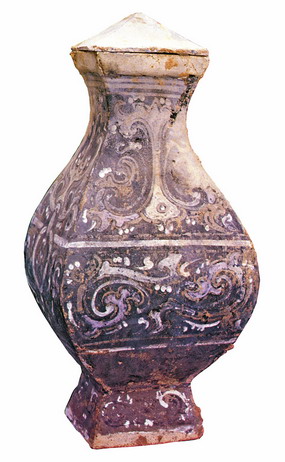
The covered square flat pottery ewer with painted cloud design (Fig.18) of the Han Dynasty measures 12.5 cm in mouth diameter and 48.5 cm in total height and was unearthed from a tomb of the Han Dynasty in the western suburb of Zhengzhou. It was wheel-made with hand-painted knob pattern. Symmetrical animal mask designs were painted on the two sides of the shoulder. The patterns of belt and stylized clouds in blue and white decorate the entire ewer from the top of the cover to the bottom.
All the above painted pottery pots are storage vessels. Most of the bodies are made from grey pottery and are decorated with powder painting, vermilion painting and colored painting on a painted ground. The colored painting used the red, umber, brown, green, black, blue, yellow and orange colors. The bodies were first painted in light black in a free style and then covered by other colors. The reddish pink was mainly used. However, it might be a result of discoloring. The designs were often separated by continuous dots, lines and triangles and the production techniques included wheel-and-hand-making, moulding and hand painting.
The potteries unearthed from tombs of the Han Dynasty in Shaogou are characterized by a silver luster on top of the original color. This is especially apparent on the knobs. In most cases, it was a result of a high temperature when the potteries were fired. It was created by applying a kind of solution on the surface of the body before it was put in the kiln to fire.
Where was the four spirits pattern painted other than on the wall of the pottery pots?
Your answer please, if you have any questions or answer, please feel free to send us email, we are waiting for your answers and participation, and your comments, answers and suggestions will be highly appreciated. We will select and publicize the most appropriate answers and comments some time in the future.
Weekly Selection Email: meizhouyipin@chnmus.net
Overview of the Structures of the Han-dynasty Tombs and Tomb 125 in Shaogou of Luoyang
The tombs of Han Dynasty in Shaogou are located 1.5 km to the northwest of Luoyang City, Henan Province. Potteries have been unearthed from every tomb in Shaogou.
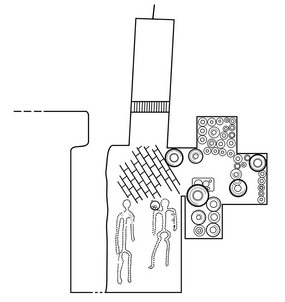
Tomb 125 of the Han Dynasty in Shaogou of Luoyang is located in the B2 Area. Its main burial chamber has brick-paved floor and the side chamber has a cross-shaped plan. The burial objects inside the chambers are in different shapes and mostly arranged in groups. The tomb buried two people who lied with their faces up and legs stretched out straight. It became popular from the early stage of the Neolithic Age among the Han people and most of the other nationalities, which symbolized the wish of “burial brings peace to the deceased.”
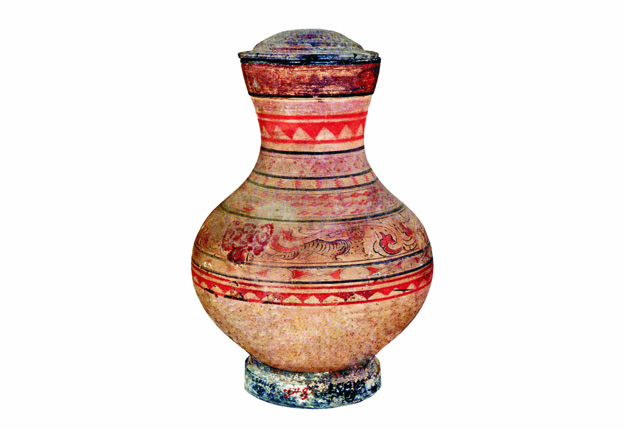
The covered painted pottery pot with four spirits pattern is a pottery storage vessel of the Western Han Dynasty that measures 47.6 cm in total height, 18.3 cm in mouth diameter, and 102 cm in belly circumference. It was unearthed from the tomb of the Han Dynasty in Shaogou of Luoyang, Henan Province, in 1953, and is now in the collection of the Henan Museum.