
Huteng Dance:
Huteng Dance, features jumping and leaping, was accordingly named. Hu means barbarian, refers to the nomads, esp. from Central Asia, Teng means, jump. Huteng Dance was popular among the northwestern ethnic minority groups in the Western Regions, and was introduced along Gansu Corridor into Chang’an by Sogdian, it was popular during Tang dynasty.
Huteng Dance looks forceful, vigorous, unrestrained, it was illustrated specifically in India texts in Sanskrit, and 108 kinds of such dancing images were carved on the walls of the Shiva Nataraja in south India, they were named Jand ava Laksanam, means Forceful, Energetic Dance. This is a evidence of the early dance exchange between China and India thousands of years ago. The noted Indian monk Bodhidharma had come to the Shaolin Temple in Songshan mountain for mission during the Southern and Northern dynasty period. One of the dances he taught “Dharma section” is a kind of forceful dance which is similar to martial arts.
Liangzhou is now Wuwei prefecture of Gansu province, lies at the east end of the Gansu Corridor, was not in the political administrative region of the Northern Qi, that is, in reality, it was not occupied by the Northern Qi court, why Fan Cui was appointed the provincial Governor of Liangzhou?
Your answer please, if you have any questions or answer, please fell free to send us email, we are waiting for your answer and participation, and your comments or answers will be highly appreciated. We will select and publicize the most appropriate answers and comments in the proper time.
Weekly Selection Email: meizhouyipin@chnmus.net
Prior to Han dynasty, the wine vessels were usually circular or square in shape in Central Plains. The nomadic people in the West and the North of China, invented a ovoid sheepskin wine pouch hanging on the saddle for adapting to the riding lifestyle. After coming to Central Plains, with the lifestyle changed, the nomads gradually got used to the ceramic wine flasks instead of the sheepskin pouch, therefore the ceramic wine vessels gradually took the place of the sheepskin pouch, but the unique characters of the Western Regions remained.
In 1986, a flattened green glaze flask was discovered at a construction site of the Grain Bureau of Yuanzhou District, Ningxia Hui Autonomous Region, now preserved at the Heritage Administration Institute of Yuanzhou District, Ningxia. The flask measures 11.3 cm in height of the remnant part, 9.5 cm in width, 5.4~4.7 cm in diameter of the foot. The belly is decorated with the Central Asian dancers, three people are dancing with one in the center on the round platform, against the background of the accompanists in the tree, forming a remarkable vivid performing scene. With exquisite craftsmanship, this flask depicts the Western Region dance introduced to the Central Plains.
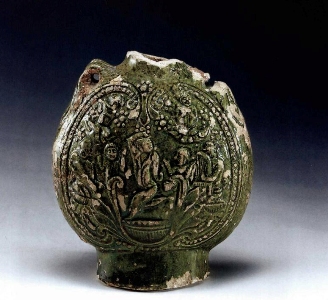
Flattened green glaze flask discovered in Yuanzhou District, Ningxia Hui Autonomous Region
Northern Wei(386~534 A.D)
A flattened flask was unearthed at Yumengou, Taiyuan city, Shanxi province in 1956, now housed by Shanxi Museum, it is 27.5cm high, 5.7cm in mouth diameter. On the body of the flask, a Central Asian figure stands in the center holding an article seems to be a floral bud, a pair of lions sitting at the front of the dancer.
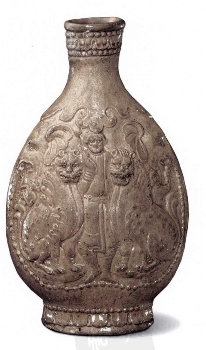
Yellow glaze flask with floral pattern
Northern Qi (550~577A.D)
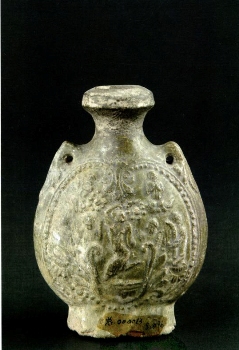
Double lacing holes flask with molded floral pattern
unearthed in Luoyang Northern Qi (550~577A.D)
In 1973, a olive brown glaze flask with double lacing holes was excavated at Luancheng county, Hebei province, housed by Shijiazhuang Municipal Museum at present. It is 22cm high, 7.5cm in mouth diameter, 16cm in foot diameter. Both side of the flask were molded a dancing mythical bird, circled by the molded grape pattern. The overall decoration produces a solid illusion of depth.
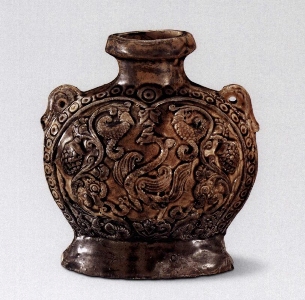
Olive brown glaze flask with double lacing holes excavated at Luancheng county,
Hebei province Northern dynasty—Sui dynasty(386---618A.D)
Based on the afore-cited comparison and the historical sources I collected, we found the continuing intermixture ethnically and culturally happened in the Central Plains in that period, and it was reflected by the constant changes of the household utensils in the era. Therefore the flattened flask diversified with different periods, areas, and cultures in the course of its evolvement.
Comparing with other existing flattened flasks from the same historical period, this flattened yellow glaze flask with Huteng Dancers from the tomb of Fan Cui is intact, with bright color, unique shape, and was elaborately made. The decoration is clear, the dancers are highlighted by the simple, neat and striking lines. It is a superb artwork among the similar articles from the same period.
The Huteng dance depicted on the flask has been confirmed as originating from the place of the Chach (around present day Tashkent, the capital of Uzbekistan) in the Central Asian region, one of the countries established by Sogdiana. Since Zhang Qian’s expedition to the Western Regions, Silk Road developed further, the merchants of the Western Regions brought their folk-custom, practices, music, dance to the Central Plain areas of China. The trade, conflict, friction, mixed residence, and intermarriage of the various ethnic groups further promoted the cultural integration between the Central Plains and the Western Regions.
Northern Qi dynasty was established followed the Northern Wei, Eastern Wei, with its territory covers the vast areas of the lower reach of the Yellow River, the present day provinces of Hebei, Henan, Shandong, Shanxi, and the northern parts of Jiangsu and Anhui. The social systems of Northern Qi are the result of succession and evolvement of the well developed Han culture.
Nevertheless, the tendency of westernization and Hu-orientation of Northern Qi regime is recognized by quite a lot historical scholars. For instance, Emperor Wen Xuan of Northern Qi, named Gao Yang, was born in 529 A.D, he began learning Han Classics from Han scholar- officials since his childhood, but none of the seven Dukes he conferred after taking the throne is of Han nationality. He always viewed himself as Xianbei nationality rather than Han, and believed that the Crown Prince was too Han-like in behavior, rather than as himself was, even considered deposing him. In the late of his reign, he usually wore Hu suits with his hair spreading.
Northern Qi regime was ruled jointly by Hu and Han people. The Xianbei nobles and Han scholars accounted for a considerable proportion in the governmental bodies. Professor Huang Shoucheng undertook a statistics and analysis on the central organ of the court of Northern Qi over the post of Prime Minister, found that among the 70 people who had ever been premier, 24 were ethnically Han, accounted for more than 34% of the total; Hu people and semi-Hu Han people, 46 people, roughly accounted for 66% of the total. The commercial activities of businessman from the Central Asia, Western Asia were quite flourishing in Northern Qi, and some of them even hold official posts of the government.
The obsession with Hu Culture by the ruling class of the Northern Qi court led to the prevailing of Hu culture in Northern Qi.
Northern Qi welcomed and encouraged the foreign traders, who were able to travel around freely for business all of the districts within its ruling areas.
Some emperors not only were obsessed with Hurong Music of the Western Regions, but also were able to compose new work.
The addiction to the music and dance of the Western Regions by the rulers of Northern Qi significantly influenced its academics and officials, as well as the general public, it created a great craze for the music and dance of Western Regions in the whole society. Hu Music and Dance had become a intermedium for the middle and lower classes, especially for the musicians to get promotion and ingratiate themselves with the nobles.
The Northern Qi regime’s favor for the excellent musicians who were proficient at Hu music and dance had gone too far that it was unbelievable for some happenings. Some musicians from the Western Regions were appointed to be high officials, such as Acting Provincial Governor, with the power of building his own official mansion, appointing his subordinates by himself, and etc, just as Three Ducal Ministers had. Though some musician were just around 14-15 years old, they were still appointed high post, just because they were capable of playing Pipa of the Western Regions, or being good at music and dance.
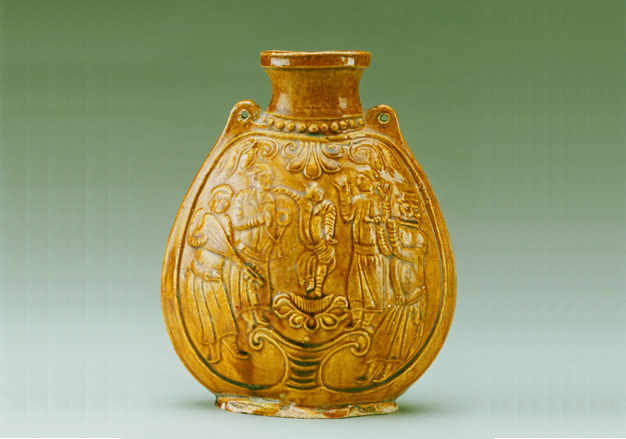
The original owner of this Flattened Yellow Glazed Pottery Flask is Fan Cui, a high rank military general of Northern Qi court, who had been granted as Piaoqi General while living. The pattern features the Huteng Dance molded on this flask from his tomb should have been prevailed at the time, it is also a witness to the culturally mutual exchange and integration between Central Plains and Western Regions.
In March 1971, a single-chambered tomb was found at Honghetun village, Anyang city, Henan province, and the tomb occupant was identified according to the tombstone as Fan Cui(548~575 A.D), a high rank general of the Northern Qi dynasty. Totally, 77 pieces of burial objects were discovered including 4 flat yellow glaze flasks, one of which is depicted in this paper.
Like a leather bag, this burial article has a flattened ovoid form tapering towards the edges, with short neck, flat and solid foot, a pair of small leaf-form handles on the shoulder with a hole for cord below the cup-shaped mouth, and outer beaded decoration around the neck.
The molded dancing scene on each side of the body is verified as the “Huteng dance” prevailed at the time. The dancer in the center dances on a lotus-shaped platform, with his right arm stretching forward, his left arm downward with palm toward backward, two feet seems leaping with the rhythms, and turning his head backward, the overall motif forms a highly dynamic scene.
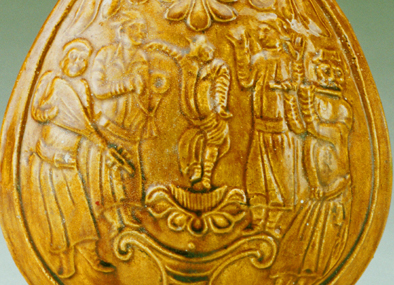
On the left side of the dancer stand two accompanists, one turns his body to right slightly, gazing at the dancer, his hands raised up for clapping; the other, bearded, is blowing a transverse flute. On the right side of the dancer, standing another two: one looks sidelong to left at the dancer, two hands striking cymbals; the other is playing a five-stringed Pipa. All of the five people are of high-nose, deep-set eyes, wearing foreign caps, narrow-sleeved robes, half booted, and waist belted, with the quintessential features of the people from the Western Regions.
Fact File:
Name: Flattened yellow glaze flask with musicians and dancers
Material:Pottery
Period:Northern Qi
Measurement:height: 20.5cm in total, width: 16.5 cm.
Excavation site and date: Fan Cui’s tomb of Northern Qi, Anyang city, Henan province in 1971.