Published treatises:
On the dragger axe of Xia & Shang dynasty and its usage in the battlefield.
The usage of the combat weapons before Qin dynasty.
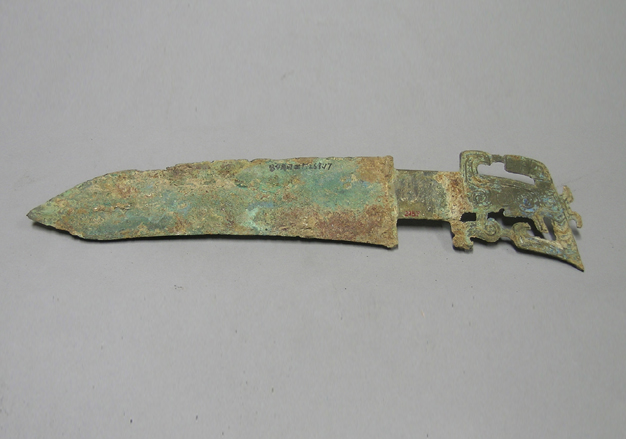
Bronze dagger-axes are divided into three categories in accordance with the shape of na or handle holder, namely, straight, curved and round handle holders. The “Yuan” dagger-axe features a curved handle holder.
This dagger-axe is quite unique in shape. The bronze edged weapons of the Shang Dynasty may feature a round-tipped tongue, pointed tongue or tongue shaped like top of gui (triangular top scepter). Nonetheless, the “Yuan” dagger-axe has an edge whose shape is different from all the above-mentioned. The upper edge is a smooth curve and the lower edge a straight line, featuring some characteristics of the shape of a triangular top scepter.
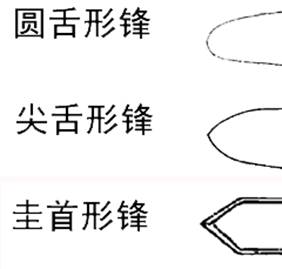
Shapes of dagger-axe edges popular in the Shang Dynasty
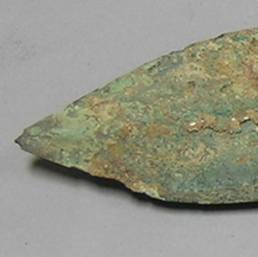
A raised ridge goes through the dagger-axe, but there is no lan or the raised part between the blade and the handle holder. Most of the dagger-axes of the Shang Dynasty have straight blades. The upper edge of the “Yuan” dagger-axe, however, slightly humps up, and the lower edge curves in. The entire blade of the dagger-axe slightly bends downwards. This is different from the popular shape then.
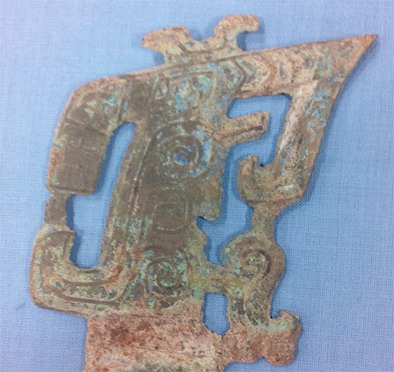
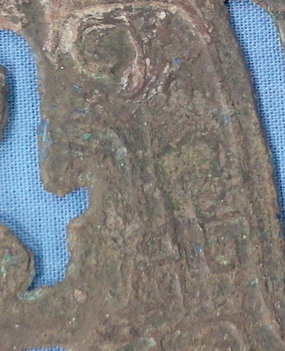
The handle holder of the “Yuan” dagger-axe is comparatively narrow at the front and is plain. The rear part of the holder features a bird pattern in openwork with a hooked beak and forked crown. The patterns on both sides are the same, except that one side is inscribed with the character “Yuan”.
Compared with an ordinary dagger-axe of the time, the “Yuan” dagger-axe is more exquisite in craftsmanship and larger in size. However, it was a burial object, instead of a weapon for practical use. There are two reasons for this. Firstly, the “Yuan” dagger-axe is light in weight and long in size. This 34.5-centimeter-long dagger-axe only weighs 230 grams, while a dagger-axe for practical use unearthed from the same tomb measures 25.1 centimeters long and about 370 grams heavy. Compared to iron, bronze is inferior in toughness and ductility, or brittle, to put it in a simpler way. The hardness, toughness and ductility of bronze must be kept in balance, so that a bronze dagger-axe could be used in fierce close combats. That’s why there were strict standards for the length and thickness of a dagger-axe for military use cast with a certain amount of bronze. Cast with a smaller amount of bronze, a dagger-axe larger in size was naturally thinner and its toughness and ductility would get worse. Such a dagger-axe would get broken at a collision. It couldn’t be used in a fierce close combat. Secondly, there is no lan part so that the handle couldn’t be well fixed to the dagger-axe. Therefore, the dagger-axe couldn’t be used in an actual combat.
The rear part of the handle holder of the “Yuan” dagger-axe is of a bird pattern in openwork with a hooked beak and forked crown. As described in Book of Songs: Eulogies of Shang: Black Swallow, “Black Swallow came from Heaven and gave birth to the people of Shang”. According to Records of the Grand Historian: Annals of Yin, “Qi of Yin was born to Jiandi, a lady from the Yousong Tribe and the second wife of Tribal Sovereign Ku. Having a bath at the riverside one day, Jiandi saw a black swallow lay an egg. She swallowed the egg and got pregnant. Later, Jiandi gave birth to Qi of Yin”. Both records prove that the people of Shang considered Black Swallow their ancestor. That might be the origin of the bird patterns on their bronzes. The bird pattern on the “Yuan” dagger-axe features large crown and beak and short body and tail. One side is decorated with cloud patterns and the other inscribed with the character “Yuan” (“爰”) in relief. In addition to this bronze dagger-axe, some other bronzes found in this tomb were also inscribed with the same character “Yuan”, including ding (tripod), lei (urn-shaped wine container), jia (wine vessel), gui (food vessel), gu (wine vessel) and jue (wine vessel). Archaeologists held that “Yuan” may be either the tomb occupant's name or the emblem of the tribe the tomb owner belonged to (2).
1. Tomb M269 and its occupant
The “Yuan” dagger-axe was unearthed from Tomb M269 of the Yin Ruins at Qijiazhuang. As indicated by the shapes and patterns of the objects and bronzes, as well as the combination of the objects, Tomb M269 dates from the late period of Phase III of the Yin Ruins Culture, or of the Era of Wu Yi, to be more accurate (4).
As indicated by the large number of burial objects unearthed from the tomb, the occupant of Tomb M269 must have been a noble living in the Era of Wu Yi. Covering an area of 6.46 square meters at the bottom, the tomb was actually for a medium-ranking noble. There were three gu and two jue among the burial bronzes. Two of the three gu are of the same shape, so are the two jue. They must have been a set of two gu and two jue. Such a set of burial objects was for a medium-ranking noble then. Plus the tomb size, the tomb occupant must have been a secondary-ranking noble living in the Era of Wu Yi. The dagger-axes and spears as burial objects must have been used to indicate the tomb owner’s identity as a military officer. In addition, two bronze yue (battle-axe) were unearthed from the tomb as well, further proving the tomb owner’s identity as a higher-ranking military officer of the Shang army.
The character “Yuan” (“爰”) inscribed on the handle holder was actually the name of a tribe that had close relationship with the royal family of the Shang court as early as in the Era of Wu Ding (5). According to the information available, the tomb occupant of Tomb M269 of the Yin Ruins at Qijiazhuang must have been a secondary-ranking military noble from the Tribe Yuan closely connected to the royal family in the late Shang Dynasty.
2. The organization and weapons of the Shang army indicated by the dagger-axes and spears unearthed from Tomb M269
Sets of weapons, including 10 dagger-axes and 10 spears, were unearthed from Tomb M269. The dagger-axes are of the same design, so are the spears. It indicates that they were arranged in sets. Mr. Yang Shengnan held that “the Shang army was organized in a decimal system” (6). Accordingly, the 10 dagger-axes and 10 spears symbolized two basic units of the Shang army.
A major weapon adopted in the Shang Dynasty, dagger-axes were never used alone in the Shang or Zhou armies, though. Instead, a dagger-axe was always used together with other weapons. A set of dagger-axe and spear was a major combination in the Shang and Zhou dynasties.
A set of battle-axe and spear was a combination earlier than that of dagger-axe and spear and particularly widely used in the Shang Dynasty. For example, a set of two dagger-axes and one battle-axe was discovered in a pit at Nanshuncheng Street in Zhengzhou, dating from the period between Baijiazhuang Phase and Phase I of the Yin Ruins Culture. However, dagger-axes and battle-axes were both swinging weapons. Such a combination could thus hardly be used in an actual combat. Besides, the number of battle-axes unearthed is much smaller than that of dagger-axes. Therefore, the battle-axes in such a set must have been the symbol of military authority. The set was thus not for actual combats at all. However, dagger-axes and spears were combined into a practical military weapon, which has been proved by historical documents and archaeological excavations.
According to Book of Documents: Speech at [the Battle of] Muye, the commander of the Zhou army gave a speech to mobilize his soldiers before the Battle of Muye, “Get your dagger-axes, shields and spears ready for the battle”. The deployment was thus supposed to be that in which the soldiers with dagger-axes and shields stood in front rows and those with spears at the rear. In such a way, soldiers with swinging and thrusting weapons were properly deployed.
There were more tombs with dagger-axes and spears as burial objects in the late Shang Dynasty. Nonetheless, such a combination was only commonly found in tombs of those of higher social status and rarely seen in small tombs. For example, 119 dagger-axes, 97 spears, three battle-axes and two knives were unearthed from Tomb M160 of the late Phase III of the Yin Ruins Culture at Guojiazhuang, Anyang, Henan Province (10). As indicated by the number of those unearthed weapons, dagger-axes and spears were the main weapons used by the Shang army. As shown by the sets of small weapons, the late Shang army was composed of dagger-axe soldiers and spear soldiers. For instance, there was a set of one battle-axe, four dagger-axes and eight spears in the southeastern corner of the vault of Tomb M160 (11). A fighting unit enjoyed better combat efficiency by deploying swinging and thrusting weapons together. According to The Methods of the Sima: His Majesty’s Rites II written in the Warring States Period, “No efficiency is achieved without the combination of different weapons”. That is, weapons combined guaranteed the best combat efficiency of an army. The combination of dagger-axe and spear was the earliest practice to that theory.
Only a small number of dagger-axes of this shape were unearthed in a comparatively small area. In addition to the 10 dagger-axes unearthed from Tomb M269 of the Yin Ruins, some were discovered in Tomb M613 of the Shang Dynasty excavated in the west zone of the Yin Ruins between 1969 and 1977. A tomb of Phase II of the Yin Ruins Culture, Tomb M613 measures 3.54 meters long, 1.8 meters wide and covers an area of about 6.37 square meters. The unearthed burial objects include ritual vessels such as bronze tripods and bu (small jar), as well as a set of bronze wine vessels gu and jue (12).
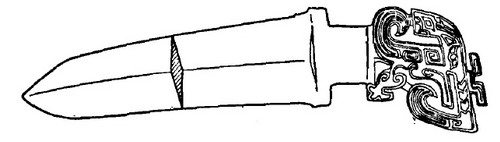
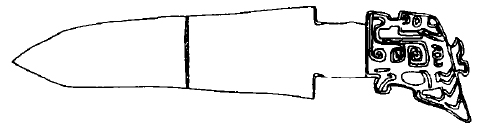
The No.5 dagger-axe unearthed from Tomb M15 at Liujiazhuang, Anyang, Henan Province, features a flat blade and measures 32.1 centimeters in length (Phase IV of the Yin Ruins Culture). Covering an area of about 3.92 square meters, the relatively small tomb was robbed before so that the tomb owner’s identity could hardly be defined through the burial objects. However, there was a human sacrifice and inner and outer coffins in the tomb, indicating that the tomb owner might be a lower-ranking noble or a rich commoner. (13)
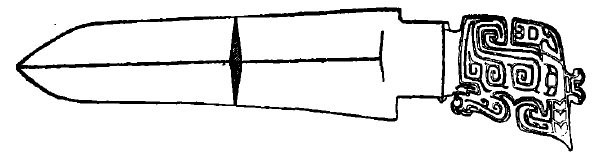
Archaeologists discovered two dagger-axes of the shape in 1983 when they launched an excavation project on Tomb 83SCKM1 in the Chang’an County, Shaanxi Province (Chang’an District, Xi’an City today). Either dagger-axe measures 18.7 centimeters long, belonging to Phase I of the Zhangjiapo Site. They had been cast before King Wu of Zhou sent an expedition against King Zhou of Shang. The tomb was to some extent damaged by tomb building in modern days. The excavation indicates that it covers an area of about 7.98 square meters and features a two-tier platform, with one outer and one inner coffin as well as two human sacrifices in the tomb. Either human sacrifice was buried with a wood coffin. The tomb owner must have been a noble. Archaeologists conjectured that the tomb owner belonged to a Zhou tribe, and the tomb dates from pre-Zhou period. (14)
All the dagger-axes mentioned above feature curved handle holders and served as burial objects. Nonetheless, there are nuances between them. For example, all the dagger-axes feature trapezoid blades, except for the one unearthed from Tomb M15 at Liujiazhuang, Anyang, which has a flat blade. Moreover, nuances are found in the forked-crown bird patterns in openwork at the rear part of the handle holder.
As shown by the archaeological discoveries, dagger-axes of the shape were only found in the tombs belonging to Phases II-IV of the Yin Ruins Culture and used by both the Shang and Zhou people. Tomb M269 in Anyang belonged to a medium-ranking noble, Tomb M613 in Anyang and Tomb 83SCKM1 in Chang’an District, Shaanxi, to nobles, and Tomb M15 at Liujiazhuang, Anyang, to a rich commoner at least. Therefore, the dagger-axes of the shape must have been the burial objects for the people of higher social status in the Shang Dynasty.
Why the “Yuan” dagger-axe is considered a burial object? In the tombs of which social class were the dagger-axes of the shape discovered?
Your answer please, if you have any questions or answer, please feel free to send us email, we are waiting for your answers and participation, and your comments, answers and suggestions will be highly appreciated. We will select and publicize the most appropriate answers and comments some time in the future.
Weekly Selection Email: meizhouyipin@chnmus.net
Yin Ruins Culture refers to that of the late Shang Dynasty. As cited in Records of the Grand Historian: Annals of Yin: Correct Interpretation from Bamboo Annals, “The Shang court didn’t change its capital city during its 273-year reign in Yin from the time when Pan Geng led his people there to the collapse of Shang when King Zhou was defeated”. Twelve kings ruled during the 273 years of the Shang Dynasty. There are basically two types of archaeological periodization concerning the Yin Ruins Culture:
I. The four-phase theory by Mr. Zou Heng from Peking University
Phase I: Pan Geng, Xiao Xin, Xiao Yi
Phase II: Wu Ding, Zu Geng, Zu Jia
Phase III: Lin Xin, Kang Ding, Wu Yi, Wen Ding
Phase IV: Di Yi, Di Xin
II. The four-phase theory by Mr. Zheng Zhenxiang from Anyang Work Team of the Institute of Archaeology, Chinese Academy of Social Sciences
Phase I: Pre- and early Era of Wu Ding
Phase II: Late Era of Wu Ding, Zu Geng, Zu Jia
Phase III: Lin Xin, Kang Ding, Wu Yi, Wen Ding
Phase IV: Di Yi, Di Xin
Bronze dagger-axes were the major bronze weapons of the Xia, Shang and Zhou dynasties and divided into three categories in accordance with the shape of na or handle holder, i.e., straight, curved and round handle holders. The earliest bronze dagger-axe discovered so far was unearthed from Erlitou in Yanshi, Henan Province, and belonged to Phase III of the Erlitou Culture.