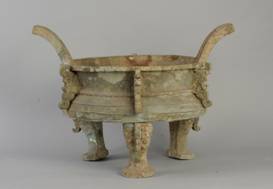
Ding has a long history in China. Originally it was used as cooking utensil. In the Shang and Zhou dynasties it became the core of ritual vessels, symbolizing state power and indicating the owners’ positions in the social hierarchy. Chu-style ding was created by Chu people, only or mainly used by the Chu State for some time and exhibiting distinctive features. The Kehuang Shengding is a representative of typical Chu-style ding of the mid Spring and Autumn Period.
Historical records show that ding of the Spring and Autumn Period fell into at least two categories. Those designed for cooking were called huoding, and those used for storing food, shengding. Sheng means to put cooked meat into another kind of ding, hence the name. Ancient nobilities regarded shengding as the most important of all ding vessels, therefore, some called them zhengding (official ding).
Generally, ding in the early Spring and Autumn Period inherited the simple and solemn style of Western Zhou Dynasty, as exemplified by the Bronze Dake Ding with a round belly and the Maogong Ding. In this context, Chu-style shengding was, without a doubt, artistically innovative with hallmarks such as a narrow waist, a flat bottom, flaring handles and a contracted body. With strikingly magnificent design, it looks vigorous and lofty.
 |
 |
Dake Ding Maogong Ding
Feature 1: A narrow waist. A narrow waist and a contracted belly were bold changes to traditional ding designs in the preceding several thousand years. The undulating S-shaped design, in particular, showed Chu people’s fondness of ingenuity and liveliness. In addition, the design was based on practical considerations, because a narrow waist enables a shengding to look bigger than it actually is and users could prepare a seemingly lavish feast with less meat.
Feature 2: A flat bottom. In traditional ding designs after the Shang and Zhou dynasties, a rectangular ding featured a flat bottom generally, while a round one had a round bottom. However, Chu people introduced harsh and forceful horizontal lines to round ding which mainly comprised arcs. Therefore, the vessel displayed an impressive visual effect and a strong rhythmic appeal.
Feature 3: Flaring handles. Shengding is characterized by a pair of flaring arc-shaped handles. From a mechanical point of view, the design may have been related to the ways in which forces acted upon the vessel when it was carried or transported. It also aimed to foster a brand-new artistic image different from traditional bronze ding. Such handles added to the loftiness, ingenuity and liveliness of the imposing vessel. This unique design resulted from bold innovation by liberal-minded Chu people at a time when Chu, which had developed itself into a strong state, vied with states in the Central Plains for supremacy.
Chu culture is an important branch of ancient Chinese culture. With the Jianghan Plains as the center, Chu people developed a distinctive culture showing strong local features under the comprehensive impact of primitive religions, witchcraft and mythology. While appreciating beauty of nature and dynamic life, Chu people preferred bright colors and complex designs. In artistic creation, they frequently resorted to the techniques of deformation and exaggeration. In contrast to the culture in the Central Plains, which is characterized by a bold, magnificent and masculine style, Chu culture features a combination of gentleness and toughness with a passionate vigor.
This unique feature of Chu culture emerged in the special geographic and cultural environment in ancient Chu State. The livable natural environment there laid the material groundwork for Chu people’s diverse spiritual pursuits. At the same time, Chu State in the pre-Qin period was located by the desolate Yangtze and Hanjiang rivers. Chu residents were therefore less restricted by the rigid rites of the Zhou Dynasty and freer to develop their individualities than their counterparts in the Central Plains. As a result, they were able to shape an unconventional romantic culture.
The Chu State developed into a major power in the Spring and Autumn and Warring States Periods. A large number of unearthed vessels show that Chu-style shengding not only exhibited distinctive features, but also was subject to influences from the cultures of neighboring states. We’d like to introduce some of these vessels to our readers.
Seven ding vessels owned by Prince Wu of the Chu State (Wangziwu Ding) dating from the mid and late Spring and Autumn Period were unearthed in Xiasi, Xichuan County, Henan Province in 1978. One of them measures 66 cm in mouth diameter and 76 cm in height. It features a narrow waist, a flat bottom, flaring handles and hoof-shaped feet. Six dragon-shaped beasts cling to the rim of its mouth, while its belly is covered with demi-relief decorative patterns. Inscriptions on its cover and the inner side of its belly total 85 Chinese characters.

Wangziwu Ding unearthed in Xiasi, Xichuan County, Henan Province
Seven shengding vessels of various sizes belonging to Marquis Zhao of Cai State (Caihou Shengding) were discovered in the tomb of the marquis in Shouxian County, Anhui Province, in 1955. One of them measures 46.5 cm in overall height and 44 cm in mouth diameter. The lidless vessel features a narrow waist, a flat bottom, hoof-shaped feet, flaring handles, simple decorative patterns and six cloud-shaped ridges. A six-character inscription is seen on the inner wall of the vessel.
Caihou Shengding unearthed from the tomb of Marquis Zhao of Cai in Shouxian County, Anhui Province
The Shengding of Marquis Yi of Zeng was unearthed from No. 1 tomb in Leigudun, Suizhou, Hubei Province, in 1978. Dating back to the early Warring States Period, the vessel measures 35.2 cm in overall height and 42.2 cm in bottom diameter. It features arc-shaped and flaring handles, a shallow belly, a narrow waist, a flat bottom and hoof-shaped feet. Four symmetric dragon sculptures in full relief as well as inlaid design decorate the outside of its belly. Seven characters were inscribed on the inside wall.

Shengding of Marquis Yi of Zeng unearthed from No. 1 tomb in Leigudun, Suizhou, Hubei Province
The Zhuke Shengding of the Warring States Period, unearthed from the tomb of a king of Chu in Zhujiaji, Shouxian County, Anhui Province, in 1933, measures 51 cm in overall height and 48 cm in mouth diameter. The vessel features a narrow waist, a flat bottom, hoof-shaped feet and flaring handles. Four beasts with the gesture of peeping inwards adorn its belly. There is a nine-character inscription on the rim of its mouth.

Zhuke Shengding unearthed from the tomb of a Chu king in Zhujiaji, Shouxian County, Anhui Province
The comparison shows that shengding vessels were mostly discovered in Chu tombs or tombs of Cai, Zeng and other states in Hanjiang and Huaihe river basins which had close ties with Chu. That’s partly because Chu became so powerful that it gained dominance in the region in the mid and late Spring and Autumn Period and the Warring States Period and established a distinct Chu culture.
As far as their designs are concerned, each of the four shengding vessels has a narrow waist, a flat bottom and flaring handles, typical features of Chu-style shengding at that time. Ding vessels in the north and the Central Plains were characterized by short legs, and their legs became even shorter over time. Chu-style shengding vessels, however, evolved in the opposite direction, with their legs becoming increasingly longer. In particular, those of the Spring and Autumn Period were mostly decorated on the outside with ridges and intricate patterns, while those of the Warring States Period featured simplified decorations.
As for the time when the vessels were forged, clear evidence shows the Kehuang Shengding is dated to before 605 B.C., earlier than others. The vessel, with a design typical of Chu-style shengding, is the oldest one of the kind so far discovered. It is also deemed as the standard vessel for dating Chu-style shengding of the mid Spring and Autumn Period.
In what ways are incense burners often seen in temples today like and different from ding discussed in this article?
Your answer please, if you have any questions or answer, please feel free to send us email, we are waiting for your answers and participation, and your comments, answers and suggestions will be highly appreciated. We will select and publicize the most appropriate answers and comments some time in the future.
Weekly Selection Email: meizhouyipin@chnmus.net
A Profile of Kehuang
Kehuang was a grandson of eminent Chu Prime Minister Ziwen. Given his meritorious service in assistance to King Cheng of Chu, Ziwen’s clan was all-powerful in the state. In 606 B.C., Ziwen’s nephew, Ruo’ao Ziyue, then Chu Prime Minister, staged a rebellion when King Zhuang of Chu was personally led his formidable army to fight against Luhunrong people (an ethnic minority) in the north. The king, nevertheless, succeeded in suppressing the rebellion with his troops and had all members of the Ruo’ao clan executed. Kehuang, who was sent to Qi State as a diplomatic envoy, heard the news during a stopover in Song State on his way back. While his attendants tried to persuade him to take refuge in other states, Kehuang retorted, “Now that we have violated the king’s order, who will give us asylum? The king is Heaven, and isn’t it a futile attempt to escape from Heaven?”
Kehuang traveled day and night back to Ying, the capital city of Chu. After reporting to King Zhuang about his trip, he repented his clan’s crimes by shutting himself into a jail waiting for punishment. The king, who felt obliged to Kehuang’s grandfather Ziwen for his contributions to the governance of Chu, said to his ministers, “If we kill all the descendents of Ziwen, a competent and high-achieving statesman, how can we motivate our people to serve the country with loyalty? Kehuang would face the death penalty rather than fleeing. What a loyal official he is!” The king ordered to restore Kehuang to his original post and renamed him Sheng (birth), indicating that he had undergone a rebirth.
The above-mentioned tomb features a rectangular and vertical earth pit and a wooden coffin. Since it had been frequently robbed, there were only 252 funeral objects left, including six bronze ding. Inscriptions on the bottom of two of them read, “Ke Huang Zhi Sheng” (literally “Kehuang’s shengding”). The two are of the same design, and one of them is collected in Henan Museum. The vessel is lidless and has a pair of rectangular upright and flaring handles on the rim of its mouth, a narrow waist, a flat bottom and three hoof-shaped feet. There is a flat beast-shaped ridge on both the front and the back sides of the vessel, whose body is covered with various decorative patterns.

It is a standard Chu-style vessel of the mid Spring and Autumn Period for the following two reasons:
First, four characters “Ke Huang Zhi Sheng” were inscribed right in the center of its inner bottom. Kehuang, the person mentioned in the inscription, was an advisor to the king of Chu State according to the Chronicle of Zuo. Since it belonged to Kehuang, there is no doubt that it is a Chu-style ding.
Second, a chapter documenting the fourth year during the reign of Duke Xuan of Lu State in the Chronicle of Zuo stated that Kehuang’s name was changed to Sheng in that year, or 605 B.C. The inscription referred to the man by his old name, a convincing indication that the vessel was made before 605 B.C. when Kehuang was renamed.

The discovery of the Kehuang Shengding not only brought to light a story that highlighted the advisor’s loyalty and patriotism, but also provided important clues for research on the exact date of No. 1 tomb at Heshangling, Xichuan County, and on bronze art at that time. The artifact is therefore of great historical, cultural and scientific values.

