
Editor of journal Heritages in Central Plain, with a master degree on ancient history, serving in Research Dept.of Henan Museum at present
The horse has a bridle on the head and a bit in the mouth. Its cheeks are flanked by Xingye. Its eye sockets are outlined with ink. The front mane on the head is loosely divided into several sections, and the mane on the neck and back is well trimmed. On its back there is a saddle and the screens, the former covered with Anfu. Both the girth and rear strap are decorated with Xingye. The saddle and mane are painted red, and Xingye, green. Made of white clay pottery, it is molded and stands on a rectangular plate. A rare masterpiece of pottery horses of the Tang Dynasty, it shows the superb skill of artists of pottery sculpture then, and provides a physical material for the study of pottery art and funerals of the Tang Dynasty.
At the beginning of the Tang Dynasty, there were only 5,000 horses. Through various measures taken by the Tang government and under the care of officials in charge of horse administration that were led by Zhang Wansui, the number of horses was greatly increased. From the Zhenguan period to the 40th year of Linde period, the Tang government announced that they had had 706,000 horses (Fig. 1). For example, Li Shimin, Emperor Taizong of the Tang Dynasty, was fond of superior horses. During the process of establishing the Tang Dynasty, he had six war horses accompanied him, and ordered to carve their images in front of his mausoleum so that they could stay together forever (Fig. 2). While the Tang government developed a complete set of system for horse administration, the emperor also introduced a system for management of imperial horses at court. Exotic horses raised by Hu people were popular among Tang people ("Hu people" is the collective name given to all northwestern minorities by the ancient Han Chinese people), which were mainly acquired by way of border trade. And such horses were mainly used to improve the quality of domestic horses and reproduce high-quality horses. At the time, horses were not only for military use, but also had been integrated into and become an indispensable part of people’s daily life.
1. Men riding horses. In the Tang and Song Dynasties, riding horses became popular. Men, from upper to lower class, regarded it an honor to ride horses, and they rode horses to attend some grand ceremonies (Fig. 3, 4).
2. Hu people and horses. Among unearthed funeral articles, we often find Hu people together with horses. These Hu people from exotic nomadic minorities were good at raising horses. They, of a low status, were dedicated to managing horses for the nobles. (Fig. 5, 6)
3. Women riding horses. In the Tang Dynasty, women were restrained less by feudal rites. During Emperor Taizong’s reign, they wore heavy Mili (a long veil to cover the whole body). In the reign of Emperor Gaozong and Empress Wu Zetian, they wore light Weimao (a kind of cap with veils hanging down). During Emperor Xuanzong’s reign, they worn Humao cap, and gradually they didn’t wear any cap at all. Moreover, they wore men’s clothes and shoes and rode horses on the street. (Fig. 7, 8, 9)
4. Playing polo. In the Tang Dynasty, all people, including the emperor, the officials and the commoners, loved this game. The mural of Playing Polo found in the tomb of Prince Zhang Huai represents the scene of scrambling for the ball at the time, and provides a true picture of the imperial family members playing polo. (Fig. 10)
5. Dancing horse. This performance was not provided at usual banquets, but only at grand ones. The silver flask with dancing horses holding cups in their mouths unearthed from Hejia Village in the southern suburb of Xi’an looks similar to what is described in Zhang Yue’s poem. (Fig. 11)
6. Hunting while riding horses. When hunting, people mostly rode horses, carrying falcons, hounds and cheetahs with them. In 1992 when the main tomb chamber of Jinxiang of the Tang Dynasty was excavated in the eastern suburb of Xi’an, a total of eight figurines hunting on horses were unearthed from the east and west walls along the tomb passageway. (Fig. 12)
7. Performing on horses. The painted figurines of musicians performing on horses (Fig. 13) unearthed from the tomb of Liu Kai and his wife in Yanshi and those in the collection of Henan Museum (Fig. 14) show different styles.
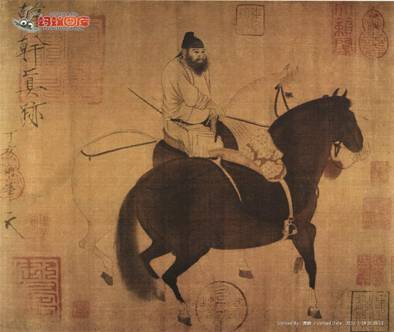
Fig. 1 Herding Horses painted by Han Gan
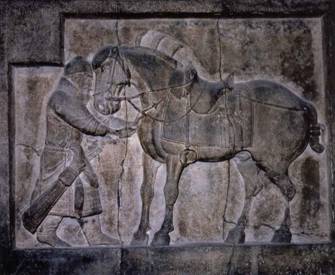
Saluzi, one of the six horses carved in Zhaoling Mausoleum of Emperor Taizong of the Tang Dynasty
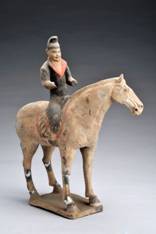
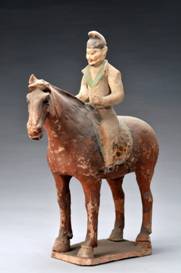
Fig. 4 Figurine of a man riding a horse (unearthed from Gongling Mausoleum of the Tang Dynasty in Yanshi in 1998)
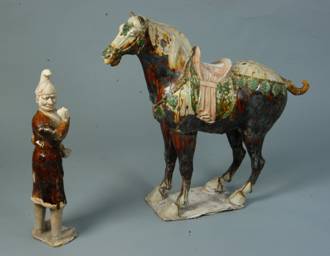
Fig. 5 Tricolored horse and the groom (unearthed from Luoyang in 1930)
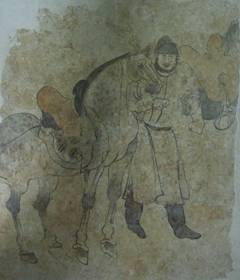
Fig. 6 Mural of a groom and horses on the east wall along the tomb passageway, the tomb of the wife surnamed Tang of Prince of Xiang who pacified the state, Tang Dynasty
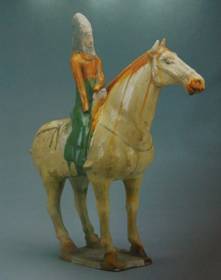
Fig. 7 Tricolored figurine of a woman riding a horse (unearthed from the tomb of An Pu and his wife in Luoyang in 1981)
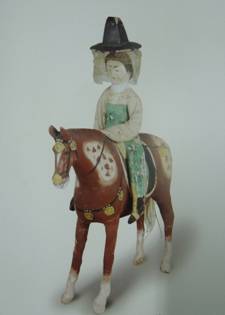
Fig. 8 Tricolored figurine of a woman wearing a Weimao hat and riding a horse (unearthed from Astana of Turpan in Xinjiang in 1973)
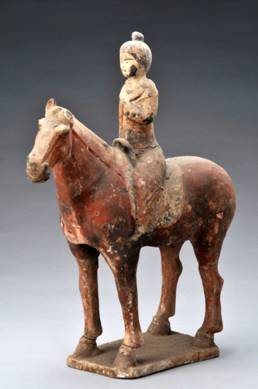
Fig. 9 Painted figurine of a woman wearing Hu-styled attire and riding a horse (unearthed from Gongling Mausoleum of the Tang Dynasty in Yanshi in 1998)
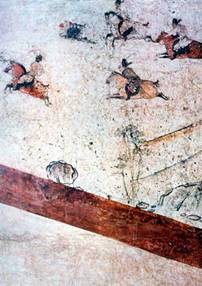
Fig. 10 Part of the mural of Playing Polo (painted on the west wall along the passageway in the tomb of Prince Zhang Huai in Qianling Mausoleum of the Tang Dynasty)
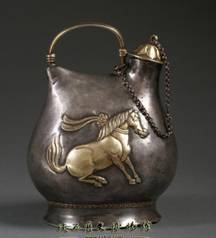
Fig. 11 Thesilver flask with dancing horses holding cups in their mouths (unearthed from Hejia Village in the southern suburb of Xi’anin 1970)
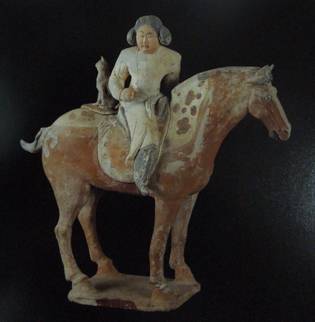
Fig. 12 Figurine of a woman hunting with a lynx and riding a horse (unearthed from the main tomb chamber ofJinxiang of the Tang Dynasty at Huokou in the east suburb of Xi’an, Shaanxi Province in 1992)
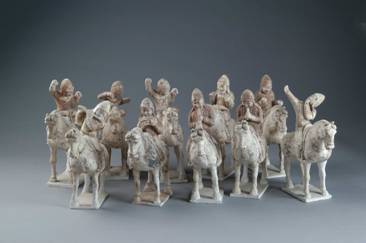
Fig. 13 Ten painted figurines of musicians performing on horses (unearthed from the tomb of Liu Kai, magistrate of Dingcheng in Guangzhou of the Tang Dynasty, and his wife, in Yanshi in 1984)
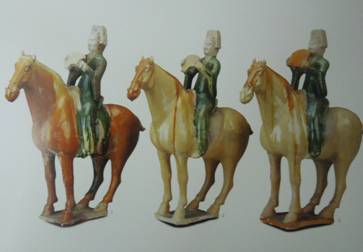
Fig. 14 Three tricolored figurines of musicians performing on horses (unearthed from Luoyang, Henan Province, in 1954)
In the Eastern Zhou Dynasty, the number of horses had become a symbol of people’s social status. In the Warring States Period, King Wuling of Zhao implemented the reform of “Wearing the Hu–styled Attire and Shooting from Horseback”, making the State of Zhao one of the seven major states at the time. Although a large number of figurines of cavalrymen were unearthed from Pit 2 of the Terracotta Warriors and Horses in the Mausoleum of the First Qin Emperor, horse-driven chariots and infantry still remained predominant. A wealth of figurines of cavalrymen were unearthed from the tomb of the Western Han Dynasty in Yangjiawan and they formed a grand cavalry troop, indicating that the cavalry had completely replaced chariot soldiers and become the main power in the battle at the time (Fig. 15). In the Eastern Han Dynasty, horses had become an indispensable part in people’s daily life, and their images were widely used in tombs (Fig. 16). The figurines on horses represent the procession during the nobles’ travel in the Western Jin Dynasty. At the time, saddles appeared, and single stirrup was used on one side of the horse, the earliest of the kind so far discovered in China (Fig. 17). During the Southern and Northern Dynasties, wars broke out frequently. Horses were armored for protection. In particular, Fig. 27 represents the image of completely armored horses then (Fig. 18). In the Sui and Tang Dynasties, horses were mainly represented in a perk-up manner, and a wealth of items related to the topic of horse have been discovered in tombs and daily life. The representation of horses at the time reflects not only people’s aesthetics of horses in the Tang Dynasty but also the image of exotic horses raised by Hu people in Central Asia (Fig. 19). The stone horses on the Sacred Way of Yongding Mausoleum of the Song Dynasty. Lack of horses had always been a problem bothering the government of the Northern Song Dynasty. There was no place to herd horses, nor superior horses to be bred (Fig. 20). The Yuan Dynasty had typical Mongolian horses. The tamed Mongolian horses were extremely brave in the battlefield. Horses had been part of Mongolian people’s life. And without such horses, it was impossible for them to conquer the Eurasian continent (Fig. 21). With the development of the society, some functions of the horse have been replaced, and the horse gradually steps down from the stage of history. However, people have never ceased their love and longing for horses. Domesticated thousands of years ago, horses witnessed how human society progressed. They have developed such a special bond with humans that made them a deep-seated symbol in human cultures and thinking. (Fig. 22).
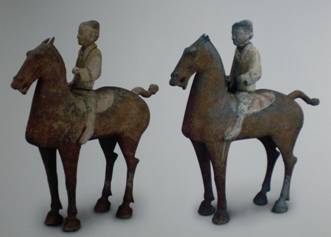
Fig 15 Terracotta warriors and horses unearthed from the Han tomb in Yangjiawan (unearthed from the attendant tomb of Changling Mausoleum at Yangjiawan, Xianyang, Shaanxi Province, in 1965)
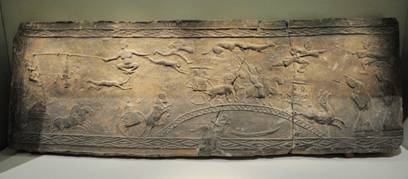
Fig. 16 Brick carved with the pattern of horse-driven carriages (unearthed from Xinye County, Nanyang City, Henan Province)
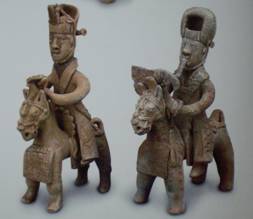
Fig. 17 Celadon figurines of cavalrymen (unearthed from Jinpenling, Changsha, Hunan Province, in 1958)
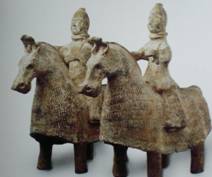
Fig. 27 Pottery figurines of warriors on horses (Northern Wei Dynasty, height: 38.5cm and 37.4cm respectively, length of horse: 34.5cm, unearthed from Caochangpo, Xi’an, Shaanxi Province, in 1953)
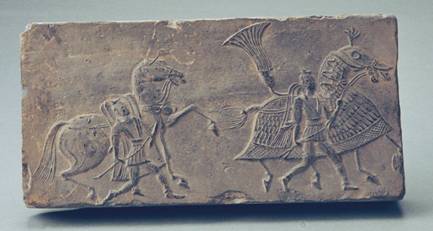
Fig. 18 Brick carved with war horses (unearthed from Xuezhuang, Dengzhou, Nanyang, Henan Province, in 1958)
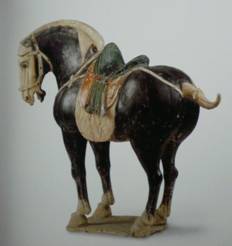
Fig. 19 Tricolored and black glazed horse (unearthed from Guanlin, Luoyang, Henan Province, in 1972)
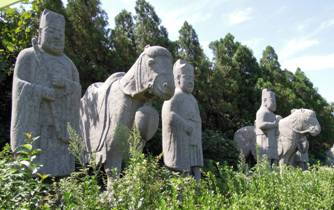
Fig. 20 Stone horses on the Sacred Way of Yongding Mausoleum of Emperor Zhenzong of the Song Dynasty (Gongyi, Henan Province, Northern Song Dynasty)
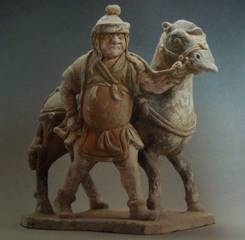
Fig. 21 Figurine of a horse-taming man (unearthed from the passageway in Jin Demao’s tomb at the intermediate post in Jiaozuo, Henan Province, in 2007)
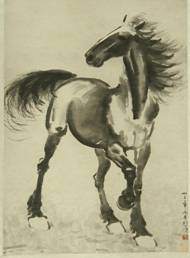
Fig. 22 Horse painted by Xu Beihong
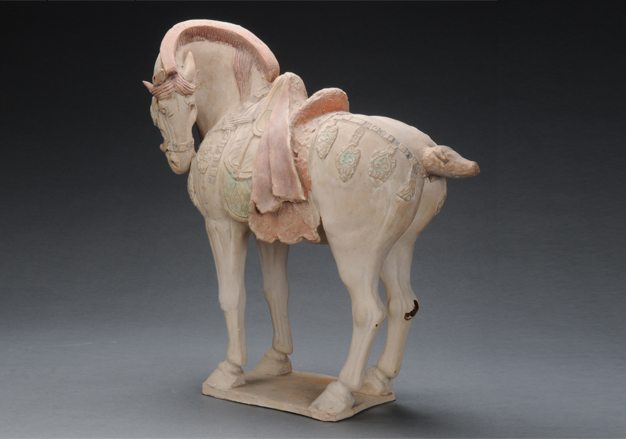
The painted horse with a turning head, falling into the category of the tricolored ware made in the prime of the Tang Dynasty, measures 48cm in height and 39cm in length. It was unearthed from Gongyi of Henan and is now in the collection of Henan Museum.