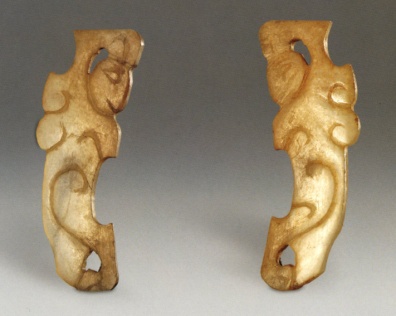
The jade pendant with a design of dancer appeared as early as the Warring States Period and became popular during the Han Dynasty. As one of the most fashionable accessories, it is the most unique among jade ornaments of the Han Dynasty in terms of its characteristics of both the times and arts. Han Jade pendants with a design of dancer are mostly carved out of small jade chips, with a profile of both elegance and simplicity. It seems a little plain compared with that of the Warring States Period. The jade pendant with a design of dancer was mostly used as a component of a set of pendants in the early Western Han Dynasty, and single-dancer pendants were very common in the middle of the Western Han Dynasty. There were also double-dancer ones. However, such jade pendants with a design of dancer became rarely seen after the Eastern Han Dynasty. The pair of jade dancers makes a posture of “stretching sleeves and bowed figure”, which is the most representative movement of “Long-sleeve Dance” of the Han Dynasty. Therefore, the pair of exquisite jade pendants is of high aesthetic value and rich cultural connotation, which can be used as precious evidence for the study of dance as well as ideology and customs of the Han Dynasty.
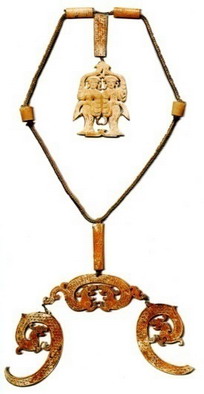
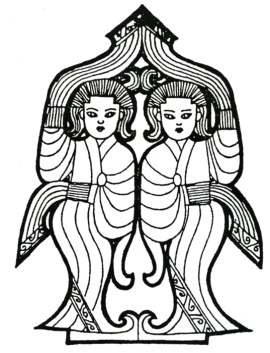
As one of the most representative dance in ancient China, the Long-sleeve Dance occupied an irreplaceable position on the list of ancient Chinese dances. It gained great popularity during the Warring States Period and reached its acme in terms of artistic level in the Han Dynasty,followed by the heyday of beautifully-shaped jade pendants with a design of dancer. A large number of well-made jade pendants with a design of dancer were excavated from the tombs of the Western and Eastern Han dynasties. The jade dancer profile of the Han Dynasty inherited and developed that of the Warring States Period. The Long-sleeve Dance, characterized by long flying sleeves, became the main feature of jade dancer accessories of the Han Dynasty. Each movement of the dance not only displays the dynamic beauty of human body, but also expresses the emotions of the dancer.
The all-embracing ideology peculiar to the Han Dynasty contributed to the great achievements in the dancing art. Political stability, centralized unity and economic prosperity were an important prerequisite of the free and flourishing development of the dancing art in the Han Dynasty. The dancing art was popular among the imperial court and ordinary people, with more increasingly rich forms. The jade dancer of the Han Dynasty, which took a posture of the Long-sleeve Dance of folklore dances, captivated both the noble and common people for its widely-accepted artistic style and gentle and graceful postures which could often be seen on many artistic carriers including pottery figurines and stone portraits of the Han Dynasty. The dancers expressed various complicated thoughts and emotions through different sleeve-stretching movements. Stretching sleeve and bowed figure, the most representative skills in the dancing art of the Han Dynasty, comprise a beautiful posture that becomes the root of beauty of implication of Chinese dancing art. Such a dancing culture has remained till today when the Long-sleeve Dance can still be seen in local dramas and many folk dances. It has various forms, including a solo, couple dancing and a group dance, among which couple dancing is frequently seen.
Jade pendants with a design of dancer made in the Han Dynasty were all excavated from tombs of kings who were invested during the Western and Eastern Han dynasties. These excavation sites are located in many regions, including Beijing, Hebei, Henan, Shaanxi, Shandong, Jiangsu and Guangdong, etc. For example, the jade dancer excavated from the Han Tomb at Dabaotai in Beijing was carved through piercing and lining on both sides to display her posture and manners. The one from the Han Tomb at Shiqiao, Xuzhou of Jiangsu, was an image of a bust incised on a square jade chip.
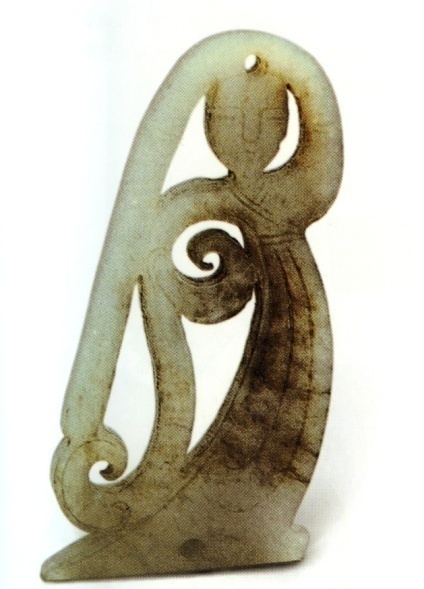
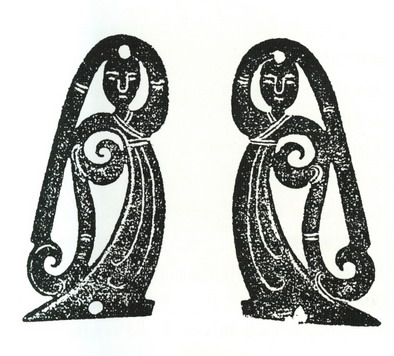
Jade pendant in the form of Female dancer and rubbings from No.2 tomb of Western Han at Dabaotai,Beijing
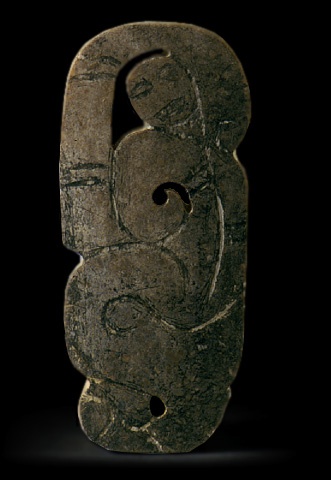
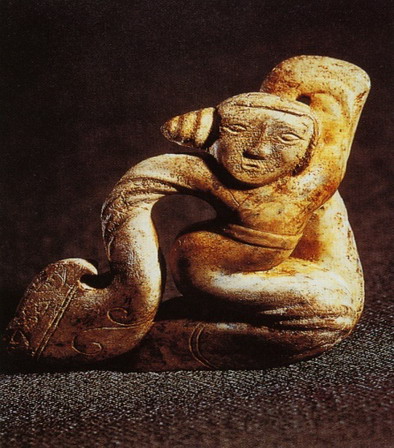
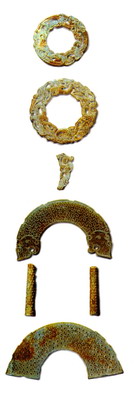
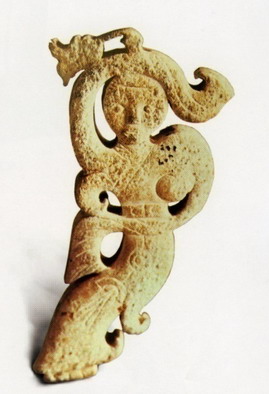
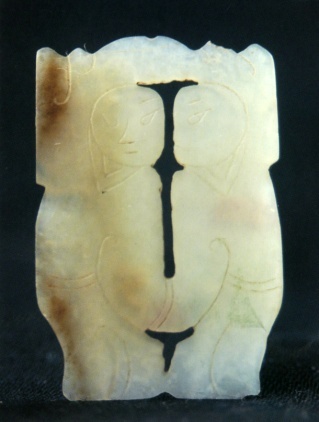
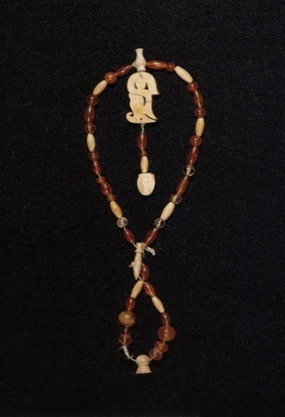
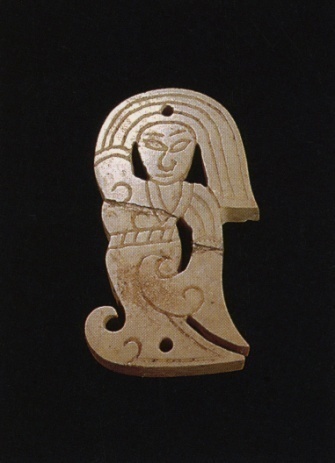
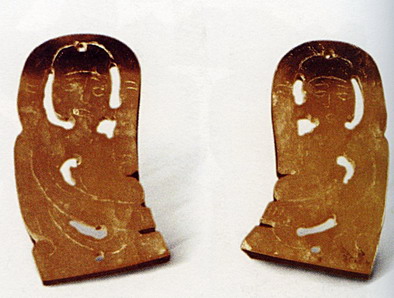
These jade pendants can not only display their distinctive cultural characteristics, but also share more common features in terms of basic design and decoration style, which demonstrate the mutual influence on each other of the Han jade wares as well as the ideology of the ruling class of the Western Han Dynasty. Jade pendants with a design of dancer of the Han Dynasty are not only excavated in a large number, but also are various in shape, delicate in design and fine in workmanship. The ones of the Western Han Dynasty have the edge on those of the Eastern Han Dynasty in terms of quantity, workmanship and artistic value. In addition to differences in the age of pendants and superiority of the tomb owners, jade pendants with a design of dancer differ distinctively in quality. The jade pendant with a design of dancer bears the mark of the times. It is an art masterpiece of realism of the Han Dynasty, reflecting the social life of the times. Those variations with the different periods and places show the social changes as well as the evolution of customs and thoughts of the Han Dynasty.
Dear friends, have you found that the dancers on the pair of jade pendant are baldheaded, without any hair carved? why? Due to its less fineness, or any other reasons?
Your answer please, if you have any questions or answer, please fell free to send us email, we are waiting for your answers and participation, and your comments or answers will be highly appreciated. We will select and publicize the most appropriate answers and comments some time in the future.
Weekly Selection Email: meizhouyipin@chnmus.net
Mt. Mangdangshan lies to the northeast of Yongcheng county, Henan province, the place where the tomb of Prince Liang of the Western Han Dynasty located, is also a rare royal cemetery where the tombs of princes distributed centrally. The tombs were mainly cut on the eight hills including Baoan Hill, Xishan Hill, and Fuzishan Hill, etc. Over 20 king’s (prince’s) tombs have been discovered up to now, with the time spaning the whole Han period.These tombs were cut in the rock, with a complicated structure and a spectacular overview. More than 20,000 items of treasures have been excavated, including colored murals, a jade burial suit, gilded chariots and harnesses, terra-cotta cavalrymen, and a lot of delicate jade wares of the early Western Han Dynasty, they are extremely rare treasures.
No.1 Han Tomb at Xishan is located on the top of the east section of Xishan, in the northern part of Mangshan Township. The tomb chambers were dug in the hill and their walls built of square stones. A large number of exquisite jade wares, bronze wares, iron wares, earthenware were excavated, among which there were over 1000 pieces of a jade suit, and other beautiful jade ornaments including some crystal and agate beads. It is verified that it is a stone-chamber tomb of Prince Liang of the late Western Han Dynasty.
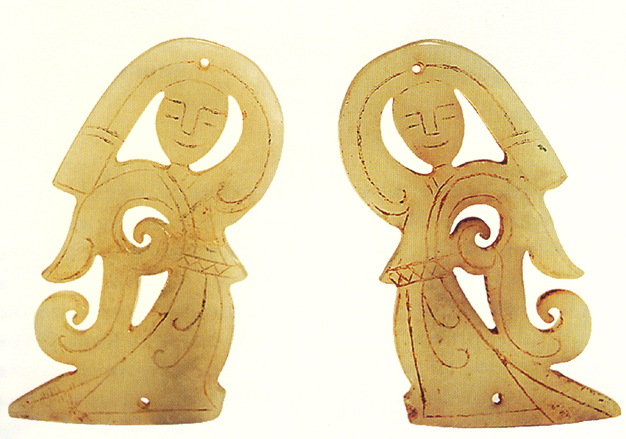
Article: Pair of White Jade Pendants Carved with Dancers
Category: Jadeware
Period: Western Han
Measurement: 4.6 cm in average height, 2.5 cm in width
Origin: discovered from No.1 Tomb, Royal cemetery of Vassal Liang at Xishan Mt, Mangdang Mount. Yongcheng city, Henan province in 1986.
