
Graduated from Zhengzhou University with Bechlor of Laws degree, holds a post at Henan Museum with an intermediate academic title Museology Researcher, devotes herself to study on museology and history.

Zhai Shufeng: Postgraduate student of the School of History and Culture, Sichuan University.
In December 1957, a tomb containing bricks with colorful patterns was discovered in Xuezhuang Village, 60 li northwest of Dengxian County, Henan Province. Dozens of potteries, coins and other artifacts were unearthed and sorted out. The tomb was built with specially made bricks that had relief patterns and were joined tightly with lime. This was the first one of the kind found in China’s archaeological history then, but it was not clearly dated. Through comprehensive analysis and comparison of the form of the tomb, murals on the gate, bricks with colorful patterns, and funeral pottery figurines, archaeologists believed it was quite similar to the tomb containing bricks with decorative patterns prevailing in Wei, Jin and Sixteen States Period, and thus deduced that it possibly dated from the Southern Dynasties.
Bricks found in the tomb boast various forms and patterns, and those that have been discovered and collected total 60 varieties. Among them, there is the brick with scene of Guo Ju burying his son.
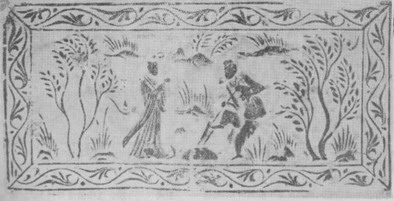
This brick was found on the 7th column of the east wall in the tomb chamber of Xuezhuang Village, and its patterns represent the story of Guo Ju burying his son and obtaining gold. The trees depicted on the brick are luxuriant. On the left side, Guo Ju is in a gesture of digging, while on the right side his wife holds their baby in arms. Between them there is a jar of gold, with three red characters “Jin Yi Fu” above.
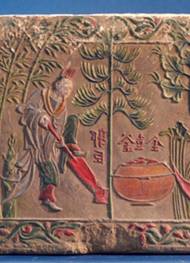
Fig. 1 Part of the brick with scene of Guo Ju burying his son
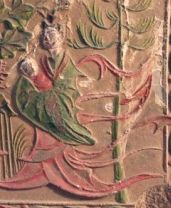
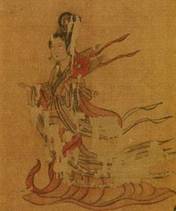
Fig. 2 Comparison between Guo Ju’s wife and the Goddess of Luo River in Guo Kaizhi’s Ode to the Goddess of Luo River in terms of dress

Fig. 3 Floral scroll design on the brick with scene of Guo Ju burying his son
Guo Ju burying his son represented on the brick is a story from the Twenty-four Examples of Filial Piety. To support his mother, Guo Ju decided to bury his three-year-old son. When he dug a hole on the ground, he discovered a jar of gold.
Multiple colors were filled into designs on the brick. The dress of Guo’s wife is in red and green, and the belt floats upward in a vivid manner. In terms of both hair bun and dress, she looks like the Goddess of Luo River in Guo Kaizhi’s Ode to the Goddess of Luo River. Guo Ju’s dress is also in red and green and floats in the air, giving a strong sense of movement. Trees in the background are luxuriant, with floral scroll designs on four edges. The whole picture features a well-spaced composition and bright colors, and can be regarded as a masterpiece of bricks with colorful patterns.
During the Wei, Jin, Southern and Northern Dynasties, bricks with decorative patterns prevailing in the Western and Eastern Han Dynasties declined and gradually vanished in north China. The tomb containing such bricks in Xuezhuang of Dengzhou is the only one of kind found in the Central Plains after the Western and Eastern Han Dynasties, and it boasts diversified subjects and rich contents. Stories of filial piety are one of the major themes depicted in bricks with decorative patterns in Dengzhou. Although there are only two pieces, they indicate the popularity of the theme of filial piety in the Southern Dynasties in a simple yet clear manner. The story represented by the brick was first found in Picture of Filial Sons by Liu Xiang in Vol. 411 of the Imperial Readings of the Taiping Era, and tells that a man prepared to bury his son to support his mother and found gold when he dug the hole. Finally his son wasn’t buried and his mother was also supported.
The other brick with decorative patterns earthed in Dengzhou was known as Lao Laizi Entertaining his Parents. On the right side of the brick there is a bed with a hanging curtain. Both parents sit on the bed in a applauding and laughing gesture. On the left side in the forefront there is a man crawling on the ground and wearing a flowery hair bun. This vividly represents the scene that Lao Laizi performs like a baby to entertain his parents.
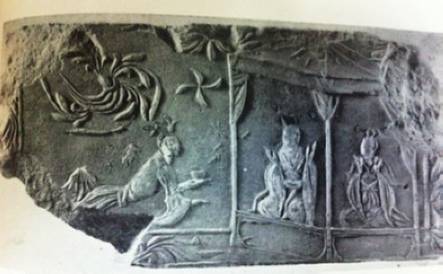
Fig. 4 Brick with scene of Lao Laizi entertaining his parents unearthed in Dengzhou
In the Central Plains in the Han Dynasty, bricks and stones with patterns related to filial piety were rarely seen, and it was not until the Southern and Northern Dynasties that such theme prevailed. On stone coffins unearthed in Luoyang, we have found line carvings of the theme. Since the mid-Northern Wei Dynasty approximately, the theme of filial piety had become a major one in secular cultures of the Central Plains, and was quite popular among folk people at the time.
From this we can know that cultural stories themed on filial piety appear in the Han Dynasty and actually prevailed in the Southern and Northern Dynasties. The reason is that distinguished families used the concept of filial piety to maintain unity among family members and to consolidate the interests of their own clan. Such a concept happened to cater to the need of the rulers at the time who intended to stop fight in the imperial family and hence promoted the theme. Against such social and historical background, more people tended to adopt the theme of filial piety in decorative patterns, which resulted in the appearance and popularity of the theme in tombs in the Southern and Northern Dynasties. The tomb containing bricks with decorative patterns of the Southern Dynasties in Dengzhou is a miniature of the theme.
On the other hand, bricks with decorative patterns of the Southern Dynasties in Dengzhou absorbed the relief technique popular in Nanyang region in the late Eastern Han Dynasty. To represent a human figure with lines marked great progress on the basis of the Han Dynasty. From the design of Guo Ju burying his son on the brick we can see that the human bodies are well-proportioned to precisely reflect the gestures of the figures in an exquisite and vivid manner. Meanwhile, simple background was added to the design on the bricks. For example, the scene of Guo Ju burying his son is set in a background of trees. Though with a straight trunk and forked branches typical of the enlightenment period of Chinese landscape painting, it plays a certain role in enriching the composition and highlighting the theme that the design on the brick is to express. Mostly, decorative patterns on bricks of the Southern Dynasties in Dengzhou feature multiple colors by using the technique of filling colors in key parts. To some degree, it was influenced by bricks with assembled and paneled patterns of the Southern Dynasties. Such painting technique better embodies the progress in brick-making skills and wisdom of artisans.
Themes of Guo Ju burying his son adopted on bricks with decorative patterns are commonly seen among cultural stories about filial piety. However, they have some differences while sharing many similarities due to the different eras when they were popular and places where the artifacts were unearthed.
In February 1984, staff of Qingshan Machinery Factory in Xiangfan City, Hubei Province, discovered a brick-chambered tomb dating back to the Southern Dynasties-Sui Dynasty in Jiajiachong at the northeast foothill of Hutou Mountain west of Xiangyang City. Three bricks with scene of Guo Ju burying his son were unearthed in the tomb. Among them, one shows Guo Ju in a digging gesture, with a jar of gold exposed on the ground. On the left side, Guo’s wife holds their baby in her arms. In the background there are hills, rocks and trees. And there are floral scroll designs on four edges. This brick shares many similarities and much consistency with the brick bearing colorful patterns of Dengxian in terms of theme, design and carving techniques.
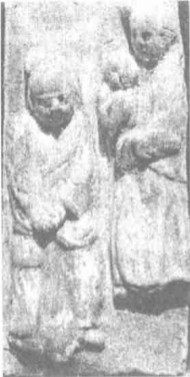
In 1989, a brick with scene of Guo Ju burying his son was unearthed from a Song-dynasty tomb with brick carvings in Nacun Village of Huguan County, Shanxi Province (Fig. 6). Two people are carved on the brick: a man in a digging gesture wears a Futou hat with soft edges and a short coat with a turndown collar and of Kaijin style (a type of Chinese-style garment which buttons down the front or on the right); behind the man is a woman wearing a hair bun and holding a baby in her arms. The patterns in relief on the brick precisely depict the figures.
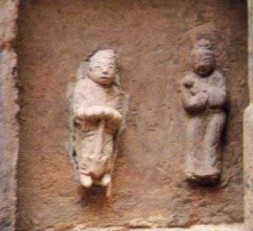
A brick-chambered tomb of the Song Dynasty was discovered in the brick kiln of Beiguan Village north of Lucheng County Seat, Shanxi Province. Stories of twenty-four examples of filial piety are carved on bricks embedded in the girth in the lower part of the tomb chamber. The brick carving of Guo Ju burying his son (Fig. 7) is one of them. The intaglio carving and line carving techniques are adopted. And the design features smooth lines, precisely-carved human figures, natural and lifelike looks and gives a strong visual force.
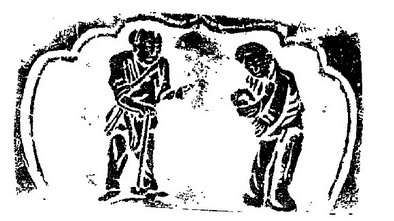
In August 2001, two Jin-dynasty brick-chambered tombs modeled after wood structure were found in the Guxian Town Middle School of Qinxian County in the southeast of Shanxi Province. The brick carving of Guo Ju burying his son (Fig. 8) was located on the right side of the west wall in Tomb Chamber No. 2. The molded brick figurines were pasted on the adobe brick and then fired into a brick carving with a side length of 24cm, or they were directly pasted into the concave part on the tomb wall. The brick carving of figurines from filial stories features rough craftsmanship and simple expression and reflects the skill of folk artisans and the artistic level of secular funeral objects.
The theme of filial piety had been popular since the Han Dynasty, and usually adopted in murals of tombs and bricks with decorative patterns in the Wei, Jin, Southern and Northern Dynasties. However, it was rarely seen in the Sui and Tang Dynasties, and didn’t prevail again in the decoration of tombs until the Song and Jin Dynasties. According to the Classic of Filial Piety, “Filial piety is the principle of Heaven, the righteousness of Earth, and the proper conduct of the people.” Not only the core of Confucianism, but also a tool by which the rulers governed the country, it played an important role in consolidating central authority. The ruling class greatly advocated and promoted filial piety, from which many examples of ridiculous filial piety derived in the society, such as the concept holding that “filial piety starts with serving one’s parents, progresses with serving one’s lord, and ends with establishing oneself.” In addition, the color-filling, outlining and line drawing techniques used to make decorative patterns on bricks fully exhibit the progress in producing techniques of such bricks and the wisdom and intelligence of artisans at the time.
Why characters of “Guo Ju” and “Jin Yi Fu” on the brick with scene of Guo Ju burying his son were inverted?
Your answer please, if you have any questions or answer, please feel free to send us email, we are waiting for your answers and participation, and your comments, answers and suggestions will be highly appreciated. We will select and publicize the most appropriate answers and comments some time in the future.
Weekly Selection Email: meizhouyipin@chnmus.net
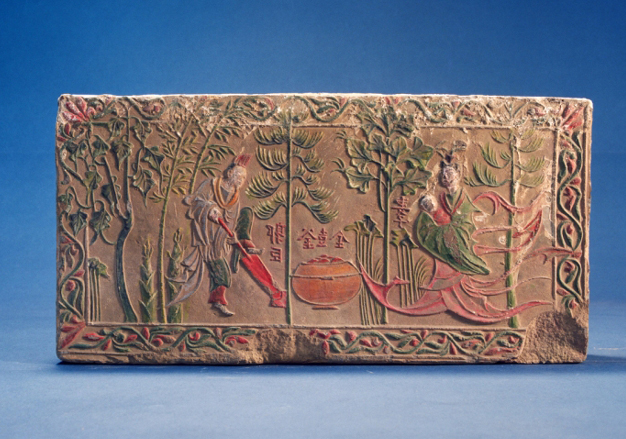
The pottery brick with scene of Guo Ju burying his son was made in the Southern Dynasties, and measures 33.8cm long, 19cm wide and 6cm thick. It was unearthed from Xuezhuang Village, Dengxian County, Henan Province in 1958, and is now in the collection of Henan Museum.