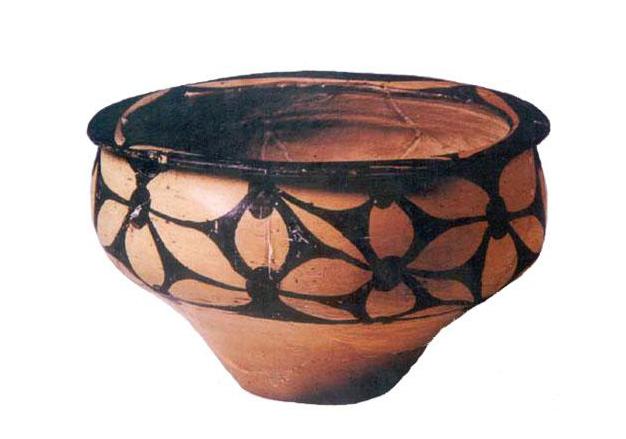
Unearthed in 1956 from Miaodigou in the Shaanxian County, Henan Province, the terracotta basin is of the delicate craftsmanship and of a shape between bowl and basin. It features a flat bottom, a bulging belly, a wide mouth with an outward-bending lip. With the heavily-slanted wall, the basin’s upper part mildly closes in to the mouth. Therefore, the basin measures the widest in diameter at the turning of its belly. In this way, the basin features a wide belly ideal for a daily utensil. The patterns are painted on the outer surface of the upper part. The smooth-lined dots and arc-side triangles extend to two directions into a decorative band. The blank parts then go into lifelike petal patterns.
Aesthetically, patterns and colors are the priority for the craftsmen in making the pottery basins. The petal patterns on this pottery basin were evolved from geometric patterns. Originally designed in accordance with the layout of the basin, the patterns are arranged in a way that the outer surface of the basin wall is divided into 4-8 portions. The mouth and outer surface of the wall is first divided into quarters by way of cross segmentation. Each quarter is then further divided into eight triangles totally the same by drawing “米”-shape lines on it. (Fig.1)
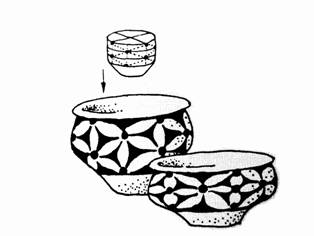
Fig.1 Cross segmentation at the mouth and the patterns
Presumably, a wide decorative belt is first outlined around the basin edge followed by drawing four equidistant straight lines parallel to the edge underneath the edge and going crossed with the vertical lines evenly, dividing the outer surface of the basin wall. Positioning dots are chosen in an alternate way. Any three neighboring dots are connected to each other with curves into arc-side triangles. The triangles are filled with paint. As there are more curves, the straight sides of a triangle inside a diamond turn to arc ones. With the concave-side triangles filled with paint, the patterns look separated and isolated from each other. On the other hand, the unpainted convex-side parts look more concentrated. The painted parts and the background produce a shifted visual effect, looking like petals. (Fig.2) The dots are enlarged accordingly as highlighted elements. The terracotta-color blanks and the painted parts merge into the overall design. Therefore, the blanks are an integral part of the patterns on the basin.
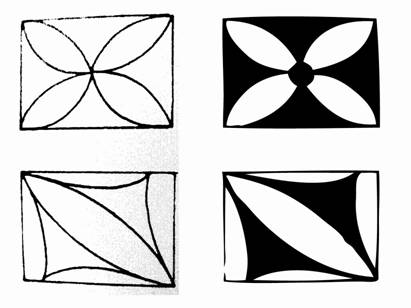
Fig.2 A transformation from arc-side triangles into petal patterns
Pottery
Pottery has been the crystallization of the wisdom of primitive people living thousands of years ago. The making process is roughly composed of three procedures, namely material selection, body preparation and baking.
Material selection: Before making a pottery, a potter selects local clay ideal to be worked on. The clay is washed, so that impurities are washed out and the clay becomes finer in texture. After that, other ingredient materials are added into the natural clay in certain proportions.
Body preparation: Wheelthrowing is completed on a potter’s wheel. However, there were no potter’s wheels in early days. Instead, potters back then made pottery bodies with their hands or moulds. Hand-making methods include dough moulding, pasting and mudstrip spiraling. Moulding refers to making a pottery body with moulds.
Baking: Temperature and duration and degree of baking also play a significant role in the color (and texture) of a pottery. A pottery baked at around 900°C has a lower density, thus is looser in texture than a porcelain is and easy to get broken.
According to the descriptions above, was this pottery basin painted with petal patterns a daily utensil or a burial object in the primitive society? Is there any relationship between the emergence of pottery and the farming life of the primitive society?
Your answer please, if you have any questions or answer, please feel free to send us email, we are waiting for your answers and participation, and your comments, answers and suggestions will be highly appreciated. We will select and publicize the most appropriate answers and comments some time in the future.
Weekly Selection Email: meizhouyipin@chnmus.net
The basin painted with human-faced fish patterns is a Banpo Type vessel of the Yangshao Culture and measures 17.0cm in height and 41.5cm wide in diameter at the mouth. Unearthed in 1979 in the Jiangzhai Village of the Lintong County, Shaanxi Province, it is now in the collection of Xi’an Banpo Museum. (Fig.5) The patterns are painted on the lip and inner surface of the wall of this flat-bottomed basin. Many archaeologists believed that the mysterious-looking human-faced fish patterns must have something to do with the primitive faith of the Banpo Clans.
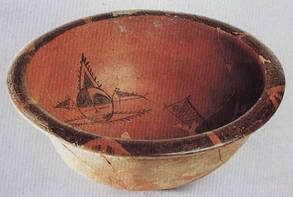
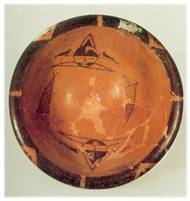
Fig.5 Basin painted with human-faced fish patterns
The pottery bowl painted with petal patterns of the Dawenkou Culture measures 10.0cm high and 16.5cm wide in diameter at the mouth. Unearthed in 1963 at Dadunzi in the Pixian County, Jiangsu Province, the bowl is now in the collection of Nanjing Museum. (Fig.6) The smooth-lined petal patterns on this bowl are mostly in multiple colors, instead of being in a single color, thus of a distinctive beauty.
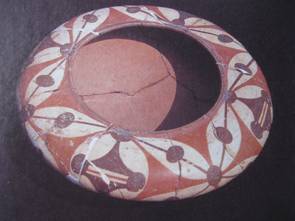
Fig.6 Pottery bowl painted with petal patterns
The painted pottery jar with spiral design of the Majiayao Type of the Majiayao Culture measures 49.3cm high and 18.4cm wide in diameter at the mouth. Unearthed in 1975 in the Sanping Village of the Yongjing County, Gansu Province, it is now in the collection of the National Museum of China. (Fig.7) The painted pottery jar is delicately decorated, with its spiral, wavy, and arc-side triangle designs.
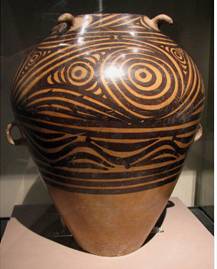
Fig.7 Painted pottery jar with spiral design
The pottery jar painted with zigzag patterns of the Banshan Type of the Majiayao Culture measures 37.0cm high and 37.0cm wide in diameter at the belly. Unearthed in the Lintao County, Gansu Province, it is now in the collection of the Museum of Lintao County. (Fig.8) The jar looks solid yet elegant, with its small mouth, bulging belly and two loop-ears. It is mysterious-looking, thanks to the black zigzag patterns painted on the surface.
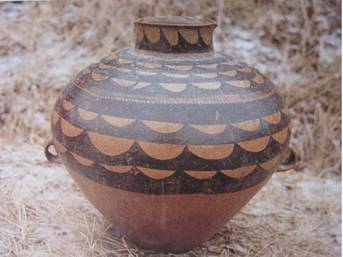
Fig.8 Pottery jar painted with zigzag patterns
The pottery pot painted with four decorative windows of the Machang Type of the Majiayao Culture measures 41.0cm high and 15.0cm wide in diameter at the mouth. Collected in 1985 by Lanzhou Municipal Administration for Industry and Commerce of Gansu Province, it is now in the collection of Lanzhou Museum. (Fig.9) Basically the same as a Banshan Type jar, this Machang Type pot also features a small mouth, a bulging belly and two loop-ears. The patterns are largely grids, diamonds, pozi and zigzags. The pot looks gracefully solid.
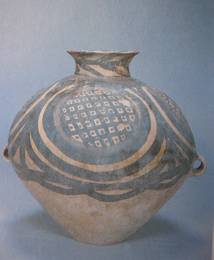
Fig.9 Pottery pot painted with four decorative windows
As described above, the patterns on potteries experienced various changes from the Banpo, Miaodigou to Banshan and Machang periods. But on the whole, the patterns were evolved from specific images to abstract designs. The geometric patterns of the late Neolithic Age, however, look more mysterious and complicated than the ones of the early stage.
The Chinese nation was one of the earliest peoples mastering pottery and boasted the earliest written records of pottery. In Yi Zhoushu (The Lost Book of Zhou) there is an item concerning “Shennong or the Emperor of the Five Grains was engaged in farming and pottery”, indicating that pottery was already in existence in the age of Shennong and revealing the natural interrelation between farming culture and pottery, which attests to the modern study of history of pottery.
Primitive people lived in harmony with nature in the age of farming. They learnt about and had various imaginations about laws of nature from their interaction with and dependence upon nature. Thus, they found the importance of naturally-formed vessels. As put in Li Ji (The Book of Rites), “it is an inspiration from the nature to make pottery calabash”. Gourds served as food for primitive people, while dried gourds or calabashes could be naturally-formed vessels, thanks to their capacity and being cutting into various shapes. Gourd-shape vessels demonstrated primitive people’s love and need of various vessels. In early earthenware there were all sorts of basins, bowls, mortars and pots, some in the shape of a gourd and others imitating different parts of a cut-open gourd. (Fig.3) This pottery basin painted with petal patterns is likely to be in imitation of the lower part of a cut-open gourd.
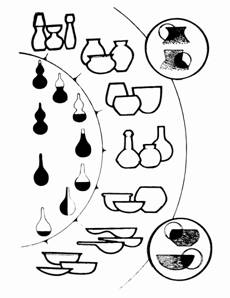
Fig.3 Gourds and impacts on the shapes of potteries
Both pattern and shape of the pottery evolved over time. Potters of the Yangshao Culture era embellished potteries with various realistic and unrealistic patterns. However, realistic patterns are not that commonly found on the potteries of that period as abstract geometric patterns like straight lines, curves and triangles. According to some scholars, the geometric patterns on the Miaodigou Type painted potteries were evolved from bird patterns. Some triangular patterns were developed from fish patterns. (Fig.4) The early research on those motifs suggests, “realistic-style” fish patterns emerged earlier than the “unrealistic-style” geometric ones which were evolved from the realistically portrayed animal patterns step by step. It went as a general tendency that patterns got more abstract and symbolic.
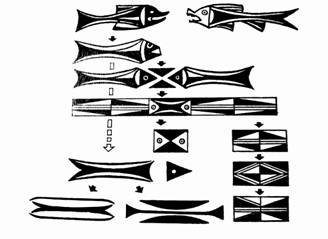
Fig.4 How realistic-style fish patterns were evolved into abstract geometric ones
An epoch-marking event in the development of primitive society, pottery as the crystallization of the mentality, culture and clan worship of the primitive people in ancient China has had a profound influence on the development of human civilizations.