There are no clear descriptions of where Ru Kiln was in ancient texts, and few of its products have survived till the present day. As a result, the location of Ru Kiln has long puzzled the academia. To crack this major mystery, archaeologists and cultural relics researchers from at home and abroad started extensive investigation in the area of Linru County (present-day Ruzhou City) in Henan Province in the 1920s. The rationale was that most of the ancient Chinese kilns were named after the places in which they were located. They spent half a century visiting almost all the ancient kiln sites in Linru, but they never found any product similar to the Ru Kiln porcelain items that have been handed down through the ages. Despite the failure to locate Ru Kiln, the samples collected enabled Feng Xianming, a porcelain expert of the Palace Museum, to draw the following conclusion in his survey report: Ru Kiln consisted of two parts. One of them, or what is known as Ru Kiln nowadays, made porcelain exclusively for the court. Its products were small in number and outstanding in quality. The other part, referred to as Linru Kiln nowadays, made porcelain for common people and formed the principal part of Ru Kiln. All the investigations of Ru Kiln sites carried out since the founding of the PRC have only come into contact with the second part. In 1977, together with other porcelain experts of the Palace Museum, Feng Xianming revisited several kiln sites in southern Henan. They found one azure-glazed porcelain fragment at the kiln site in Qingliangsi, Daying Town, Baofeng County. Testing of this fragment by the Silicate Institute of Shanghai yielded data largely identical to those of the Ru-Kiln celadon plate in the collection of the Palace Museum. This led archaeologists to focus on the area around Qingliangsi in their search for the Ru Kiln site that made court porcelain. In 1986, a villager of Qingliangsi found a complete azure-glazed Ru-Kiln wash bowl (Fig. 6).
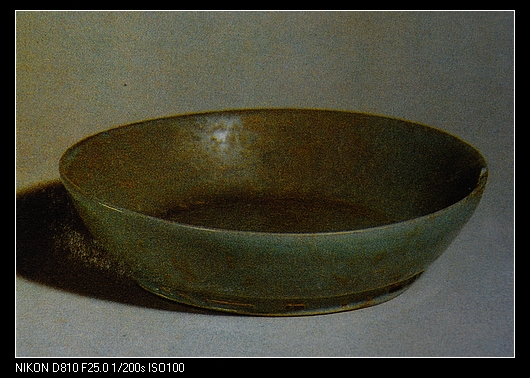
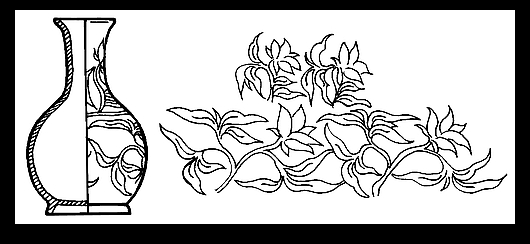
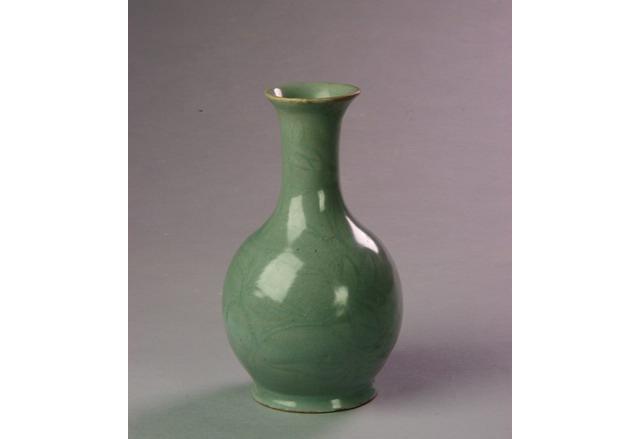
This Ru-Kiln celadon vessel drew the attention of Wang Liuxian, who used to study ceramics at the ceramics factory at Qingliangsi and who had closely followed the search for Ru Kiln sites. In 1986, he presented the Ru-Kiln wash bowl found at Qingliangsi at the annual conference of the China Ancient Ceramics Society held in Xi'an. Experts attending the conference identified it as a Ru-Kiln product made for the court. Following this clue, ceramics experts Wang Qingzheng of Shanghai Museum sent personnel twice to the kiln site near Qingliangsi for investigation. Based on the Ru-Kiln porcelain fragments found at the site and systematic study of the Ru-Kiln wash bowl, Shanghai Museum published The Discovery of Ru Kiln, in which it announced to the world for the first time that the Ru Kiln site that made celadon for the Northern Song imperial court was located at Qingliangsi in Baofeng County. Inspired by this, the Cultural Relics and Archaeology Institute of Henan Province made the first archaeological drilling and trial excavation at the kiln site in Qingliangsi. Though the archaeologists did not find the central firing area, they stumbled upon thirty porcelain items that were largely intact in an ash pit with a diameter of less than one meter. Among them were ten fairly complete Ru-Kiln vessels dating from the Song Dynasty. One of them is the azure-glazed goose neck vase with engraved designs, which would become one of Top Nine Treasures of Henan Museum.
Other Ru-Kiln vessels unearthed together with this vase mainly include the following:
Powder green-glazed vase with bent shoulder (Fig. 7), height 23.6 cm, diameter of dish-shaped mouth 8.4 cm, base diameter 8.5 cm.
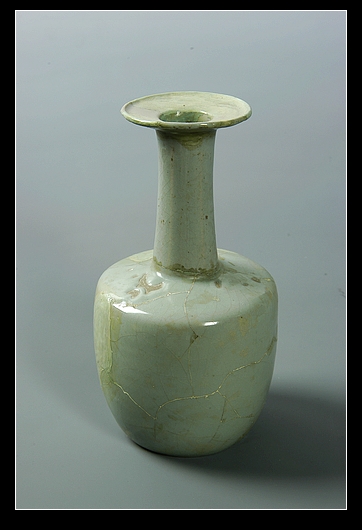
Azure-glazed saucer (Fig. 8), height 4.3 cm, stand diameter 6 cm, rim diameter 17 cm, base diameter 12.3 cm.
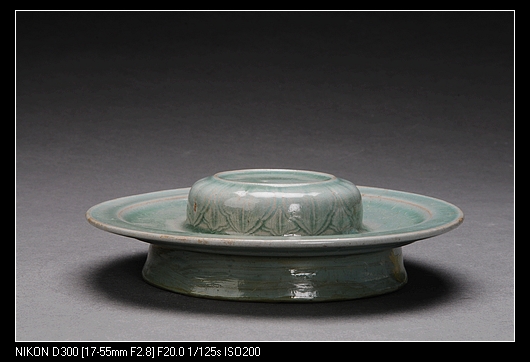
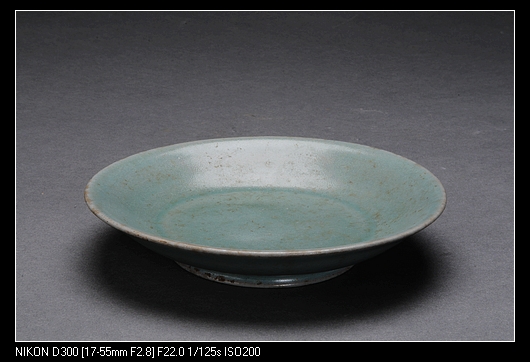
Azure-glazed plate (Fig. 9), height 3.2 cm, mouth diameter 17 cm, base diameter 9 cm.
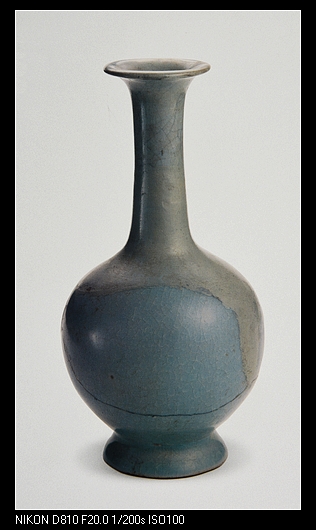
Azure-glazed vase with slim neck and small mouth (Fig. 10), height 20 cm, mouth diameter 5.4 cm, base diameter 6.4 cm.
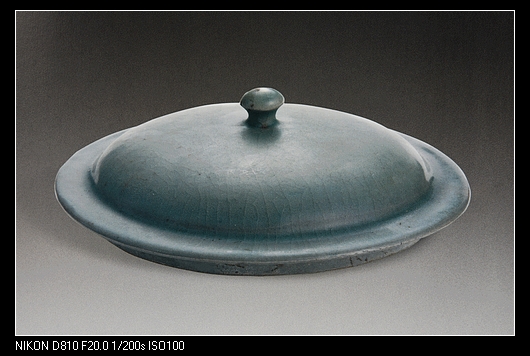
Pea green-glazed lid (Fig. 11), height 4.6 cm, lid diameter 14.2 cm.
Throughout the ages, historical records on Song porcelain of Ru Kiln have highlighted their glaze color and texture, but have barely touched upon the condition of their bodies. The shards unearthed at the state-owned Ru Kiln in Qingliangsi indicate that the bodies of its porcelain products are not so compact as described in certain records. In fact, the bodies of Ru Kiln porcelain are relatively soft in comparison with those of the products of other well-known Song kilns. Besides, most of them show signs of slight under-firing to various degrees. How did the artisans of Ru Kiln make bluish green Ru porcelain, with its jade-like quality, out of such soft bodies? And why was Ru porcelain slightly under-fired?
Your answer please, if you have any questions or answer, please feel free to send us email, we are waiting for your answers and participation, and your comments, answers and suggestions will be highly appreciated. We will select and publicize the most appropriate answers and comments some time in the future.
Weekly Selection Email: meizhouyipin@chnmus.net
Ru-Kiln celadon vs celadon from Zhanggongxiang Kiln at Ruzhou. Zhanggongxiang Kiln at Ruzhou is an ancient kiln site discovered in 2000. It is located in the southeast of the urban area of Ruzhou. Generally speaking, the glaze on the celadon of Zhanggongxiang Kiln is different from both the "pea green" glaze of Linru Kiln and the azure glaze of Ru Kiln at Qingliangsi in Baofeng. Its colors include "egg green", light green and bluish green. Such celadon typically has a thin body and a thin layer of light-colored glaze with a strong resemblance to glass. The body, which is fine and solid, is usually pinkish white or grayish white, and occasionally light gray. Vessels come in ten-odd varieties, including bowls, plates with flower-like mouth, bent belly and ring base, vases with dish-shaped mouth and slim neck, oval wash bowls with fully glazed base, flat-bottom square plates, goose neck vases, saucers, incense burners with attached sculptures, nesting boxes, and vessel lids. Four of these varieties—the plate with flower-like mouth, bent belly and ring base, the flat-bottom plates with sunflower-like mouth and bent rim, the oval wash bowl with fully glazed base, and the flat-bottom square plate—are absent among the products of Ru Kiln. On vessels with ring bases, there are much more “straight ring bases” (i.e. not slanting outward or inward) than fully glazed base. Some vessels have prop marks on the bottom, which resemble neatly arranged millet grains. A large number of fragments of unglazed vessels were unearthed at the kiln site. These indicate that, like the celadon ware of Ru Kiln, the celadon ware made at Zhanggongxiang was fired without glaze before it was glazed and fired again in the kiln. Samples of unearthed artifacts from the two kilns show that both of them made a limited variety of celadon ware in similar styles marked by dignified and graceful shapes. A considerable portion of the vessels were meant for ornament. The vessels are coated with smooth, milky and translucent glaze; the surface is not richly decorated, and most of the vessels were fired while standing on props, which were rather small. These similarities suggest certain hereditary relationship between the two kilns. However, there are also clear differences between them in certain respects.
Firstly, the glaze on the celadon porcelain of Ru Kiln at Qingliangsi in Baofeng is typically in the hue of pure azure. The crackle on its surface shows either an "ice crack" pattern or a "fish scale" pattern. The celadon porcelain of Zhanggongxiang Kiln typically has light-colored glaze, and the crackle on the surface is finer than that on the porcelain of Ru Kiln at Qingliangsi.
Secondly, the porcelain of Ru Kiln at Qingliangsi has an ashen body whereas that of Zhanggongxiang Kiln has a relatively thin body that is typically grayish white.
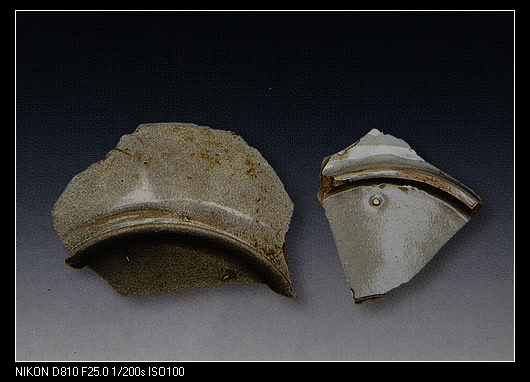
Thirdly, most of the vessels fired on props at Ru Kiln in Qingliangsi have fully glazed bases; the props were long and slim, leaving marks that resemble sesame seeds. Most of the porcelain from Zhanggongxiang Kiln have straight ring bases (only a few have fully glazed bases), and the props left round marks resembling millet grains (Fig. 5).
Fourth, there are differences in shape between certain varieties among the celadon ware of Zhanggongxiang Kiln (vases with dish-shaped mouth and slim neck, goose neck vases with bulging belly, incense burners with attached lotus design, saucers, and nesting boxes) and corresponding varieties among the products of Ru Kiln at Qingliangsi. Some varieties, such as plates with flower-like mouth, bent belly and ring base, flat-bottom plates with sunflower-like mouth and bent rim, oval plates with ring base, flat-bottom square plates and small lidless jars, are absent among the products of Ru Kiln at Qingliangsi. Many porcelain experts have identified Zhanggongxiang Kiln as the Northern Song government kiln that porcelain connoisseurs at home and abroad have been searching for over half a century.
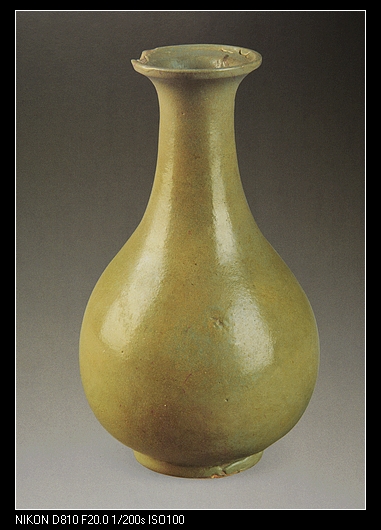
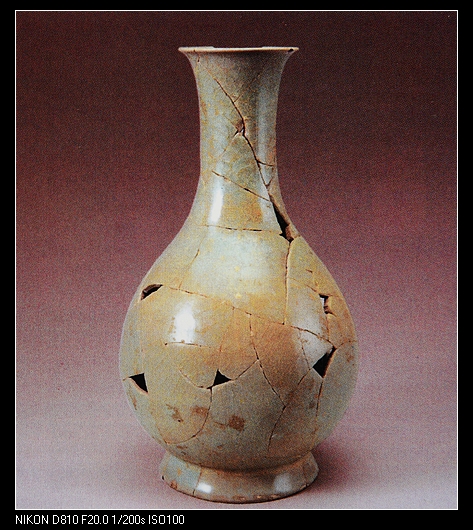
During the Song Dynasty, large quantities of fine porcelain were used in teahouses, restaurants and hotels in cities. Moreover, the imperial family, aristocrats and merchants not only demanded high-quality porcelain for daily use, but also porcelain ornaments and collectibles with aesthetic value. As a result, along with the phenomenal growth of private kilns, the Song Dynasty witnessed the emergence and rapid development of porcelain exclusively crafted for the imperial family and officials under the supervision of the authorities. Of all types of Song porcelain, vases in various shapes are the most typical of the zeitgeist. In Song porcelain vases, a rich diversity in shape is achieved through proportional variations of certain parts. Take the Song plum vase for example. Being rather tall, it apparently shows a simple contrast in size between the mouth and the main body. The short neck provides a transition between the two, producing a sense of continuity and order. The Yuhuchun vase was derived from the holy water vase used in Buddhist monasteries during the Tang Dynasty. As one of the most precious items in Henan Museum's collection, the Ru-Kiln azure-glazed goose neck vase with engraved designs is somewhat similar in overall shape to the Yuhuchun vase, which was quite popular during the Northern Song Dynasty. However, in comparison with the latter, it has a smaller diameter ratio between the mouth and the neck; besides, the curve of its main body is even more smooth and natural, which produces an overall effect of greater elegance, dignity and harmony. Song goose neck vases in this shape have only been found among the products of Ru Kiln, Zhanggongxiang Kiln, and the government kiln of Laohudong in Hangzhou, their rarity adding to their preciousness. (Fig. 3. The goose neck vase unearthed at Zhanggongxiang; Fig. 4. The goose neck vase unearthed at Laohudong in Hangzhou)
Many of the Northern Song emperors believed in Taoism, setting a good example for their subjects. Throughout the Song Dynasty, cultural development was shaped by the Taoist orientation towards tranquility and worship of nature. This was also reflected in the color of porcelain glaze. In the reign of Emperor Hui, the porcelain produced at Ding Kiln, which had always been used at the court, was replaced by celadon ware. The reason, it is generally believed, is that the former had mangkou (unglazed mouth), which made it disagreeable to users. However, some experts have interpreted mangkou as the gleam of the white-glazed porcelain of Ding Kiln. Such dazzling gleam was disfavored by Emperor Hui, whose habitual chanting of Taoist "green words" (qingci, also known as lüzhang, or "green writings", i.e. prayers to heaven written on green paper with red paint) had inclined him towards a serene hue of green. Hence his command for the making of celadon in large quantities. That might be one of the main causes for the substitution of Ru-Kiln celadon for Ding-Kiln white porcelain as court porcelain.