Chopping block was not only for cutting meat on, but also a ritual object used in ancestral temple sacrifice activities. In historical documents, chopping block (zu) was oftentimes referred to in close association with ding (cooking vessel); in practice, chopping block was usually used along with ding and dou (food vessel). During sacrifice the sacrificial body was taken out of huo (cooking vessel) and placed in ding, which was called zheng (cooking vessel with sacrificial body in), aka deng (sacrificial/food vessel) or sheng (container), hence ding self-named as dengding or shengding. The meat taken from ding with bi (an ancient spoon) and placed onto chopping block was referred to as zai. Taking the sacrificial body from ding and cutting it into fine slices on chopping block might be regarded a picture of the ancient people’s diet based on the rules of ‘not disliking to have the rice finely cleaned, nor to have the meat finely minced, The same rules might as well apply to religious ceremonies and ancestral sacrifices.
When offering entertainment to guests, chopping block was placed on the left side of the guests to hold large chunks of meat. As stated in The Rites of Zhou • The Chef, ‘There used to be a sacrifice in the imperial court on a daily basis, for which twelve ding were provided, each matched with a chopping block.’ According to this statement, one ding was supposed to be provided with one chopping block, which is supported by the discovered Western Zhou bronze wares that bear inscriptions of zhizu (chopping block for pork/pig) and gaozu (chopping block for mutton/lamb), suggesting that the chopping blocks designed for different sacrificial animals had their own specific names. Practically, very few chopping blocks were found in archaeological excavations, much in contrast to ding which were numerous. We reckon that the chopping blocks of the ancient times are mostly made of wood and that only a small number of them are made of stone, which explains why they are difficult to last long and very few ancient blocks have been unearthed. Notably, it is no rare that lacquer wood chopping blocks have been found, in considerable number, from Chu tombs of the Warring States, which apparently adds grounds to the above conjecture and further reveals the preciousness of bronze chopping blocks.
Chopping block is a rarity in contrast to the numerous types of bronze wares unearthed so far through archaeological excavation, not to mention bronze chopping block.
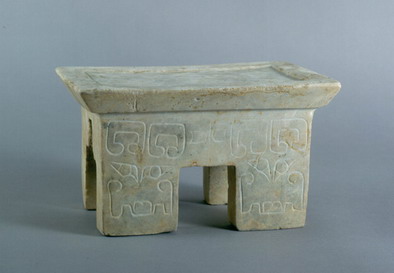
The Izumiya Museum, Japan houses a Shang dynasty bronze chopping block with animal mask motif③, with the measurements of 41.2cm in length and 18.6cm in height, which resembles a rectangular table in appearance, whose slender surface caves in slightly and is decorated with cicada pattern on the edges and Kui dragon design on both narrow ends, under which are two somewhat bent wall feet that are adorned with animal mask motif and cicada pattern.
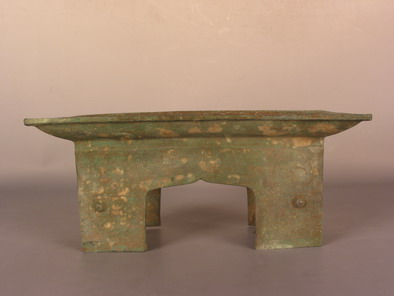
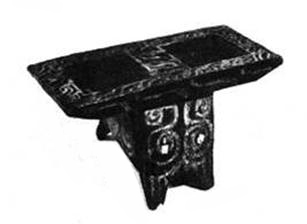
This twin-belled bronze chopping block of the late Shang and early Zhou period④, found in the bronze hoard at Huaerlou, Yi county, Liaoning province, is measured 33.6cm in length, 17.7cm in width, 14.3cm in height, and 2.5kg in weight, kept presently in the Jinzhou Museum. Its cutting surface is of a long, narrow trough shape with reinforced edges and is supported on either wide end by two confronting U-profiled feet that are adorned with animal mask motif over the background of fine cloud-and-thunder pattern, each end with a flat circular bronze bell hung between the two legs.
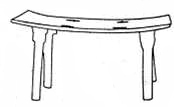
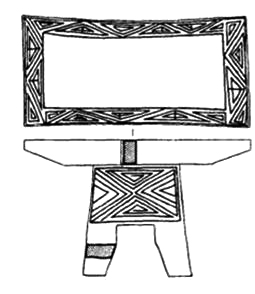
This is a bronze chopping block unearthed at Zhujiaji, Shou county, Anghui province⑤, with measurements of 32.6cm in length, 16.3cm in width, and 16.3cm in height. Also in the shape of a long table, the block has a slightly concave cutting surface, in the central part of which are four cross-shaped holes arranged in two rows, and is supported by four feet that are tapered from top to bottom.
By comparing the formats of the above bronze chopping blocks, one may find that in the early stage the blocks are mainly made in the shape of a trough, along with development they began to have a concave surface in most cases. Also developed was the type of foot, from “wall foot” to “plate foot”, and further to four separate feet. On the decorative designs, the Shang and Zhou period was typical of animal mask motif, and there emerged other patterns, such as band, coiled serpent, dragon, etc. during the Spring and Autumn period, which corresponded, on the whole, to the belly decorations of the bronze ding of their respective times. The bronze chopping blocks, found either in Xiasi, Xichuan, Henan province or in Zhujiaji, Shou county, Anhui province are utensils belonging to the Chu State, which look very much alike in overall style as well as format and openwork technique, with a duration stretching from the mid-Spring and Autumn to the late Warring States period. Therefore, this chopping block with hollowed-out interlaced dragon pattern, which is kept in the Henan Museum, well deserves to be called a classic example of Chu style bronze chopping block.
The chopping block of the Henan Museum has a slightly concave surface, on which 24 holes are engraved. Why was it designed to have such a shape and so many holes?
Your answer please, if you have any questions or answer, please fell free to send us email, we are waiting for your answers and participation, and your comments, answers and suggestions will be highly appreciated. We will select and publicize the most appropriate answers and comments some time in the future.
Weekly Selection Email: meizhouyipin@chnmus.net
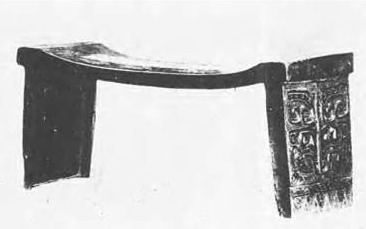
In the shape of a saddle, this chopping block shows a small degree of concavity on the surface which is wide on both ends but slightly curved in the middle, standing on four flat, U-shaped feet that are tapered from top to bottom.
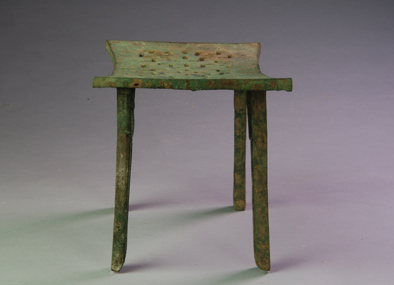
Side view of the bronze chopping block
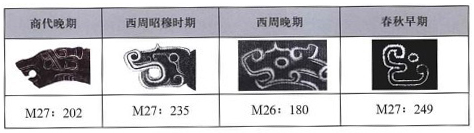
The hollowed-out interlaced dragon pattern carved on the cutting surface of the block was achieved by two techniques, i.e. openwork and incised lines. Centrally located on the cutting surface, the openwork is composed of two groups of symmetrical interlaced dragon patterns, in which the dragon head is facing out and tail gathering towards the center of the block. Thanks to the saddle-like format of the block, the dragon head is actually positioned higher than the tail, which makes the dragon look high-spirited as if it is leaping up. As to the incised lines, they may be divided into three groups, i.e. the fine cloud-and-thunder pattern carved between the holes, the coiled serpent pattern decorated on the narrow ends of the cutting surface, and the ripple pattern band engraved on the wide ends of the cutting surface. The flat feet are also adorned with stylized perforated dragon pattern, however, limited by the slender shape of the feet, the dragon pattern had not been depicted amply and became stylized. Between the perforated holes is fine coiled serpent pattern.
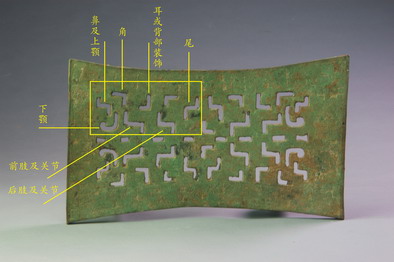
This chopping block is adorned with a total of eight hollowed-out dragon patterns, four on the surface, the other four on the flat feet, in head-to-head pairs that are corresponding to one another. Furthermore, the four dragons on the surface form head-to-head matching pairs each with those on the feet. From the overall layout viewpoint, this chopping block, as it were, embodies the idea of multi-dimension symmetrical design.
The Evolution of the Pre-Qin Dragon Patterns
The Pre-Qin dragon patterns evolved from representation to abstract and ended up in stylization. Take the interlaced dragon pattern that intertwines two dragons, for instance. On layout, the earliest dragon pattern depicts two dragons that are intertwined with their body and tail clearly distinguished; even on the occasions where two dragons interlaced their tails they could still be recognized as two separate dragon designs. Not until the late Western Zhou and early Spring and Autumn had the two dragons begun to lose their boundary on the tail part and appear indistinct, sharing partial body and even head with each another. The dragon pattern had, in its infancy, clearly defined head, body and tail, and was enlivened with meticulous depiction of details such as horn, eyes, and mouth.
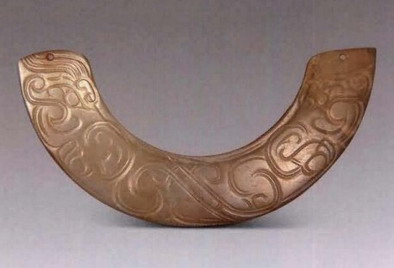
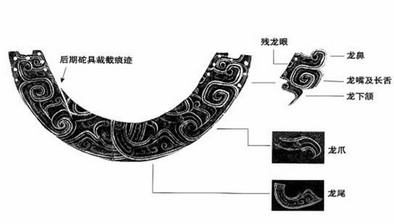
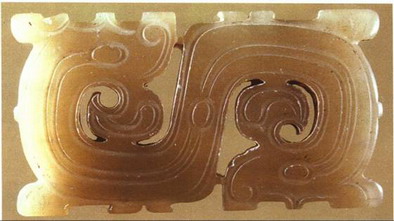
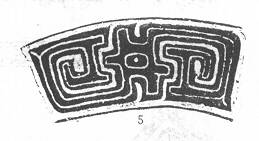
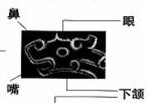
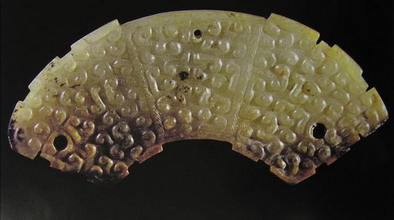
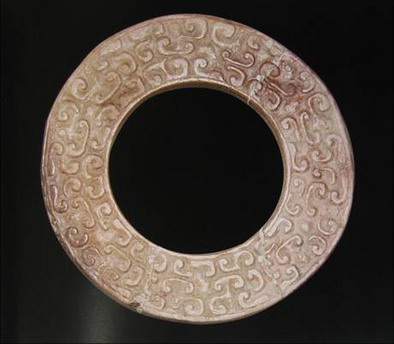
Ever since the late Western Zhou the dragon pattern tended to appear with abstracted horn, eyes, scales, etc., and further disintegrated into geometric designs such as S-shaped pattern, C-shaped pattern, and tadpole pattern. Not long after the disintegration, these patterns were still able to indicate the specific parts of the dragon’s body and stand as a complete dragon pattern, but during and after the Warring States period such stylization had become increasingly serious and the dragon pattern had continued to grow in the direction of abstraction, ending up in vagueness and darkness. On the other hand, the S-shaped pattern, rolling cloud pattern, and vortex pattern that had evolved from dragon pattern became the mainstream design and got used on vessels as full-body engravings, and they further developed into variations such as grain pattern and cattail pattern. The disintegrated dragon pattern is mostly seen on the Pre-Qin jade wares, whereas the dragon pattern carved on bronze wares is generally of a representational type. Indeed, it is preciously rare for this hollowed-out, dragon pattern ornamented chopping block of the Henan Museum, a bronze ware itself, to use disintegrated dragon pattern as the openwork decoration.
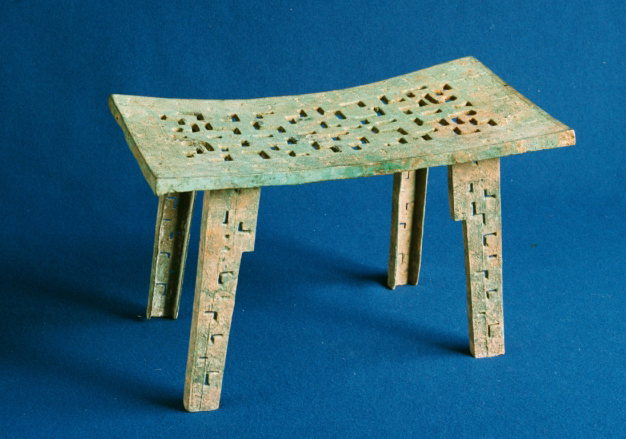
The Chopping Block with Hollowed-out Dragon Pattern is a bronze ritual object dating to the Spring and Autumn period. With a 35.5cm long and 21cm wide cutting surface, the block is 24cm in overall height and 3.85kg in weight. Found in Tomb #2 at Xiasi, Xichuan county, Nanyang city, Henan province in 1978.

Tao Liang: born in 1980, graduate of Academy of Ancient Text, Jilin University,a museologist of the Exhibition Dept. in Henan Museum, dedicating to the study of exhibition of the ancient history.

Guo Feifei: born in 1978, works in the Exhibition Dept. of Henan Museum, specializing in design of the exhibition arrangement.