A real miracle in the ceramics history of China, the Tang sancai technique best embodies the gracefulness of the prosperous time, reflecting visually the political situation and powerful, broad look of the Tang Dynasty at its prime. The social aesthetic preference after the Benign Reign of Zhenguan had changed gradually from fullness to luxury, which went on rampantly to an unstoppable degree during the reign of Ruizong. These, had exerted strong influences upon the creation and development of Tang sancai ceramics.
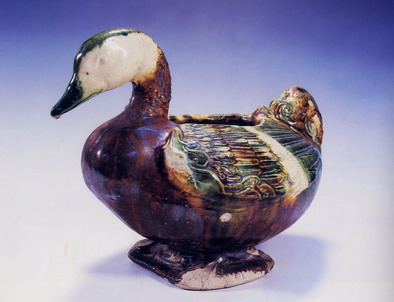
Primarily, what make sancai wares so striking are their varied forms, bright colors and lifelike modeling, which, mixed with the charm and grace of that time, accord perfectly with the characteristics of the Tang Dynasty art that favored fullness, sturdiness and plumpness in aesthetic activities, and showcase the aesthetic values of the people living at that time.
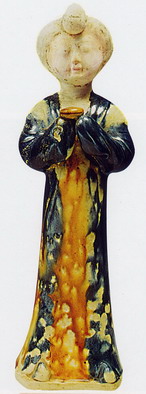
To sum up, the sancai horse has two distinguishing features. Firstly, the modeling. The sancai horse is usually crafted in a stout shape, with broad neck and extremely muscular haunch, a type that is distinctly different from today’s horse. It is a breed said to originate from the Western Regions as tribute. There could be artistic exaggerations in the modeling, though.
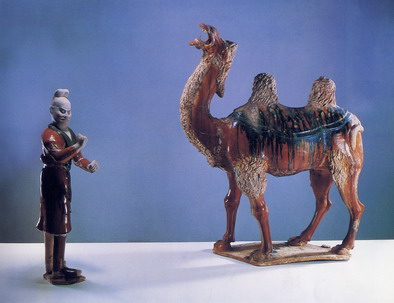
The colors of the glazes used are another feature of the Tang sancai horse. The coating glaze is at first of a soft, lead-rich glass paste with multiple colors such as dark green, sky blue, light yellow, white, reddish brown, and brownish red, of which yellow, green and brown are the three principal colors, hence the name Tang Sancai. When the clay wares, coated with lead oxide-rich glaze which is used as flux, are placed in kiln for firing, the different coloring metals begin to diffuse, spread and blend, giving rise to the so-called phenomenon of ‘kiln transmutation’.
In the evolution of China’s feudal society the pottery horse of Han and Tang is the most unique funerary sculpture, an artistic image shared by both dynasties. In ancient times, horse was regarded as a powerful weapon during wartime, whose quantity and quality were to determine the outcome of the war, and which was something that tested the power of a nation. The New Annals of Tang says, ‘Horse is the weaponry of a nation. Without it, the nation would be jeopardized.’ The Han and Tang are both empires built up through wars fought on running horse, in whose society the horse, as battle gear, took a historical position that nothing could replace.
Then, when we talk about the sculpture of pottery horse, what are the epoch distinctiveness and cultural peculiarities?
First and foremost, the Han and Tang horse figurines are products of different historical setting, displaying significance specific to their own time. In the Han horse figurine, importance had been attached to the sculpture of overall image, with modeling adopted from that of the Qin Terracotta Army’s clay horse, only in reduced scale and simplified form. In the arrays of the Han Terracotta Army at Yangjiawan, Xianyang, Shaanxi, the sturdy war horses were arranged in neat formation, mighty and spirited, demonstrating vividly the power politics and unshakable royal will of the Han dynasty. From a historical perspective, the mighty strength seen on these figurines is an appropriate reflection of the martial spirit and warrior culture of that age. Few terracotta army of such scale, however, has been found following this one of the Han dynasty.
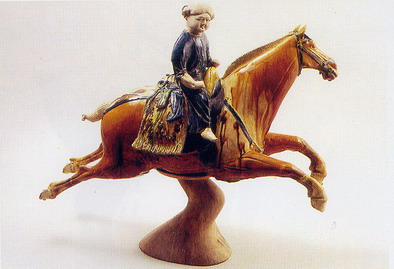
The Tang horse figurine, as compared with its Han precursor, had undergone a remarkable change in shape, by which they stepped down from the altar and became a form of art loved by the masses. Evidently, this is a transition from the spiritual world to the secular society. The war functionality, as once assigned to horse, had been diminished in the Tang horse figurine, instead, attention had been paid to dignity, grace and joie de vivre, accompanied with the display of a kind of elegant and luxurious symbolic metaphors.
In the second place, the Han and Tang horse figurines are distinctly different in artistic style, they exhibit the cultural feature and era essence of different times.
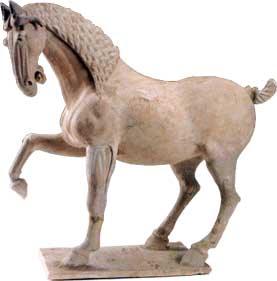
From the viewpoint of artistic style, the Han horse figurine is shaped usually in an unconstrained, daring form, with emphasis on the all-conquering momentum, so as to display the martial exploits achieved on running horse, leaving audience unlimited room for imagination. The Western Han painted pottery horses found at Maoling, Xingping, Shaanxi were almost cast in the same mould as the Terracotta Army, no extra engraving on the body, no apparent differences on the four limbs, only the overall shape remained unchanged. During the Tang dynasty, however, which exceeded Han both in the size of territory and trade, and which saw frequent exchanges of culture and art between China and the West, the art returned to worldly reality, as shown in the sculptures, with interest in the spatial relationship of mono sculpture, which is mixed with a glow of pride felt only in the golden age. By comparison, the Tang horse figurine usually appears bright and breezy in manner, yet remains dignified in the same time. The lean, delicate style prevailed in the Wei and Sui dynasties was discarded and replaced with a new fashion that typically involved fullness without being swollen, splendor without being vulgar, and richness in decoration yet remaining crisply clear.
1) The success of sancai horse making lies in its charm and grace, namely, the characteristics of epoch it reflected. Curiously, all sancai animals, be it horse or camel, turn their head to the left side without exception. What phenomenon is it reflecting? Moreover, why does the sancai horse, stout and sturdy as it is, have such a short tail?
2) Ever since sancai was discovered at the beginning of last century it has attracted wide attention from art circles both abroad and at home, triggering a quick influx into the market of fakes that reached such a level that they could make people take the counterfeit antiquities for genuine ones. Some expert pointed out that these high imitations possessed all the basic features that the genuine sancai had, and that their similarities were as high as over 96%. Now, where on earth comes the skimpy 4% difference between the genuine sancai and the high imitations cloned by means of modern technologies?
Your answer please, if you have any questions or answer, please fell free to send us email, we are waiting for your answers and participation, and your comments, answers and suggestions will be highly appreciated. We will select and publicize the most appropriate answers and comments some time in the future.
Weekly Selection Email: meizhouyipin@chnmus.net
As early as around 1898 when the Qing government-financed Longhai Railway was being built, the workers dug up a large number of ancient tombs along the tracks between Zhengzhou/Luoyang and Xi’an, among which were the Tang dynasty tombs from where sancai pottery of humans, animals and vessels were unearthed in astonishing quantities. This is the first time the mysterious Tang sancai pottery was brought to view. Later, some complete sancai pottery was passed on to Beijing where it was authenticated by the renowned scholars Luo Zhenyu and Wang Guowei, with high praise, and was named the Luoyang Tang Sancai. Then, a question arises: where is the firing place of these sancai products?
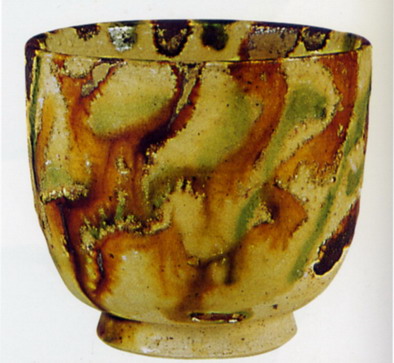
During 1959 summer, a three-person team led by China’s famous ceramics expert Mr. Feng Xianming conducted an archaeological investigation in Gongxian County (now Gongyi City) and discovered the Huangye kiln site, where a few sancai ware samples were collected, but these samples did not draw due attention in the archaeological circles. Following that, experts, scholars and pottery workers from both inside and outside China came to Gong County to investigate and did a tremendous amount of work. In 1976 summer a joint investigation team formed by the Henan Museum and the Gong County Cultural Relics Administration, performed drilling and trial excavation in the Huangye kiln site, their efforts being rewarded with large quantities of sancai products and moulds, thus revealing thoroughly the real look of the Huangye kiln.
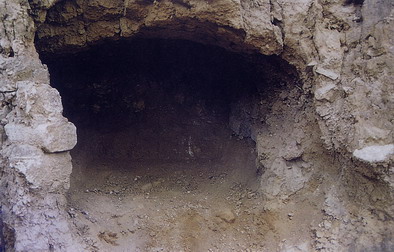
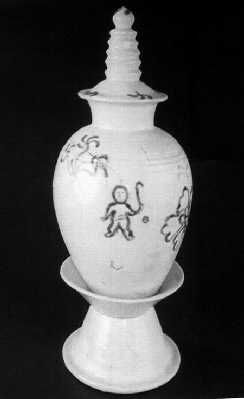
In 2005 summer, the archaeological institutes staged a rescue excavation to the Huangye sancai kiln site at Gong County, consequently, sorting out 6 Tang dynasty kilns, over 1,500 bags of ceramics, sancai and unglazed ware fragments, and more than 800 intact, broken but restorable wares, of which are not only a good deal of intact or relatively intact samples of white, black, yellow, and green ceramics, but also a large number of sancai wares, semi-products, and various kiln tools that serve as preciously rare physical materials for today’s study on areas such as the Tang sancai making techniques, stage division of the Huangye Kiln, and the layout of handicraft workshops.
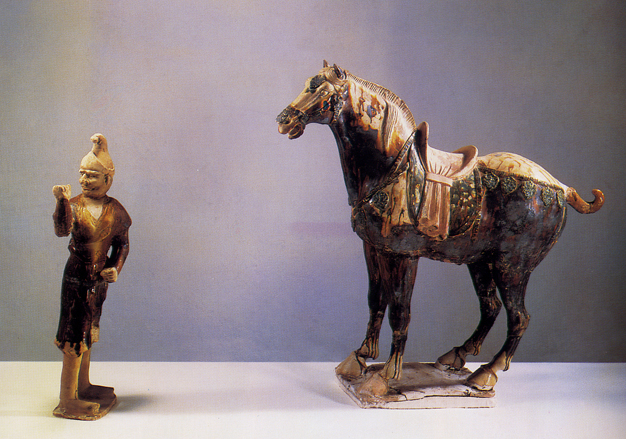
Housed by the Henan Museum, the sancai horse is a figurine equipped with saddle and bridle. Its mane is trimmed, shortened tail curled up, and the green bit hang from the mouth. The ornate white tassels are worn around the chest, matched with green apricot leaf decoration on the haunch. A steady and robust animal, it has muscular buttocks and strong legs, with eyes bright and piercing, head raising upright. A true beauty of strength and vitality. The bright glaze used is of a color composite, of which reddish brown, white and green are the basic colors. The body is reddish brown while the face and back appear white, with the dense white mane sticking smoothly onto the strong neck. Under light it stands out full of brilliant colors and splendor.
The horseman figurine is a Hun, with high-bridged nose and deep-set eyes, appearing easy but somewhat grave in countenance. He wears a white felt cap and reddish purple cross collar style robe, with a travelling bag tied to his waist, bound feet pants and pointed-end boots. With both hands clenched, he poses himself as if he is leading the horse. Static yet dynamic, the vigorous figurine is modeled so naturalistically that it seems he is training his steed or waiting orders to set out on a journey into the unknown ways ahead.

Su Ying: graduated from History Department of Zhengzhou University, majoring in archaeology with a BA degree, working at Henan Provincial Library at present.
Liu Jie: Director of the Regional Documents Department of Henan Provincial Library, with a BA degree.
