The Phoenix Motif on Shang and Zhou Bronzes
The phoenix motif is an important part of the motifs and patterns on Shang and Zhou bronzes. Mostly represented as a bird profile, either with a crest or horns, it is usually used in symmetrical series. The motif has some distinctive features: a head with a crooked beak or other variations; a bird body that is sometimes reduced into a rectangle; a "multi-toothed”, long or flower crest; crooked, giraffe-style or pointed horns; a long, drooping or split tail. The phoenix motif was first found in the mid-Shang Dynasty (as evidenced by findings at the Yin Ruins) and had been in use until the late Spring and Autumn Period. Besides, the phoenix motif has variations like the bird motif, owl motif and wild goose motif.
The Zu-xin You bears the two-character inscription “Zu-xin” on the interior of the lid and the inner bottom of the vessel. As we know, among the Shang kings, there was one known as Zu-xin. Does the “Zu-xin” in the inscription refer to the namesake king, or anyone else?
Your answer please, if you have any questions or answer, please feel free to send us email, we are waiting for your answers and participation, and your comments, answers and suggestions will be highly appreciated. We will select and publicize the most appropriate answers and comments some time in the future.
Weekly Selection Email: meizhouyipin@chnmus.net
So far, in archaeological circles, there has been great controversy as to what vessels can be named you. Therefore, it has been impossible to count the you that have been preserved, or to form a clear picture of its history. Based upon this understanding, this paper will discuss some generally uncontested bronze you of different period, hoping to arrive at a relatively systematic understanding of this special type of vessel.
In 1963, the Ya-guan You made in the late Shang Dynasty was unearthed at M172 in Miaopu Beidi, Anyang, Henan in 1963. Overall height: 29.5cm; belly diameters: 16.5cm×20cm. [1]
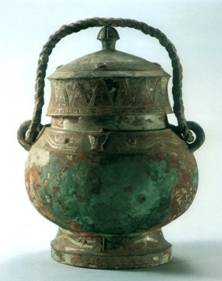
Fig. 6 Ya-guan You unearthed in Miaopu Beidi, Anyang
In 1990, the Ya-zhi You (Fig.7) created in the late Shang Dynasty was unearthed at M160 to the west of Guojia Village, Anyang, Henan. Overall height with lid: 35.8cm; weight: 10kg. [2]
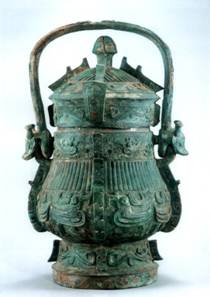
Fig. 7 Ya-zhi You unearthed to the west of Guojia Village, Anyang
In 1985, a bronze you created in the late Shang Dynasty (Fig.8) was unearthed in Quanjiang Town, Suichuan, Jiangxi. Overall height: 39cm. [3]
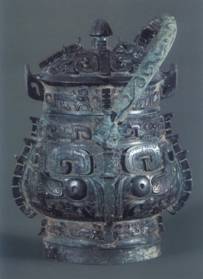
Fig. 8 Bronze you unearthed in Quanjiang Town, Suichuan, Jiangxi
In 1980, an owl-shaped you of the late Shang Dynasty (Fig.9) was unearthed from M11 at Houli Village, Luoshan County, Henan. Overall height: 18.5cm. [4]
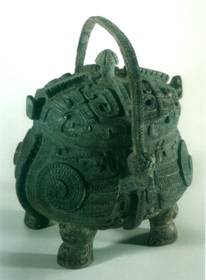
Fig. 9 Owl-shaped you unearthed at Houli Village, Luoshan, Henan
In 1976, a Shang-style you of the early Western Zhou Dynasty (Fig.10) was discovered in the pit at Zhuangbai Village, Fufeng, Shaanxi. Overall height: 38.6cm. [5]
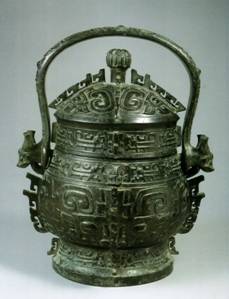
Fig.10 Shang-style you discovered in the pit at Zhuangbai Village, Fufeng, Shaanxi
In 1948, the Bao You (Fig.11) created during the reign of King Cheng of the Western Zhou Dynasty was unearthed in Luoyang, Henan. Overall height: 25.8cm. [6]
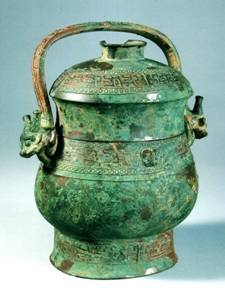
Fig.11 Bao You unearthed in Luoyang, Henan
In 1976, two cylindrical you vessels (Fig.12) of the early Western Zhou Dynasty were unearthed from M13 at Zhuyuangou, Baoji, Shaanxi. Overall height with handle: 27cm. [7]
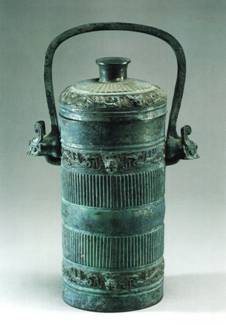
Fig.12 Cylindrical you unearthed Zhuyuangou, Baoji, Shaanxi
In 1965, the Gong You (Fig.13) of the mid-Western Zhou Dynasty was unearthed from M3 at Yiqi, Tunxi, Anhui. Overall height: 23cm; mouth diameters: 10.2X12.8cm. [8]
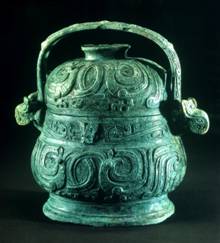
Fig.13 Gong You unearthed at Yiqi, Tunxi, Anhui
In 1969, the Qi You (Fig.14) of the mid-Western Zhou Dynasty was unearthed at Xiaoliu Village, Guicheng, Huanxian County, Shandong. Overall height: 22.7cm. [9]
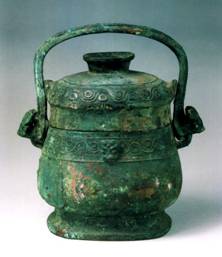
Fig.14 Qi You unearthed at Xiaoliu Village, Guicheng, Shandong
In the collection of Shanghai Museum, there is a you vessel with beast-face motifs (Fig.15) created in the early Spring and Autumn Period. Height: 34.2cm; mouth diameters: 12.2x15.3cm. [10]
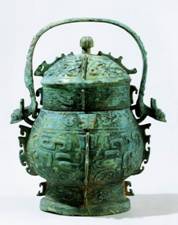
Fig.15 You with beast-face motifs collected by Shanghai Museum
In 1959, two bronze you vessels (Fig.16) of the late Spring and Autumn Period were unearthed from Tomb 1 at Yiqi, Tunxi, Anhui. Height: 22.3cm; lid height: 7.8cm. [11]
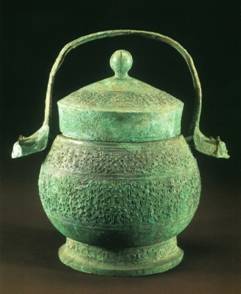
Fig.16 Bronze you unearthed at Yiqi, Tunxi, Anhui
The flower-shaped knob, prominent ornamental ridges, exquisite three layers of decorative phoenixes and kui dragons, and longitudinal handle of the Zu-xin You are features shared by other mainstream bronze you created in the late Shang Dynasty. In these aspects, it is similar to the Ya-zhi You of the late Shang Dynasty unearthed from M160 to the west of Guojia Village, Anyang, Henan. Therefore, it can be concluded that the Zu-xin You is a typical one of the kind of the late Shang Dynasty, and provides an important physical material for studies on the culture and technology of the Shang Dynasty.
The earliest records of the you can be found in Luo Gao or "Announcement concerning Luo”, Shang Shu [Book of Documents], which writes, "…along with two flagons of the black-millet herb-flavoured spirits, saying, ‘Here is a pure sacrificial gift, which with my hands to my head and my head to the ground I offer for you to enjoy its excellence’…"; and in a poem beginning with Jiang Han in Da Ya [Major Court Hymns], The Book of Songs, which says, “…I endow you with a jade goblet/ and one you of the black-millet herb-flavoured spirits…” As recorded in Explanation of Vessels, Er Ya (an ancient Chinese dictionary), "The you is a medium-class zun (wine container)." The above-cited records show that the you was a medium-sized vessel used to contain the black-millet herb-flavoured spirits awarded by the King, though they bear no information as to what it was like.
The earliest association between the you in physical form and that in literature is established in An Illustrated Book of Antiques or Kao Gu Tu by Song Scholar Lü Dalin. Many vessels named you are, however, very different as namesake vessels in modern times. The name has been preserved, but opinions are divided on what vessels it refers to. So far, consensus has been basically achieved on vessels like Zu-xin You, whereas the naming of pot-shaped you has been highly controversial. In 1982, a bronze pot with beast face motifs (Fig.5) was unearthed at Zhengzhou Xiangyang Food Factory, Henan. Some scholars including Zhu Fenghan have seen it as the earliest bronze you ever discovered in China, whereas other scholars represented by Ma Chengyuan have put it under the category of pot. Given the dispute over the naming of some you-type vessels, this paper will be restricted to those vessels universally recognised as you.
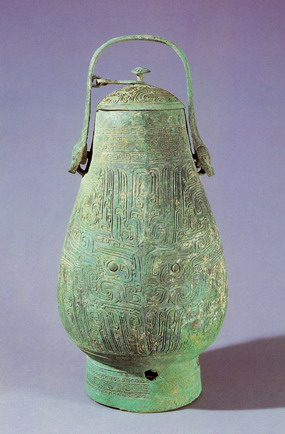
The you was a bronze ritual vessel used to contain the black-millet herb-flavoured spirits during the Shang and Zhou Dynasties. According to Explanations of Flora, Er Ya, "The ju is the black millet"; according to the Shuowen Jiezi [Explaining Simple and Analyzing Compound Characters], “The chang is a kind of wine brewed with black millet and herbs. This fragrant drink is used to commune with deities." These, together with the records in Luo Gao of Shang Shu and Jiang Han in Da Ya of The Book of Songs, shed light upon the main function of the bronze you as a ritual wine vessel. That is, it was used to hold the black-millet herb-flavoured spirits when sacrifices were offered to ghosts, deities or ancestors.
The emergence, prevalence and disappearance of the bronze you as a bronze wine vessel is closely associated with the different social systems, cultural thoughts, and customs. The Yin people [in the Shang Dynasty] valued wine, honoured and worshipped deities. Under this influence of the culture and customs, the bronze you was invented as a wine vessel and instantly gained popularity. As an important ritual vessel, it was interred with other ritual vessels like the lei [wine jar], pot, goblet, gu [wine vessel] and jia [three-footed wine cup] to manifest a tomb owner’s nobility. When the Zhou replaced the Shang regime, it inherited the former dynasty’s ritual system. As a wine vessel, the you received much attention and developed. The you-and-zun combinations started to appear in tombs, with their differences in quantity showing the different classes and social status of the dead. As the Zhou Dynasty gradually consolidated its rule, the Zhou people was awakened to the lesson taught by the predecessors' collapse: indulgence in wine, and gradually built its systems of culture, ideology and customs, which gave more prominence to food and valued ritual and charity. Under the rigorous patriarchal system and system of enfeoffment, food containers, as an indicator of status, were receiving more and more attention. The bronze you, as a wine vessel, was doomed ineluctably to obscurity. Gradually, it faded out of the Zhou people's life and disappeared.
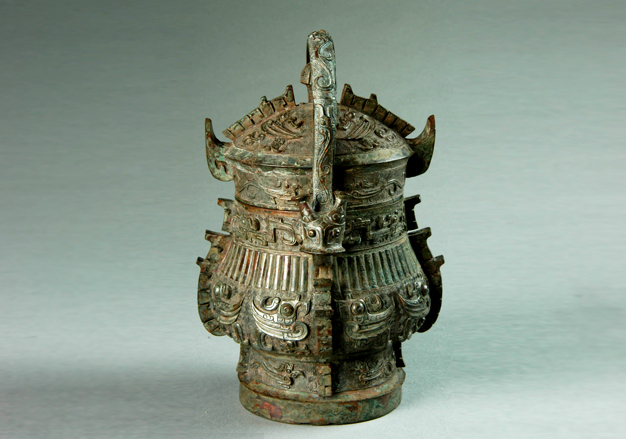
The Zu-xin You consists of two parts, i.e. the lid and the body, with a roughly oval horizontal section. The lid is oval and convex, with a knob shaped like a six-petal flower and an edge turning downward to form a mu-kou (literally "mother mouth"). The body features an upright "son mouth" (zi-kou), a contracted neck (shu-jing) on which there are two symmetrical half-rings joining a curved handle, a drooping protrusive belly, a round bottom, and a circular foot with a broad edge turned inward.
On the body there are four vertical “ornamental ridges” (fei-leng) running from lid to bottom. Each petal of the six-petal flower on the knob is decorated with a small “cicada motif”. On the lid and on the middle and lower parts of the body, there are identical "upright-bird" patterns on the ground of "cloud-and-thunder" motifs. The folded lid edge and the circular foot are each adorned with four identical "long-tailed birds" on the ground of “cloud and thunder” motifs. The neck is ornamented with four large kui-dragon patterns on the ground of "cloud-and-thunder" motifs. The upper part of the body is decorated with “tile ridges” (wa-leng). On the outer surface of the handle there are four kui-dragon patterns on the ground of “cloud-and-thunder” motifs, whose heads point toward the centre; and on the inner surface of the handle there are evenly spaced "wave" (huan-dai) patterns. On the two ends of the handle there are beast heads in relief. The front of each exaggerated “ornamental ridges” on both sides of the folded edge on the lid is decorated with a large “cicada motif”. On the outer bottom there is a decorative grid design (Fig. 1). The interior of the lid and the inner bottom of the vessel bear the intagliated two-character inscription “Zu-xin”, after which the you is named.
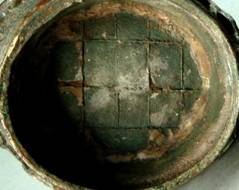
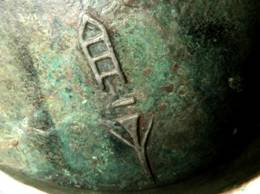
Fig. 1 Grid design on the bottom of the vessel Fig. 2 Inscription on the interior of the lid
Uniquely shaped and exquisitely adorned, the Zu-xin You not only reveals the spendour of the vessel itself and the distinction of the user, but, more importantly, represents the superb craftsmanship of the time. The patterns and motifs have been ingeniously designed and crafted to suit the two different means of placing the vessel i.e. transversely and longitudinally. When the handle is placed longitudinally and the body transversely, the patterns on the folded lid edge, belly and circular foot are composed with the beast face-mounted fei-leng ridge as the central axis (Fig.3). When the handle is placed transversely and the body longitudinally, the patterns on the lid surface, neck and belly are composed with the exaggerated fei-leng ridge as the central axis (Fig.4). Whichever fei-leng ridge serves as the central axis, the patterns are all visually harmonious, with a visual "gravity centre". All these give evidence to the refined taste and high design level of the vessel producer.
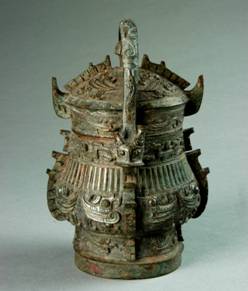
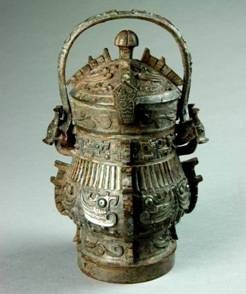
Fig. 3 Longitudinal handle with transverse body Fig. 4 Transverse handle and body
The Zu-xin You is a rare treasure of Shang and Zhou bronze art, which represents the technological progress in bronze casting during that period.